

Autumn Miles. Limited-Time Deals 🏷️
--
Days--
Hours--
Mins--
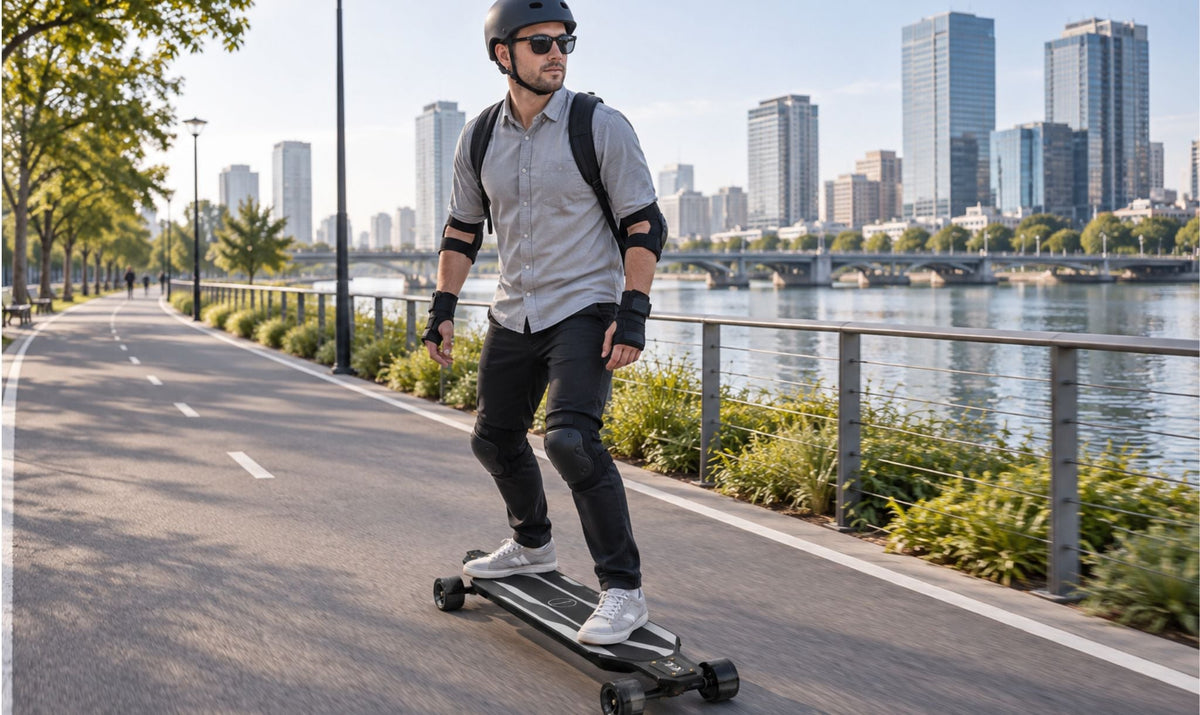
SecsA long-range electric skateboard should cover your regular route with energy left for hills, wind, detours, and battery aging. The best choice is not simply the model with the highest advertised mileage. Wheel type, road surface, rider weight, speed, and carrying needs all determine which setup will work best in daily use.
Published range is useful for comparing models, but it should be treated as a reference rather than a guaranteed distance. Real-world conditions can change how far a board travels on one charge.
Manufacturers generally measure maximum range under controlled conditions with a particular rider weight, speed, wheel setup, and road surface. A heavier rider, repeated acceleration, steep hills, headwinds, cold weather, or rough pavement can increase energy use and shorten the final distance. A practical long-range electric skateboard should therefore have enough published capacity to complete the planned trip without relying on the final portion of the battery. If your round trip is 20 miles, choosing a setup rated for only about 20 miles would provide little protection against hills, changing weather, detours, or gradual battery wear.
Leaving a reasonable reserve makes commuting more predictable. Riders with consistent, mostly flat routes may need a smaller margin, while frequent hills, rough roads, higher speeds, and changing temperatures justify a larger one. Measure the entire round trip, include regular side trips, and consider whether you can recharge safely at your destination. The best long-range board is one that covers this realistic distance comfortably, not one that achieves the largest number only under ideal conditions.

The MAXFIND CYBER ULTRA provides the highest published range of the two models compared here. MAXFIND lists up to 56 miles, or 90 km, when the 107mm Space Wheels included with the Belt Motor 2-in-1 configuration are installed, making this setup suitable for long paved routes where additional range reserve is the main priority. The Belt Motor version with 175mm all-terrain pneumatic wheels has a lower published range of up to 37 miles, or 60 km, but its larger air-filled tires are better suited to cracks, coarse pavement, uneven transitions, and mixed surfaces. These tires require regular pressure checks and may need puncture-related maintenance. MAXFIND also offers a Hub Motor version with 165mm pneumatic wheels, but the current product-page summary does not provide a separate range figure for that configuration, so buyers should confirm the specifications of the exact version rather than applying the 37-mile or 56-mile rating to every CYBER ULTRA.
The MAXFIND CYBER MAX is the more street-oriented option. MAXFIND lists a top range of up to 37 miles, or 60 km, for the product line, which can provide useful capacity for longer paved commutes. The current line includes configurations with 90mm PU wheels and 107mm Space Wheels, as well as different motor and battery setups, so the maximum figure should not be assumed to apply equally to every version. Its street-focused wheel choices are better matched to maintained roads than deeply broken pavement, loose terrain, or rough trails. Riders who regularly encounter poor surfaces may find the CYBER ULTRA’s pneumatic-wheel configurations more appropriate, even though the 175mm setup has a lower published range than the CYBER ULTRA with 107mm Space Wheels.
Battery capacity is important, but it works together with rider weight, motor demand, wheel configuration, and the riding environment. Understanding these variables helps prevent unrealistic range expectations.
Moving more total weight requires more energy, especially during acceleration and climbing. Frequent stop-and-go riding can consume more battery than maintaining a moderate, steady pace, and the effect becomes more noticeable on hilly routes because the motors must repeatedly work against gravity. Higher speed also increases energy demand and aerodynamic resistance, so a rider trying to maintain maximum speed is unlikely to reproduce a maximum-range claim established under more economical conditions. For longer trips, progressive acceleration and a sustainable cruising speed generally make better use of the available battery than repeated full-power starts.
Larger, softer, or pneumatic wheels can improve comfort and control on imperfect pavement, but they may require more energy than a smaller street setup. Tire pressure also matters on pneumatic configurations because incorrect inflation can affect handling, comfort, and rolling efficiency. Surface quality has a similar effect: smooth pavement allows the board to maintain momentum more easily, while coarse asphalt, broken paths, grass, and loose ground increase rolling resistance. A wheel setup that delivers strong mileage on a smooth bicycle path may therefore produce a different result on a rough urban route.
Lithium-ion batteries can provide less usable performance in cold conditions, so a familiar route may consume a larger portion of the battery during winter. Battery age, storage habits, charging history, and repeated use can also influence available capacity over time, which means published range should not be treated as a permanent result throughout the board’s service life. Store and charge the board according to the official instructions, use the supplied compatible charger, and avoid exposing the battery to extreme temperatures. If the battery, enclosure, charging port, or cable appears damaged, stop using the board and contact qualified support rather than attempting an improvised repair.
The right configuration depends on where the board will be ridden and how it fits into the rest of the journey. Maximum mileage is only useful when the board also suits the pavement, storage space, and handling requirements of the route.

For maintained city streets, bike paths, and long sections of relatively smooth pavement, a street-oriented setup normally provides the most direct balance of range and everyday usability. The CYBER MAX fits this role, while the CYBER ULTRA with 107mm Space Wheels offers a higher published maximum for riders who need substantially more distance. Measure the route in both directions and note sustained climbs, frequent traffic stops, and sections where riding may not be permitted, since a trip that appears short on a map may require more energy if the return journey climbs steadily or involves repeated acceleration.
For routes with recurring cracks, rough asphalt, park paths, or uneven transitions, wheel comfort may matter more than achieving the largest possible range figure. The CYBER ULTRA with 175mm pneumatic wheels sacrifices some published mileage compared with its 107mm Space Wheel setup, but its larger tires are better aligned with irregular surfaces. All-terrain capability does not remove the need to inspect the route because loose gravel, wet leaves, potholes, standing water, and debris can still reduce traction or destabilize the board. Riders should slow down for uncertain surfaces and avoid treating a high-performance board as a substitute for careful riding and appropriate protective equipment.
Long-range boards generally use substantial batteries and hardware, which can make them less convenient to carry. Before buying, consider stairs, public transportation, office storage, apartment access, and whether the board must regularly be lifted into a vehicle. A board with more range than you need may add cost, size, and carrying burden without improving the actual commute. Riders making short trips with frequent carrying sections may be better served by a smaller board, while someone completing a long, uninterrupted route can benefit more from the additional capacity.
Begin a long trip with enough charge for the planned route and a reasonable reserve, check the board and wheels before departure, accelerate progressively, and maintain a moderate pace when maximum distance matters. Whenever possible, choose a smoother route because severe hills and rough surfaces can consume more energy than a small increase in distance. After riding, follow the official charging and storage instructions, use the supplied compatible charger, keep the charging area dry and ventilated, and allow the board and battery to return to a suitable charging temperature after demanding use before connecting the charger.
The CYBER ULTRA with 107mm Space Wheels is the stronger choice of the two compared models when maximum manufacturer-rated range is the priority. Its pneumatic-wheel configurations make more sense for consistently rough routes, while the CYBER MAX offers a street-focused alternative for long paved commutes. Choose according to the exact configuration and leave enough reserve for real-world conditions.
Start with the complete round-trip distance and add a reserve for hills, wind, temperature, detours, and battery aging. Avoid choosing a board whose advertised maximum only just matches your normal journey.
Advertised range is usually measured under specific conditions. Rider weight, speed, repeated acceleration, hills, rough pavement, cold temperatures, wheel type, tire pressure, and battery condition can all reduce real-world mileage.
They can. Larger, softer, or pneumatic wheels may increase rolling resistance or energy demand, although the exact result depends on their construction, pressure, terrain, and riding speed. Their main advantage is improved comfort and capability on imperfect surfaces.
No. Additional range may come with greater weight, cost, size, or maintenance. A shorter-range board can be the better choice when it comfortably covers the route and is easier to carry, store, and control.
More reading: Best Electric Skateboards for Commuting in 2026


Share:
The best electric scooters for adults in 2024
How to Choose a Fast Electric Scooter Under $1000