

"Black Friday" Price Guarantee 🔒
--
Days--
Hours--
Mins--
SecsQuick Answer: Match the wheels to the most difficult surface you ride regularly, then assess hill-climbing ability with your full riding load. Larger, shock-absorbing street wheels can improve comfort on cracked pavement, while repeated riding on grass, gravel, and uneven dirt favors pneumatic all-terrain tires. Within Maxfind’s Cyber lines, the Cyber Mini offers street-focused configurations, the Cyber Max Pro and X provide 107mm wheels for rough-road use, and the Cyber Ultra offers 165mm or 175mm pneumatic setups for all-terrain riding. [1][2][3]
The key distinction is between a route that mainly rattles your feet and one that can stop your wheels. Rough pavement is mostly a problem of vibration absorption and rollover ability. Soft ground, loose stones, and steep slopes add traction and drive demands. Evaluate those issues separately before choosing one board to handle them together.
Describe your route more precisely than “rough” or “off road.” A firm dirt path can be easier to ride than a badly broken street, while grass can hide holes and create much more rolling resistance than pavement.
Use these surface categories to identify the main problem:
For primarily paved riding, a larger hollow-core urethane wheel is a reasonable comfort-focused option. Its material and internal structure can flex over small irregularities. Pneumatic tires use air for compliance and become the more relevant choice when off-road surfaces are a regular part of the route.
Frequency matters as well. An occasional short dirt connector does not place the same demands on a board as spending every weekend on grass and gravel. Choose based on the difficult surfaces you expect to ride regularly, and plan to walk isolated hazards that exceed your skill or the board’s clearance.
A 25% grade means the road rises 25 units for every 100 units of horizontal distance. It does not mean a 25-degree slope.
For a heavier rider, hill suitability depends on several factors working together: enough drive torque to keep moving, enough tire grip to transmit that force, and enough power over the full length of the climb. Rider weight, a backpack, and other cargo all increase the work required.

Start with the exact configuration’s hill-climbing figure, but treat it as a screening criterion. A maximum-grade specification does not guarantee a particular uphill speed for every rider or on every surface. A short paved climb and a sustained grassy climb at the same grade place different demands on the board.
For a daily 25% hill, make the decision in this order:
The downhill return should also be part of the route assessment. Practice braking on a gentle, clear slope before committing to a steep route, and wear a helmet and protective equipment.
Wheel diameter is only one factor in the clearance beneath the board. Deck shape, enclosure position, and drivetrain layout also affect whether a speed bump, raised pavement seam, or trail obstacle can make contact.

Look at the lowest vulnerable components, especially between the wheels and around the motors. A wheel may clear an obstacle while the enclosure catches as the board passes over it. On gravel and trails, also consider how exposed the drivetrain is to stones and debris.
More ride height can improve clearance, but it also changes the rider’s position above the ground. The change in rider position makes clearance and carving feel a trade-off worth considering.
Before riding an unfamiliar section, inspect the route on foot if the obstacles are hard to judge. Do not treat a motor guard or large tires as permission to ride blindly over debris.
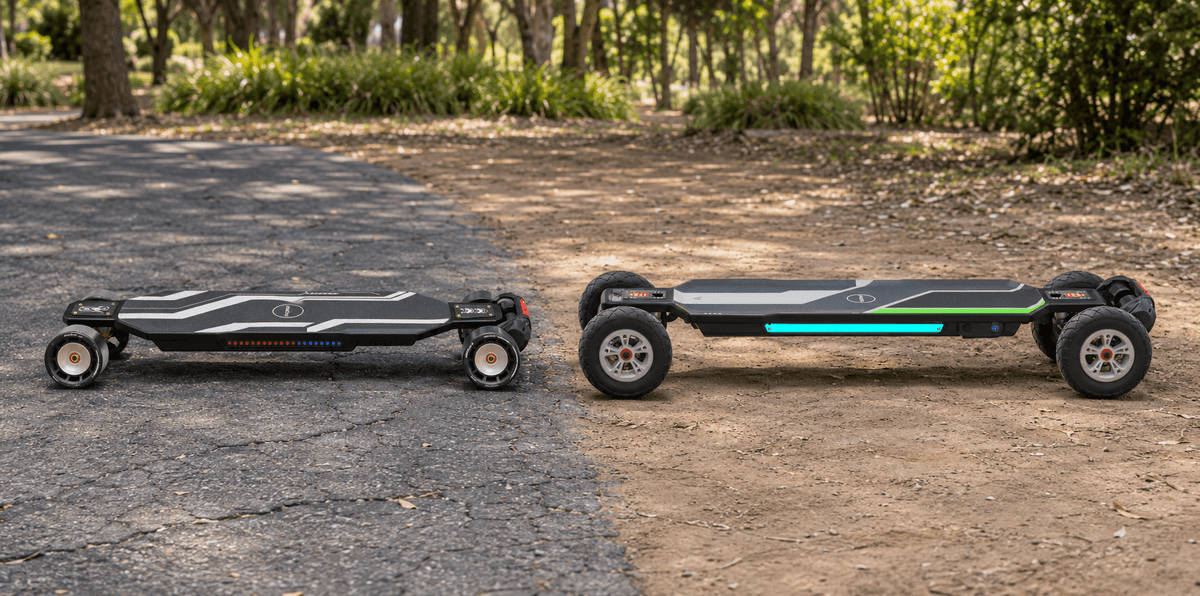
Configuration matters more than the family name. Both the Cyber Mini and Cyber Max have smaller street-wheel versions and larger-wheel versions, while the Cyber Ultra adds pneumatic all-terrain configurations. [1][2][3]
The following comparison uses Maxfind’s specifications to match each line to a practical route.
| Product line | Wheel configurations | Manufacturer hill-climbing figures | Practical route fit |
|---|---|---|---|
| Cyber Mini | Mini / Air: 90mm PU wheels. Pro / X: 107mm Space Wheels. [1] | Air: 20%; Mini / Pro: 30%; X: 35%. [1] | Start with the 90mm versions for smoother street use; consider Pro or X when rough-pavement comfort matters. Their 107mm wheels use 74A urethane and 10 hollow pockets for flex over rough roads. [1] |
| Cyber Max | Max / LR: 90mm PU wheels. Pro / X: 107mm Space Wheels. [2] | Max / LR: 30%; Pro / X: 35%. [2] | Pro and X are the rough-urban-road options in this electric longboard line. The 107mm wheels use 74A urethane and 10 hollow pockets for shock absorption. [2] |
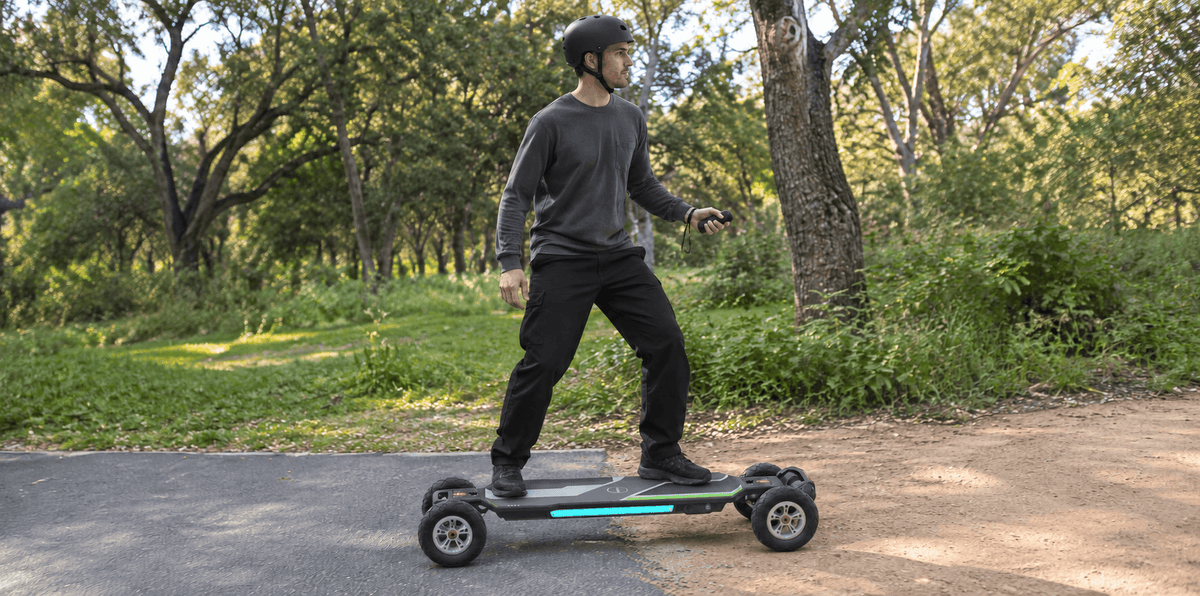
| Cyber Ultra | Belt: 175mm AT pneumatic wheels. Hub: 165mm AT pneumatic wheels. Belt 2-in-1: 175mm pneumatic wheels plus 107mm Space Wheels. [3] | 35%. [3] | The strongest fit among these lines for regular grass, gravel, and light off-road riding: Electric Skateboard HQ found the tested belt-drive, 175mm pneumatic setup effective on those surfaces and cracks. [4] |
For rough pavement with occasional dirt or grass, the Cyber Max Pro represents the middle ground. A customer review on Maxfind’s site from a 135 lb rider living in Denver describes a smooth commute and the ability to cross a little dirt or grass when needed. [2] Repeated riding on uneven trails points more clearly toward the pneumatic setup in the table.
For a 220 lb rider facing a daily 25% hill, the Cyber Mini Air’s rated climb is below the route requirement. The higher-rated configurations are more relevant candidates, but the strongest terrain-and-drive combination here is the Cyber Ultra belt version. Its specified motor torque is 12Nm × 2, compared with 6Nm × 2 for the hub version, and Maxfind positions the belt drive for greater torque and off-road power. [1][3]
All three Cyber lines have a 330 lb / 150 kg load limit. [1][2][3] Staying below that limit is necessary, but it does not establish the speed a 220 lb rider will maintain on a sustained 25% climb. For that demanding daily route, favor the torque-focused configuration and evaluate hill behavior with your normal gear and cargo before relying on it for commuting.
A customer review on Maxfind’s site provides a relevant illustration: a self-described bigger rider using the Cyber Ultra belt version reports completing a steep daily hill while carrying a heavy work backpack, with a slowdown of a couple of mph near the top. The rider gives neither an exact body weight nor a measured grade. [3]
For clearance and protection, the Cyber Ultra’s tested 175mm setup offers a useful trade-off. In Electric Skateboard HQ’s review, the slightly dropped deck and large wheels create higher ride height, which reduces the likelihood of enclosure scraping on speed bumps while limiting how deeply the rider can lean into carves. [4] The Cyber Ultra also has a motor guard designed to shield the drivetrain from rocks, gravel, and debris. [3]
Weather is a separate route condition. For the IPX5-rated Cyber Ultra, Maxfind’s guidance is to avoid heavy rain because water exposure can damage the board. [3] Plan off-road rides around manageable ground conditions, and walk sections where traction or obstacle clearance is doubtful.
Yes, one appropriately configured board can cover rough pavement and light trails, but potholes still require individual judgment and avoidance. Among the Cyber lines, the Cyber Ultra belt version with 175mm pneumatic tires has review support for cracks, gravel, grass, and light off-roading. [4] Choose a safe line around deep holes rather than relying on wheel size to carry you through.
All three matter. Torque provides the turning force, tire grip transfers it to the ground, and rider weight increases the force needed to climb. Prioritize a suitable tire-and-drive combination, then judge performance with your full riding load and the actual slope length.
They can be the right choice when repeated vibration and small surface irregularities are the main problems. Larger compliant street wheels address that task without requiring a pneumatic setup. Deep potholes, large raised edges, and broken sections still call for slowing down, choosing another line, or walking.
Share:
How to Judge Maxfind All-Terrain Fit for Rough Roads, Weekend Trails, and Steep Hills