

Autumn Miles. Limited-Time Deals 🏷️
--
Days--
Hours--
Mins--
SecsHub motors win on quiet operation, low maintenance, and a lighter, more affordable build, making them the better fit for daily commuters on flat routes. Belt drives win on torque, hill climbing, and wheel customization, which makes them the choice for hills, off-road riding, and performance-focused riders. This guide walks through noise, maintenance, power, wheel compatibility, waterproofing, and price so you can pick the setup that fits your ride.
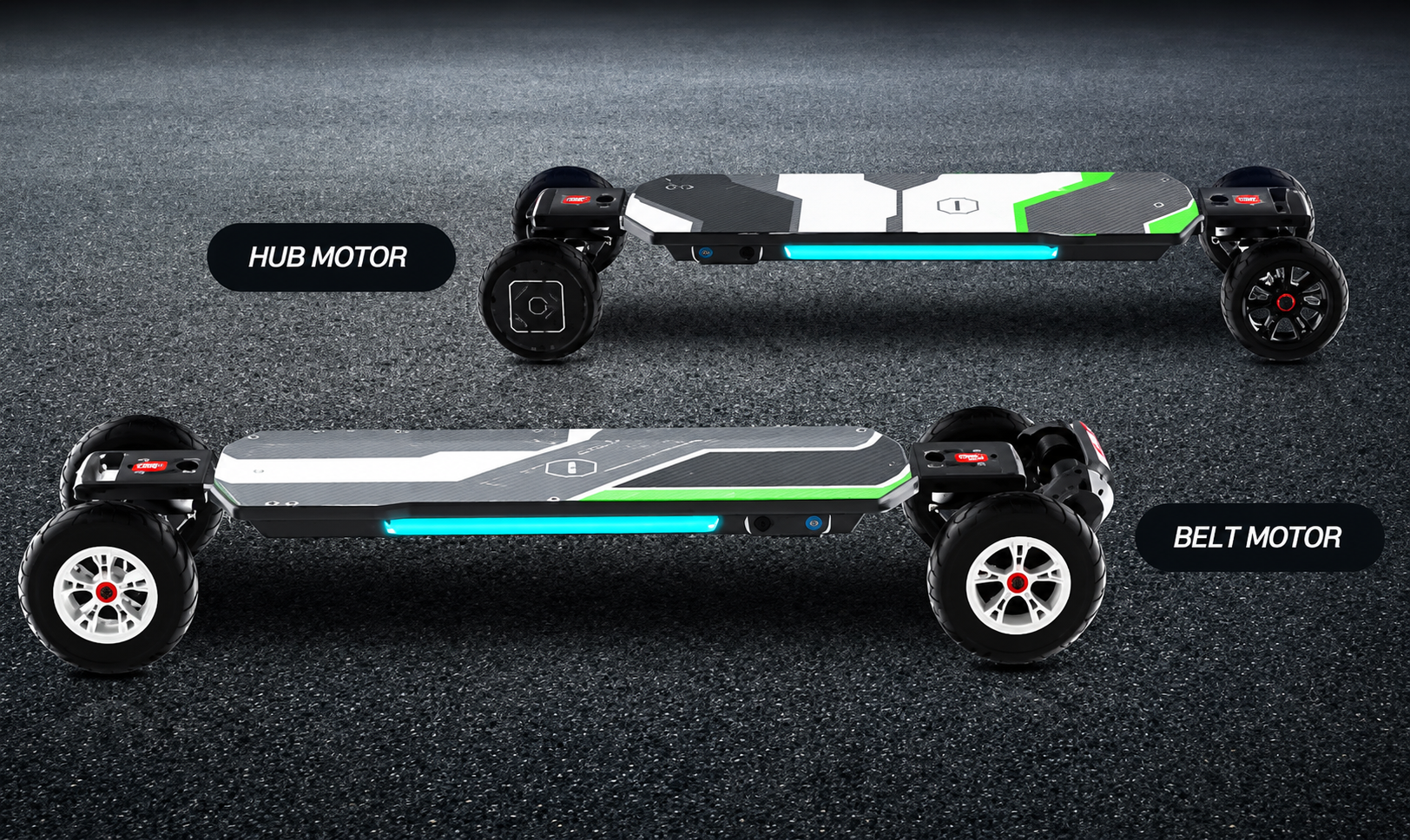
A hub motor electric skateboard has the motor built directly inside the wheel itself. There's no belt, no external pulley, no exposed drivetrain. The motor and the wheel are one unit, with power transferring straight from the motor to the wheel at a 1:1 ratio.

A belt drive electric skateboard uses an external motor mounted near the trucks, connected to the wheel by a rubber belt and a set of gears. It works on the same principle as a bicycle chain drive: the motor spins, the belt transfers that motion to the wheel, and the gear ratio multiplies torque along the way.

|
Hub Motor |
Belt Drive |
|
|
Noise level |
Very quiet |
Noticeably louder |
|
Maintenance |
Minimal |
Belt replacement every 5–6 months |
|
Torque and hill climbing |
Moderate |
Stronger |
|
Wheel swap |
Limited |
Easy and flexible |
|
Weight |
Lighter |
Slightly heavier |
|
Price range |
More affordable |
Higher end |
|
Best for |
Daily commuting, flat routes |
Hills, off-road, performance riders |
Hub motors are wrapped in urethane and sealed inside the wheel, so there's almost nothing for the motor to vibrate against. You get a smooth, low hum that blends into the road, which is a big deal if you're rolling through a quiet neighborhood at 7 a.m. or cruising past coworkers on a campus path. People often don't even realize you're on an electric board until you pass them.
Belts wear down. That's just the nature of the system. Under normal riding, you'll want to replace the belt every 5 to 6 months, and you'll occasionally need to check tension, clean out grit, and keep an eye on the pulley. It's not a huge job, but it is a job. Hub motors skip almost all of this. There's no belt to snap, no pulley to clean, and no tension to dial in.
The gear system in a belt drive multiplies torque in a way a hub motor physically can't. That means harder acceleration off the line, more confidence on inclines, and a more responsive feel under load. If you've ever felt your hub motor board slow down halfway up a hill, you've felt the limit of a 1:1 drive ratio. Belt drives just don't have that problem to the same degree.

A belt drive board can pull a heavier rider up a steep grade without losing speed, and it picks up faster from a stop. If your route includes hills, gravel, or longer rides where you want headroom, the extra power is worth the noise and upkeep. For heavier riders or anyone who wants a more aggressive feel, that's an easy call.
On a belt drive, the wheels and the motor are separate parts. That means you can pop off your street wheels and put on cloud wheels, off-road tires, or a different durometer for grip, and the motor doesn't care. Same trucks, same motor, new ride feel. For riders who like to experiment or who want one board to handle different terrain, this flexibility is huge.
On a hub motor board, the motor lives inside the wheel, so swapping wheels means swapping the motor unit too, or replacing the urethane sleeve over the existing hub. Either way, your options are narrower and usually tied to what the manufacturer offers. You're locked into the ecosystem.
The sealed-wheel design gives hub motors a natural advantage here. With the motor inside the wheel, there are fewer exposed parts for water to reach. That's a design advantage, not a guarantee. Water can still get into the bearings, the ESC, or the battery compartment if the board isn't built carefully — so the design helps, but it's not the whole story.
Belt drives have more exposed hardware, so they're more vulnerable to grit, puddles, and road spray. The belt itself can pick up debris that wears it down faster, and the exposed belt, pulley, and drivetrain hardware give water and grit more places to collect. None of this means you can't ride a belt drive in light rain, but it does mean you need to dry the board afterward and stay on top of maintenance.
Here's the part most brands hope you don't ask about. "Waterproof" is a marketing word. It doesn't mean anything unless it comes with an IP rating, the international standard that defines exactly how much water a product can handle. IPX5, for example, means the board can withstand low-pressure water spray from any direction.
MAXFIND lists an IPX5 water-resistance rating on several Cyber series boards, which gives riders a clearer standard than a vague “waterproof” claim. It still does not mean the board should be submerged or used in heavy rain, but it gives useful protection for splashes, wet pavement, and light rain when the board is dried properly afterward.

Hub motor boards are typically a little lighter because the motor and wheel are combined into one unit. If you carry your board up stairs, onto a train, or into an office every day, that weight difference adds up.
Hub boards are also generally more affordable. The simpler design and fewer parts mean a lower entry price, which makes them a strong pick for first-time buyers. Belt drives sit at the higher end of the market because of their performance hardware and more complex assembly. You're paying for power, customization, and a more aggressive ride.
Your routes are mostly flat, your priority is a quiet, simple ride, you carry your board often, or you're new to electric boards and want something forgiving. Hub motors are the lower-stress option, and for the majority of daily commuters, they're more than enough board.
You regularly ride hills, you want the freedom to swap wheels for different terrain, you're a heavier rider who wants stronger acceleration, or you just enjoy the more aggressive feel of a high-torque board. You'll trade some quiet and convenience for serious performance. The CYBER ULTRA Belt Motor 2-in-1 is built around exactly that instant wheel swaps between 175mm all-terrain tires and 107mm street wheels on the same board.

Hub motors and belt drives are built for different riders, not competing for the same one. If your daily ride is flat and you want something quiet and low-maintenance, a hub motor gets the job done. If hills, heavier loads, or swappable wheels matter to you, a belt drive is worth the trade-off. MAXFIND's Cyber series offers both options across the same build, so you can pick what fits your ride without starting over.
Not easily. The two systems use different motor mounts and wheels, so converting one to the other usually means replacing the entire drivetrain. It's cheaper to pick the right system upfront, or choose a board that offers both versions of the same model.
Under normal riding, every 5 to 6 months. Hills, heavier riders, and aggressive acceleration shorten that timeline; smooth, flat commuting extends it. Belts are inexpensive and quick to swap.
They can run warmer on sustained uphill rides because the motor is sealed inside the wheel with less airflow. For flat commuting, this is rarely an issue. For repeated steep climbs, belt drives dissipate heat more effectively.
Belt drives hold value slightly better with enthusiasts because parts are easier to replace individually. Hub motors depreciate a bit faster but sell quickly to entry-level buyers. Brand reputation and battery health usually matter more than drive type.


Share:
How Much Weight Can an Electric Skateboard Hold?
Off-Road Electric Skateboard for Rough Roads and Park Paths