

Lowest Price of the Year 🏷️
"Black Friday" Price Guarantee 🔒
Quick Answer: For a Maxfind electric longboard focused on rough urban roads, start with Cyber Max PRO or X, which pair belt drive with 107mm Space Wheels. [1] Cyber Ultra with pneumatic tires is the stronger hardware match when dirt, grass, and off-road riding define the route. [2] Cyber Mini is the portability-first line, with larger-wheel PRO and X versions for riders who want that compact format with rough-road-oriented wheels. [3]
The useful Black Friday decision starts with the surface you want to ride. Cracked asphalt, a steep paved commute, and a grassy trail place different demands on an electric skateboard. Within Maxfind’s three Cyber lines, choosing the right wheel-and-drive configuration matters more than choosing by the line name alone.

Cyber Mini makes sense when carrying and storing the board are central to your day. Maxfind positions it as an ultra-portable mini electric skateboard. [3] Its MINI and AIR versions use 90mm PU wheels, while PRO and X use 107mm Space Wheels. [3] That gives you a street-oriented starting point and a larger-wheel option within the same compact line.
Portability also needs a variant-specific reading. Maxfind’s detailed specifications list Cyber Mini AIR at 12.4 lbs / 5.6 kg, MINI at 16 lbs / 7.3 kg, PRO at 18.7 lbs / 8.5 kg, and X at 20.3 lbs / 9.2 kg. [3] If stairs or frequent carrying are part of your commute, consider the weight of the version you actually intend to buy.
Cyber Max occupies the commuter middle ground. Maxfind presents the line as a commuter e-board, with the base Cyber Max and LR using 90mm PU hub-motor setups and PRO and X using 107mm Space Wheels with belt motors. [1] For deteriorating city roads, PRO and X are the versions to explore: their wheel construction targets rough-road comfort, while their belt-drive positioning addresses riders who prioritize torque. [1]
This makes Cyber Max particularly relevant when your main goal is improving an everyday paved ride. A route with rough asphalt and road seams calls for a different purchase emphasis from a weekend ride built around loose ground.
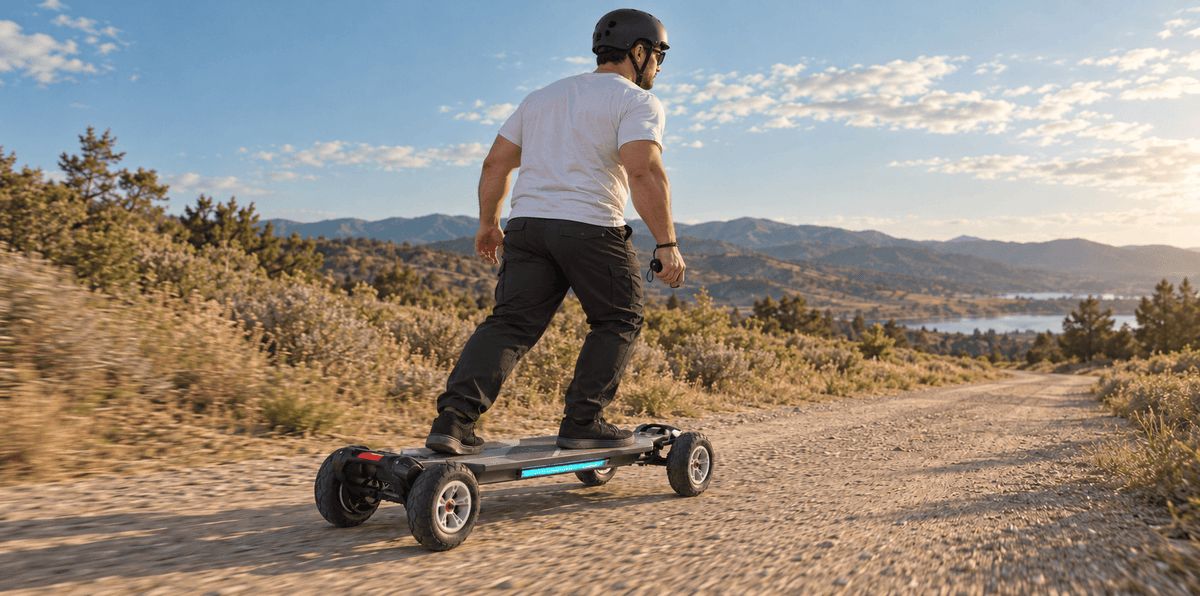
Cyber Ultra is the all-terrain branch of the lineup. Its documented choices include a belt-drive version with 175mm pneumatic tires, a hub-drive version with 165mm pneumatic tires, and a belt-drive 2-in-1 configuration. [2] Maxfind’s model guide positions the belt-drive option toward torque and off-road power, and the hub-drive option toward lower maintenance and urban riding. [2]
For Black Friday shopping, make that route-based shortlist before comparing offers: Cyber Mini for compact portability, Cyber Max PRO or X for rough-road commuting, and a pneumatic-equipped Cyber Ultra when unpaved terrain is a core requirement. Confirm the exact variant and included wheel setup in your order rather than relying on a headline image or line-level specification.
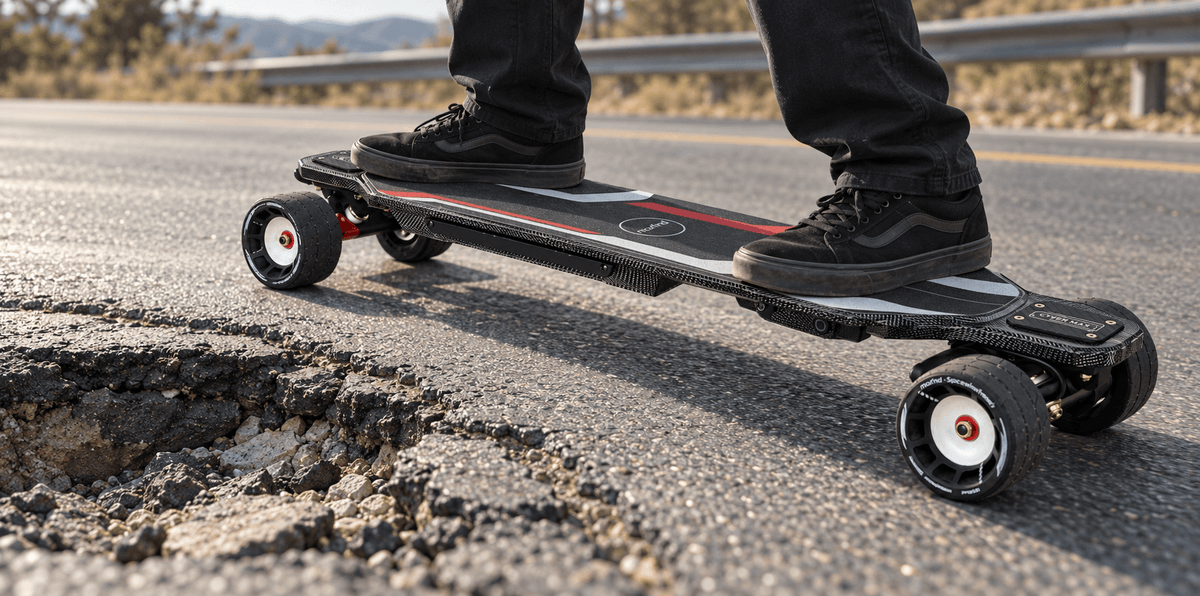
Cyber Max’s 107mm Space Wheels combine a larger diameter than its 90mm street setup with soft urethane and a reinforced nylon core. [1] Maxfind describes ten hollow pockets that allow the polyurethane to flex, with shock absorption intended to smooth rough roads. [1] The wheel description also attributes improved grip and traction to a concave tread pattern. [1]
Those features address two different parts of a rough commute. A larger wheel can approach small surface discontinuities more gradually, while a compliant wheel can soften the vibration transmitted through the board. For the rider dealing with coarse asphalt and repeated pavement seams, that is a concrete reason to consider the PRO or X setup. It does not make a deep pothole safe to hit; slow down and avoid sharp-edged holes rather than treating wheel size as permission to ride through them.
Cyber Mini PRO and X bring the same 107mm Space Wheel concept to the compact line. [3] Its product description likewise identifies soft urethane, a reinforced nylon core, and ten hollow pockets for rough-road shock absorption. [3] Choose that format when portability remains important, then weigh the actual PRO or X carrying weight against your daily routine.
Owner experience helps illustrate Cyber Max’s middle-ground appeal. A 135 lb Cyber Max PRO owner writing in Maxfind’s customer reviews described a smooth ride over local surfaces, including a little dirt or grass when needed. [1] That is useful evidence of one rider’s mixed-surface experience. The account does not identify obstacle dimensions, soil firmness, or the conditions needed to reproduce the ride.
Clearance matters alongside wheel comfort when a route contains roots, ruts, or raised obstacles. Maxfind’s terrain guidance notes that the available Cyber Max accounts do not establish loaded ground clearance or prove that the board will avoid bogging down or falls on a particular dirt-and-grass route. [4] Describe those obstacles when discussing PRO or X with Maxfind; “rough road” is much less precise than identifying the sections that catch your current wheels or underside.
Cyber Ultra adds a documented drivetrain guard designed to shield against rocks, gravel, and debris. [2] That protection is relevant to trail use, but it does not establish a maximum obstacle height. Evaluate the route’s clearance demands separately from its vibration and traction demands.

For hill-focused urban riding, Cyber Max PRO and X deserve a place on the shortlist. Maxfind lists a 35% hill-climbing claim for both, compared with 30% for the base Cyber Max and LR. [1] The PRO specifications list motor power of 900W × 2 and motor torque of 5Nm × 2; the X lists 1800W × 2 and 6Nm × 2. [1]
The X therefore has the higher published motor output within those two rough-road configurations. Both pair their hill-oriented specifications with the 107mm belt-drive setup, making them relevant choices when the daily problem is a paved climb followed by uneven city streets. [1]
Cyber Mini’s compact format also includes hill-oriented options. Its detailed specifications list a 20% climbing claim for AIR, 30% for MINI and PRO, and 35% for X. [3] Cyber Mini X lists 1200W × 2 motor power and 6Nm × 2 motor torque. [3] These figures show why the line should not be treated as one uniform performance level, even when portability is the main reason to consider it.
Cyber Ultra’s belt-drive configuration has the strongest published motor output among these choices. Maxfind lists 2000 Watts × 2 and 12Nm × 2 for the belt-drive version, alongside a 35% hill-climbing claim. [2] Its 175mm pneumatic configuration combines that output with the line’s trail-oriented tire hardware. [2] That combination makes it the more relevant candidate when the climb itself is unpaved.
These are published motor and climbing specifications, not a same-load, same-surface climbing test. They support a hardware-based shortlist, but they do not establish how much faster one board will climb your hill or how long it can sustain that climb.
There is encouraging owner experience for the Ultra. Roberto G., a self-described bigger rider reviewing the belt-drive version on Maxfind’s site, reported repeatedly completing a steep daily-route hill with a heavy work backpack, slowing by a couple of mph near the top. [2] His account leaves rider weight, wheel setup, measured grade, climb length, and surface unspecified. [4]
For a 220 lb rider facing a 25% grade, successful completion remains unresolved for the exact rider, configuration, and route. A sustained grassy ascent adds traction and thermal demands that a motor-output figure alone cannot answer. Maxfind’s own hill guidance makes that distinction and recommends a configuration-specific inquiry for demanding grassy climbs. [4]
The useful next step is to give Maxfind your total riding load, measured grade, climb length, surface condition, and intended wheel-and-drive setup. Keep rider and carried load within the relevant maximum: Cyber Max and Cyber Ultra list 330 lb / 150 kg. [4] A matching route description makes the guidance more useful than asking whether a board is simply “good for hills.”

Decide how demanding—and how essential—the trail portion is. For pavement-led riding with occasional light unpaved crossings, Cyber Max PRO or X is a relevant commuter choice; Maxfind’s terrain guidance distinguishes that use from demanding trails with roots, deep loose ground, or taller grass. [4]
If weekend trail riding is a regular goal, explore Cyber Ultra’s belt-drive 2-in-1 configuration. It includes 175mm pneumatic tires plus 107mm Space Wheels, allowing a dedicated all-terrain setup and a street setup on the same board. [2] Maxfind explicitly describes switching between the pneumatic tires for trails and the 107mm wheels for urban riding. [2]
Allow time for that change rather than assuming “instant” means tool-free or immediate. In Maxfind’s customer reviews, 2-in-1 owner Elijah T. reported roughly 15 minutes for the first swap and under ten minutes after practice, using the included skate tool. [2] Those are his experience-based times, not a guaranteed procedure duration.
Their clearest supported role on Cyber Max and Cyber Mini is rough-road comfort through flexible, hollow-pocket urethane construction. [1][3] A Cyber Max PRO owner’s report supports considering occasional light dirt or grass crossings, but it does not establish sustained trail capability. [1]
A 107mm Space Wheel setup alone does not prove that either line can handle your grass or dirt route without getting stuck. Cyber Max’s route-specific bogging and fall risk remains unresolved, and the Cyber Mini wheel descriptions establish construction and intended comfort rather than a comparable off-road completion result. [4][3] For a route centered on those surfaces, choose from Cyber Ultra’s documented pneumatic configurations and assess the actual terrain conditions. [2]
A 35% grade means 35 units of vertical rise for every 100 units of horizontal distance; it does not mean a 35-degree incline. Treat the advertised percentage as a climbing capability claim for the specified model, not a promise for every rider and surface.
The detailed Cyber Max specifications assign 35% to PRO and X, and Cyber Ultra’s belt-drive description also claims 35% climbing. [1][2] Those figures do not supply a guaranteed result for a particular riding weight, tire pressure, climb length, grass condition, or traction level. Maxfind’s hill guidance specifically cautions against treating the maximum load as the load used to establish the advertised grade. [4]
Use the percentage to identify a suitable configuration to explore, then evaluate completion under conditions resembling your route. For a heavy rider on a steep grassy hill, the decisive question is sustained climbing with usable grip—not merely whether the advertised percentage is higher than the hill’s measured grade.
Share:
Black Friday Electric Bike Deals on the MAXFIND MINI P