


Lowest Price of the Year 🏷️
"Black Friday" Price Guarantee 🔒
By the end of this guide, you’ll know which Maxfind drivetrain makes the most sense for your campus commute and why the quiet-versus-torque choice matters more than the top-speed number. The key decision is simple: go hub motor if stealth, simplicity, and low maintenance come first; move to the FF belt-drive side if your route has real hills and you want stronger pull, even if that means a little more drivetrain sound.

| Rider type | Recommended Maxfind drivetrain | Key variable | Realistic target |
|---|---|---|---|
| Flat-campus commuter who wants the quietest ride | Hub motor | Noise and maintenance | Short daily rides, easy hills, simple ownership |
| Beginner who wants smooth control more than hard launches | Hub motor with Hobbywing tuning | Predictable throttle feel | Calm starts, approachable learning curve |
| Rider crossing longer climbs or rougher pavement | FF Belt or another belt-drive configuration | Low-speed pull and comfort | Better hill confidence and more usable torque |
| Style-focused commuter who still wants punch | FF Belt or Cyber belt-drive configuration | Balance of power and polish | Civilized commuting with stronger acceleration |
| Budget-first student choosing between speed claims and real use | Depends on route | Range honesty and terrain | Pick by hill grade and daily miles, not headline speed |
Maxfind sits in a useful middle lane in electric skateboards. It is a direct-to-consumer micro-mobility brand with a lineup that stretches from entry boards like the Max One at $199 to Cyber Ultra configurations starting at $999. In between, the split that matters for this article is clear: hub-motor boards such as the Max5S, Max2 Pro, FF Pro, and selected Cyber configurations on one side, and belt-drive boards such as the FF Belt and selected Cyber Max and Cyber Ultra configurations on the other. That split is what lets a rider choose between stealth-first commuting and stronger hill-friendly punch without jumping straight into oversized premium performance boards.
Quiet torque sounds like a contradiction until you ride the same route on two different drivetrains. A hub-motor board usually feels cleaner and quieter because the motor sits inside the wheel, so there is no exposed belt system adding mechanical sound. A belt-drive board usually gives you stronger low-speed pull and a more eager feeling off the line, but it is rarely as discreet as a hub setup.
That trade-off matters because the lineup covers both styles. Across the range, official hill-climb claims run from 25% to 35% depending on model and configuration. Those are manufacturer grade claims, not degrees or results from one standardized independent test. Reviewed boards such as the Max5S and Cyber Ultra also use Hobbywing ESC tuning, which tends to matter more in daily commuting than spec-sheet bragging because smooth throttle delivery can make a board feel easier and calmer in crowded campus spaces.
Before you choose, measure five things instead of guessing:
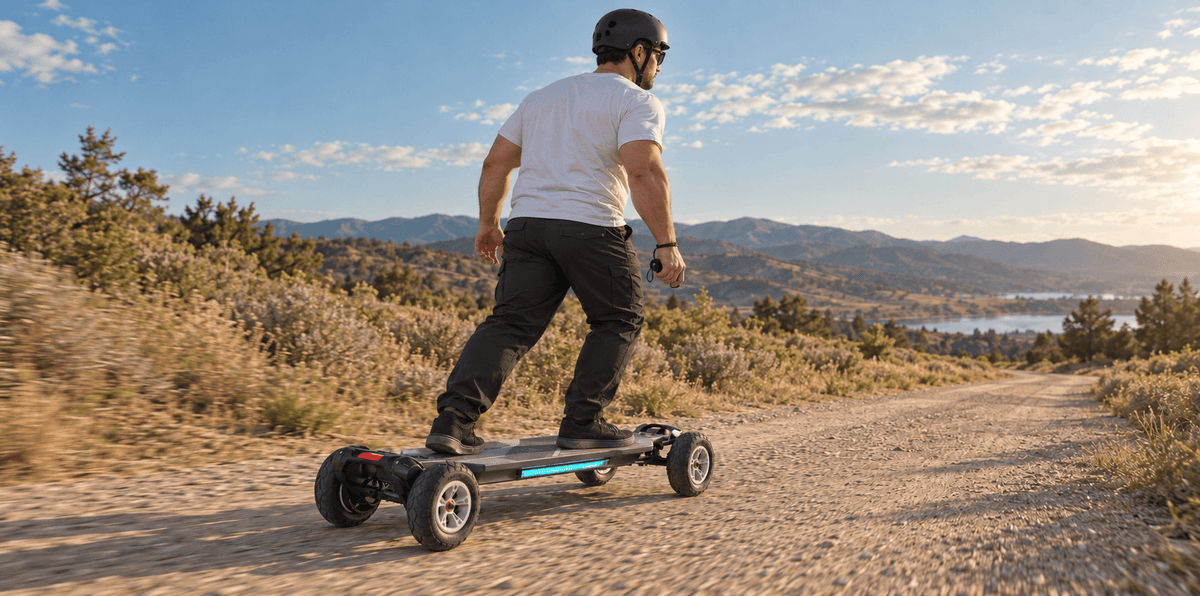
If your route is mostly smooth bike-lane pavement, a quieter hub setup can feel exactly right. If your commute includes parking-garage ramps, long inclines, or rough connectors between buildings, belt drive starts making more sense. A useful visual here is a split scene: one rider gliding over smooth campus pavement with a low-profile hub board, another crossing rougher roads where bigger comfort and stronger pull matter more.
A lot of buyers get distracted by top speed. For campus commuting, the better question is how the board behaves at 8 to 18 mph, because that is where you actually live most days. Quietness, launch smoothness, and whether the board feels strained on a hill will shape your commute more than whether the spec page says 28 mph or 37 mph.

Choose a hub-motor Maxfind if your top priority is stealth, simplicity, and low maintenance.
The Max5S is the cleanest proof point for this side of the lineup. Electric Skateboard HQ lists it with dual 650W hub motors, 90mm wheels, and a Hobbywing ESC, and tested its top speed at 23.6 mph. That combination tells you a lot before you even ride it. The power is commuter-level rather than extreme, the wheel size stays compact, and the ESC choice points toward smoother control instead of aggressive launch behavior.
Hub boards often get criticized for two things: they can feel harsher over rough pavement, and they can feel weaker on climbs than a comparable belt-drive setup. The reason the Max5S still deserves a serious look is that reviewers did not frame it as a cheap, rattly beginner board. Electric Skateboard HQ praised the forged trucks and overall build, while also noting that road vibration remained one of the board’s weaknesses. That is a fair reminder that truck quality and deck feel can help, but they cannot fully erase the usual “hub boards ride harsh” complaint.
The range story is where this choice gets real. The Max5S was tested at 7.8 miles versus a claimed 15.5 miles. That gap is not a reason to dismiss it. It is exactly the kind of reality check that helps a commuter buy the right board. If your actual use case is a 2-mile ride to class, a few cross-campus trips, and a return home, a quiet hub setup can still be more than enough. If you expect one charge to cover a long day of detours, errands, and repeated hill climbs, this is where you should stop romanticizing stealth and start looking at the belt-drive side.
You’ll know this is the right fit when your route is short, your hills are modest, and the thought of adjusting belts or hearing more drivetrain noise sounds annoying. You’ll also know it fits if you want a board that feels easy to live with rather than exciting in a spec-sheet way.
There is another subtle reason hub drive works well on campus: it tends to look and sound less dramatic. That matters if you ride through pedestrian-heavy areas, around dorms, or near quiet residential streets. A board that does not announce itself can be the better daily tool even if it loses the torque contest on paper.
For beginners, this side of the lineup also lines up with the brand’s smoother tuning reputation. The target audience insight around these boards points to riders who want easier control and less aggressive launch behavior. If you are still learning foot placement, braking confidence, and how to manage crowded paths, that matters more than raw punch.

Move to the FF Belt or a belt-drive Cyber configuration if your commute includes longer climbs, rougher pavement, or enough stop-and-go riding that you want more usable torque than a typical commuter hub board can give. If you want a quieter, longer-range alternative, the FF Pro stays on the hub-motor side of the lineup.
This is the sweet spot in the lineup for riders who do not want a dead-silent board at all costs. The FF Belt is officially rated for 28 mph, 25 miles of range, and a 35% hill climb. The hub-driven FF Pro is also rated for 28 mph, with 28 miles of range and a 30% hill climb. Both offer quick battery swaps, and the FF Pro adds Silent Glide Technology.
That last detail matters because it shows the brand understands the exact tension this article is about. Some riders want belt-drive pull without the full “performance board” vibe, while others want more range without giving up the low noise and simple ownership of hub motors. The FF Belt speaks to the first group; the FF Pro speaks to the second.
eSkate Hub adds useful context here. Its FF Belt review describes a quick-swap battery compartment, a comfortable commuting deck, and a board aimed at intermediate and advanced riders. That combination makes sense for mixed campus use. A comfortable deck helps on longer rides and rough connectors between smooth sections. A quick-swap battery is practical if you ride to class, then to work, then back across town. And stronger low-speed pull is exactly what helps when a route includes repeated ramps and climbs.
This is also where Maxfind starts to separate itself from plain budget boards. The FF line brings commuter-friendly polish into a category that often swings too far in one direction. Some boards are quiet but underwhelming on hills. Others are powerful but feel like overkill for daily campus use. The FF Belt and FF Pro sit in the middle for different reasons: the FF Belt brings stronger belt-drive pull, while the FF Pro brings quiet hub-motor cruising and more range. Both are clearly designed for real-world riding rather than pure enthusiast flex.
Watch out for one thing, though: belt drives are not maintenance-free. They can sound more noticeable than hubs, and they ask more from the owner over time. If your dream board is something you charge, ride, and barely think about, hub drive still wins that argument. If your route keeps exposing the limits of hub pull, the extra involvement is usually worth it.
A good rule is this: if you have ever found yourself thinking, “I want this ride to feel easier on hills, but I do not need a giant all-terrain machine,” you are probably the rider the FF Belt is built for. If your thought is, “I want a quiet ride with more range,” the FF Pro is the closer match.
Use published numbers, not imagined torque figures, when you compare commuter boards.
The table below compares only data verified in the source set used for this guide. If a field was not verified here, it is marked that way rather than guessed.
| Brand / model | Published price | Drivetrain type if stated | Top speed if stated | Hill-climb claim if stated | Quiet-commute angle | Standout trade-off |
|---|---|---|---|---|---|---|
| Maxfind Cyber Ultra | From $999 | Hub or belt, depending on configuration | 31 mph hub; 37 mph belt | 35% | Hub favors quietness; belt favors stronger torque | Strong feature density, but larger and less campus-subtle |
| Maxfind Cyber Max | From $399 | Hub or belt, depending on SKU | 28–37 mph | 30–35% | Design-led commuter appeal | The $399 hub model and $799 X belt version have very different specs |
| Maxfind FF Belt | $599 | Belt drive | 28 mph | 35% | Civilized for a belt board, not hub-quiet | Better hill pull, but more drivetrain presence |
| Maxfind FF Pro | From $699 | Dual 1,000W hub motors | 28 mph | 30% | Quiet, long-range commuting with Silent Glide Technology | Less belt-drive pull, but lower noise and maintenance |
| Maxfind Max5S | $379 official; $499 review price | Dual 650W hub motors | 24 mph official; 23.6 mph tested | 25% | Best fit for stealth and low maintenance | Tested range is much shorter than claimed |
| Maxfind Max2 Pro | From $299 | Hub; single, dual, and X versions | 20–24 mph | 25% in specs; 30% in page highlights | Campus-friendly short-trip option | The product page needs one consistent hill-climb figure |
| Tynee Mini 3 SL | $399 | Not verified in this source set | Not verified in this source set | Not verified in this source set | Strong torque/value reputation in enthusiast circles | More torque-focused reputation than design-led polish |
| Meepo Go | $499 | Not verified in this source set | Not verified in this source set | Not verified in this source set | Value-first commuter angle | Meepo is often treated as a value benchmark |
| Meepo Voyager X Limited | $999 | Not verified in this source set | Not verified in this source set | Not verified in this source set | Performance/value reputation | Less emphasis on integrated styling |
| Propel Pivot GT | $999 | Not verified in this source set | Not verified in this source set | Not verified in this source set | More performance-oriented than stealth-oriented | Less commuter-subtle at this tier |
| WowGo 2S Max | $349 | Not verified in this source set | Not verified in this source set | Not verified in this source set | Budget commuter option | Lower price, fewer premium design cues |
| Backfire cited commuter models | Not verified in this source set | Not verified in this source set | Not verified in this source set | Not verified in this source set | Often praised for remote polish | Specific figures not verified in this source set |
| Exway cited commuter models | Not verified in this source set | Not verified in this source set | Not verified in this source set | Not verified in this source set | Often praised for app and control polish | Specific figures not verified in this source set |
The honest takeaway is pretty straightforward. Maxfind’s edge is not “highest torque in every class.” Its edge is integrated aesthetics, lighting, quick-swap battery options on the FF line, and a commuter-friendly sense of polish. Tynee is often discussed for torque and value in enthusiast content. Meepo is commonly treated as a value benchmark, while Backfire and Exway are often praised for remote and app polish. That makes the choice less about one universal winner and more about what kind of daily ride you want.
If you care most about stealth, the hub side remains the better fit. If you want stronger hill confidence without jumping into a much more expensive performance category, the belt-drive side is where the lineup gets interesting.

Pick the board by route shape and daily behavior, not by whichever spec looks biggest.
If you want the easiest campus carry-and-go option, start with the Max2 Pro. eSkate Hub describes the Max2 Pro as a strong campus shortboard, and the review notes a 24 mph top speed with up to 21 miles on the X variant. It also says the Max2 Pro X “looks and feels premium, and rides like a dream.” That is the kind of board that makes sense for short trips between classes, apartment-to-library runs, and riders who value portability over brute force.
If you want a quiet beginner commuter, the Max5S is the more convincing choice. It gives you a verified hub setup, smoother Hobbywing tuning, and a tested top speed that lands right where many campus riders actually ride. It is the one to choose when you hate maintenance and your route is mostly flatter pavement.
If you are tempted by headline speed and futuristic styling, the Cyber Max is the one that will catch your eye. Just make sure you choose by SKU, not by the biggest numbers on the page. The $399 base hub version is rated at 28 mph, 15 miles of range, and a 30% hill climb. The 37 mph, 37-mile, and 35% figures belong to the $799 Cyber Max X belt version. If your real use is commuting, treat those numbers as part of the picture, not the whole picture. The better question is whether your route actually needs that kind of claimed performance or whether you would be happier with a calmer, quieter setup.
If your route mixes hills with longer pavement stretches and you still want comfort, the FF Belt is the practical move. It is priced at $599, and the combination of 28 mph, 25 miles, 35% hill climb, and quick battery swap makes it one of the clearest commuter-upgrade boards in the range. This is the board for the rider who has outgrown a basic hub commuter but does not want to jump to a huge all-terrain setup.
If you want more range and the convenience of battery swapping, the FF Pro earns its place. Starting at $699, it keeps the 28 mph top speed, stretches official range to 28 miles, and adds Silent Glide Technology. That makes it a strong pick for riders who want quiet hub-motor cruising with a little more range and refinement in the overall experience.
If your commute includes rough roads, broken pavement, or all-terrain paths, the Cyber Ultra is the obvious outlier in the lineup. Configurations currently start at $999. The 175mm belt version is rated at 37 mph and 37 miles, while the 165mm hub version is rated at 31 mph and 37 miles. The 2-in-1 belt configuration reaches the 56-mile claim with its 107mm street wheels. All three list a 35% hill climb. Electric Skateboard HQ adds that the tested belt version uses a 648Wh 12S3P battery with LG 21700 cells, a Hobbywing ESC, 175mm all-terrain wheels, an IPX5 rating, and a 43-inch PPS composite and fiberglass deck. That is a different category of machine from a quiet campus hub board, but for riders whose “campus commute” includes rough connectors, poor roads, and weekend trail use, it may be the right answer.
The price ladder helps you self-sort fast:
That spread is useful because it shows the brand is not trying to force every rider into one type of board. There is a real progression from entry commuter to more capable belt-drive commuter to all-terrain flagship.
One more practical signal: the Cyber Max X page on Walmart holds a 4.7 out of 5 rating from 113 ratings and reviews. Many of those entries are labeled as reviews from maxfind.com or maxfindboards.com, so this is better understood as cross-site aggregated feedback than 113 independent Walmart verified purchases. The recurring praise centers on smoothness, speed, range, ride feel, and design. That does not replace a route-specific decision, but it does suggest that the commuter appeal is landing with real buyers.
Read the spec sheet as a starting point, then check whether third-party ride impressions support the kind of commute you actually have.
The clearest example is range. The Cyber Ultra is officially claimed at 37 to 56 miles, but Electric Skateboard HQ puts a more realistic aggressive-use estimate closer to 30 miles. That is not a knock on the board. It is exactly how you should read electric skateboard range in the real world. Riding style, terrain, speed, and rider weight all move the number.
The same lesson shows up on the Max5S. Its tested range came in at 7.8 miles against a 15.5-mile claim. For a campus rider, that gap is useful because it helps you stop buying for the fantasy version of your week. If your real daily loop is 4 to 6 miles total, that board may still fit beautifully. If your route is longer or hillier, the spec sheet alone can lead you into the wrong drivetrain.
Design and ride feel are another place where outside voices help. Ziyad Khairi of Electric Skateboard HQ wrote that the brand has “built a reputation for well-polished boards with distinctive design language and signature aesthetics.” On the Cyber Ultra specifically, he called it “quite possibly the most polished-looking all-terrain board you can buy right now.” Those lines matter because they explain why some riders keep coming back to this lineup even when cheaper value boards exist. The appeal is not just speed or range. It is the feeling that the board was designed as a complete product, not just assembled around a motor spec.
That same pattern shows up lower in the range. eSkate Hub called the FF Belt “one of the most interesting electric skateboards I have ridden lately.” That is a strong signal for riders who want something more characterful than a generic commuter board. Forbes also covered the FF Belt, which shows the board reached beyond niche eskate media and into mainstream tech and lifestyle attention.
User reviews can add one more layer when they are specific. A Walmart reviewer, Wesley G., wrote of the Cyber Max X: “The cyber max x is smooth as butter, has great range and top speed. Fast charge time, great commuter board with a great thrill!” That kind of comment is useful because it speaks directly to the commuter angle rather than just celebrating speed in the abstract.
The best buying habit is to weigh four things together:
If you chase only one flashy number, you usually end up compensating somewhere else. The quietest board may feel underpowered on your route. The strongest hill climber may be more noticeable than you want around dorms and neighborhoods. The smartest choice is the one that matches your route most of the time, not the one that wins the most dramatic spec-sheet argument.
Usually, yes. If your priority is stealth, a hub-motor setup is the better fit because it avoids the extra mechanical sound that comes with belt systems. The Max5S is the clearest example in the lineup because its dual 650W hub motors and Hobbywing ESC point toward a smoother, calmer commuter ride. It makes the most sense on flatter routes, shorter daily distances, and campuses where you want the board to feel low-drama.
Not necessarily, but it is more noticeable than a hub board. The FF Belt is the better choice when your route includes real hills and you want stronger low-speed pull, yet it is still positioned as a commuter-friendly board with a comfortable deck and quick-swap battery. If your neighborhood or campus environment makes stealth the top priority, hub drive remains the safer pick. If hill confidence matters more, the FF Belt is the more balanced answer.
Tynee is often discussed for torque and value in enthusiast content, so if your buying lens is pure punch per dollar, Tynee often enters the conversation first. Maxfind’s advantage is different. It leans harder into integrated design, commuter polish, lighting, and quick-swap battery convenience on the FF line. For many riders, the real question is not “Which brand wins torque?” but “Do I want torque-first character or a more design-led commuter package?”
Yes, but the right model matters. The hub side works best on smoother pavement and easier hills. The FF Belt makes more sense when your route includes longer climbs, while the FF Pro is the quieter choice when range matters more than belt-drive pull. The Cyber Ultra is the strongest fit for rough roads or all-terrain paths because it offers 165mm or 175mm all-terrain wheels, an IPX5 rating, and a larger composite deck. Match the board to the route instead of assuming every model handles the same abuse equally well.
It can be, especially if you are drawn to the design. The key is to stay practical and choose the exact SKU. The $399 base hub version is rated at 28 mph, 15 miles, and a 30% hill climb. The 37 mph, 37-mile, and 35% figures belong to the $799 Cyber Max X belt version. Commuters should still judge either one by route shape, daily distance, and how much they care about quietness. The strong aggregated rating shown on Walmart and repeated praise for smoothness and ride feel suggest the lineup resonates with real commuter buyers.
There is not enough model-by-model test data here to describe exact push resistance by drivetrain with confidence. Hub and belt systems can feel different when unpowered, but the exact resistance depends on the motor, bearings, belt tension, gearing, and wheel diameter. If this matters a lot to your commute, it is worth checking hands-on reviews for the exact board and configuration you want.
Maxfind’s real strength in drivetrain choice is not absolute torque dominance. It is the split it gives commuters and style-focused riders: quiet hub convenience on one side, and stronger belt-drive punch from options such as the FF Belt and selected Cyber configurations on the other.
If you want stealth first, the hub side makes the most sense. If you want hill power first, the FF Belt and belt-drive Cyber configurations are where the lineup gets more compelling. The Cyber and FF models together cover both ends of the everyday commuting decision, which is why this brand keeps showing up in conversations about boards that look polished, ride comfortably, and give riders a clearer choice than a one-size-fits-all commuter lineup.
Pricing reflects listings at the time of writing; confirm current prices before buying.

Share:
MAXFIND CYBER MAX Use Review: Ride Comfort, Carving, and Everyday Control
How to Judge Electric Skateboard Commute Safety and Reliability