

Lowest Price of the Year 🏷️
"Black Friday" Price Guarantee 🔒

A small electric skateboard is not automatically easier for a beginner. A compact board can make sense if you already feel comfortable on a short deck and need to carry it often. A longer board is worth considering first if you want more room to position your feet and most of your trip will be spent riding.
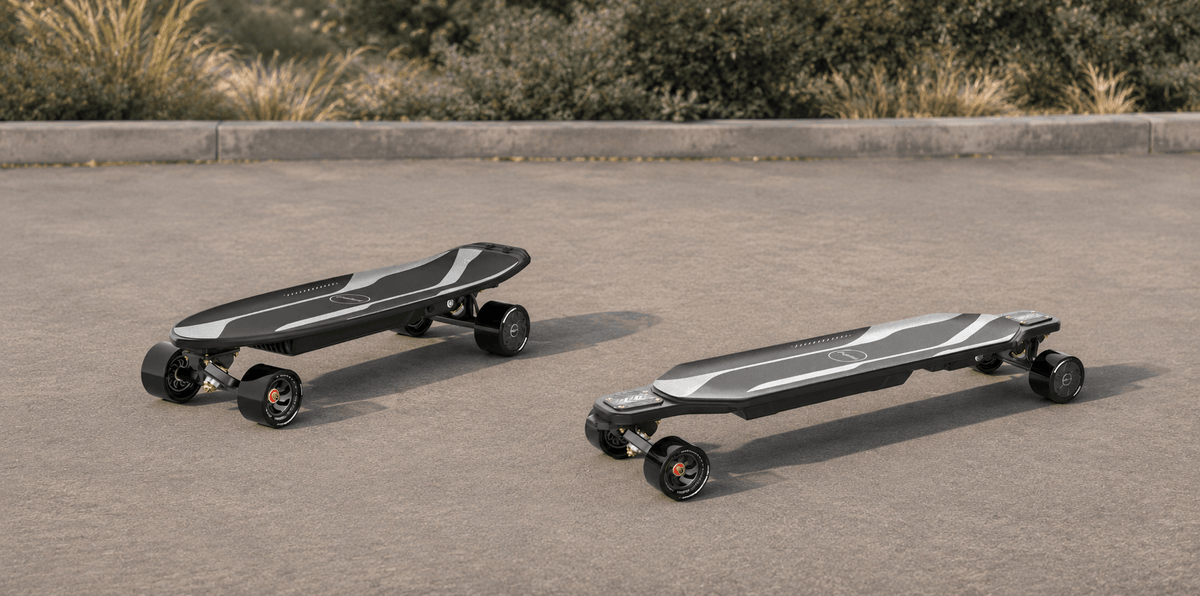
When comparing the MAXFIND CYBER MINI and CYBER MAX, start with your skateboarding experience, usable standing space, wheelbase, and carrying routine. Board size is one part of choosing a first electric skateboard. You also need controls you understand and time to learn how the board responds.
These are different starting points.
If you already ride a conventional skateboard, you may be comfortable standing sideways, steering through your feet, and making small balance adjustments on a compact deck. The CYBER MINI may fit that familiar preference, particularly when carrying and storage matter. You will still need to learn its remote, acceleration, and braking response.
If you have never skateboarded, you are learning both balance and powered control. We suggest looking closely at the CYBER MAX if extra room for foot placement is a priority. Its longer platform gives you more length to work with, although the deck shape and your own stance determine how much of that space feels useful.
Your experience helps narrow the choice. A comfortable fit should decide whether that choice works for you.
This comparison covers the standard CYBER MINI and standard CYBER MAX. Other versions in each family have different specifications.
| Specification | CYBER MINI | CYBER MAX |
|---|---|---|
| Listed overall board length | 32.87 in / 83.5 cm | 38 in / 97 cm |
| Listed board weight | 16 lb / 7.3 kg | 19.8 lb / 9 kg |
| Wheels | 90 mm | 90 mm |
| Riding modes | 4 | 4 |
| Main size consideration | Shorter overall package for carrying and storage | More board length to consider for foot placement |
Dimensions and weights are manufacturer-published figures. Check the selected configuration on the CYBER MINI product page or CYBER MAX product page before ordering.
Both standard models offer four riding modes. That number alone does not establish how gentle a start will feel or how braking behaves. Learn what the modes change on the exact board you choose.
The important fit question is whether you can place both feet comfortably on the part of the deck intended for standing.
Overall length includes the nose and tail. Curves, raised areas, and the deck outline can affect where your feet feel supported. A longer board gives you more overall length, but it does not tell you the exact usable stance distance or the width beneath each foot.
When reviewing a deck or trying one with a retailer, check:
If you can check the fit in person, ask the retailer or instructor to secure the stationary, powered-off board first.
Your shoe size and preferred stance are more useful than a simple height cutoff. If the MINI makes you bring your feet closer together than feels comfortable, consider the MAX. If the MINI already gives you a relaxed, supported stance, its shorter size may suit your routine well.

Board length runs from nose to tail. Wheelbase describes the spacing of the trucks or axles, depending on the measurement convention. A deck specification may measure between mounting holes, while an assembled-board comparison may use axle centers. Compare figures measured the same way.
With a comparable truck setup, a longer wheelbase generally favors a steadier steering feel, while a shorter one tends to turn more readily. Truck geometry, bushings, and rider input also affect the response. These are general design tendencies, explained in this wheelbase design guide, rather than measured handling results for the MINI and MAX.
For a precise CYBER MINI versus CYBER MAX wheelbase comparison, confirm the values and measuring points for both configurations with our team. Do not calculate wheelbase by subtracting an assumed nose and tail length from the overall dimensions.
For a beginner, the practical question is whether the board's steering response feels manageable alongside a comfortable stance. Extra board length does not replace learning to make controlled inputs.
The standard CYBER MINI is shorter and lighter than the standard CYBER MAX. That difference matters most when getting off the board is a regular part of your trip.
Picture two routines:
The MINI still weighs about 16 lb. Check whether you are comfortable lifting that weight and holding a board of its dimensions for the walking portions of your day. Also consider doorway clearance and where you will put it when you arrive.
If carrying is frequent but a compact stance feels cramped, try both sizes before ordering when possible. That is a real tradeoff between fit and portability.

| Your situation | Start by considering | What to confirm |
|---|---|---|
| You have no skateboarding experience and carrying is occasional | CYBER MAX | Its usable standing area supports a relaxed stance, and you understand the controls. |
| You already enjoy a compact conventional skateboard and carry often | CYBER MINI | The deck fits your stance, and you are comfortable learning powered acceleration and braking. |
| You prefer more space between your feet or feel crowded on a short deck | CYBER MAX | The deck shape provides useful space where your feet actually go. |
| Stairs, walking connections, or limited storage are daily constraints | CYBER MINI | Both the 16 lb weight and the standing area work for you. |
| You mainly want a board to ride, with only brief carrying | CYBER MAX if you prefer the longer platform | Its size fits your storage space and feels comfortable underfoot. |
| You have no board experience, need frequent carrying, and are unsure about stance | Compare both before choosing | Check fit and lifting comfort with a retailer or instructor when possible. |
These are starting points for a purchase decision, not ratings of how safely every rider will handle each board.
Start with fit, then check the controls, then weigh the carrying demands of your routine. Choose the CYBER MINI when its standing area suits you and frequent carrying makes the compact size useful. Choose the CYBER MAX when you prefer a longer platform and can accommodate its extra size and weight.
For either board, read the supplied manual and learn starting and stopping at a manageable pace. Wear a properly fitted skateboarding helmet and protective gear, inspect your board and riding surface, and practice away from traffic. The CPSC's skateboarding safety guidance covers these basic precautions.
For the control questions to ask before buying, see our first electric skateboard checklist.
Share:
Electric Skateboard Wheels for Rough Roads: Street Wheels or Pneumatic Tires?
How Much Does an Electric Scooter Cost to Own? Charging, Tires, Brakes, and Maintenance