

Autumn Miles. Limited-Time Deals 🏷️
--
Days--
Hours--
Mins--
SecsSpring is a great time to commute, cruise, or explore outdoors on an electric skateboard. This guide compares the MAX6, MAX5S, FF AT, and FF BELT to help you choose the right model for your riding distance, experience, and road conditions.
An electric skateboard can make short trips, outdoor exploration, and daily commuting more convenient during spring.
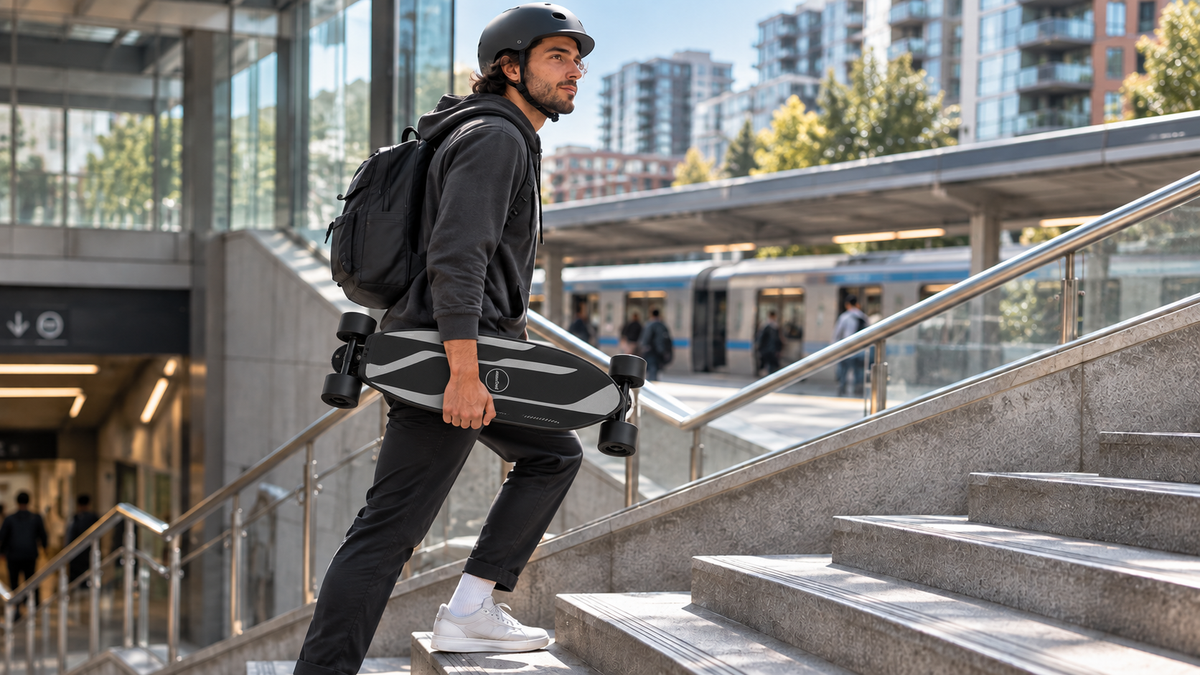
Electric skateboards are easier to store than most bicycles and scooters. They can work well for trips between home, work, school, public transportation, and nearby outdoor areas.Portability varies by model, so riders who regularly carry their board should also check its weight and dimensions before buying.
Electric skateboards do not produce tailpipe emissions while being ridden. They can be an alternative for short journeys that might otherwise require a car.Battery production, charging, and transportation still have an environmental impact, so they should not be described as completely emission-free.
A remote-controlled motor handles acceleration and helps riders cover longer distances without constantly pushing. Riders still need balance, braking awareness, and basic board control.
Smooth neighborhood streets, park paths, waterfront routes, and suitable paved trails can all provide different spring riding experiences. Always confirm that electric skateboards are allowed on the route before riding.
|
Model |
Best for |
Top speed |
Listed range |
Motor system |
Main feature |
|
MAX6 |
Long street rides and commuting |
28 mph |
31 miles |
Dual 900W belt motors |
Long range and stable control |
|
MAX5S |
Beginners and shorter daily rides |
24 mph |
15 miles |
Dual 650W hub motors |
Smooth control and lower maintenance |
|
FF AT |
Rough roads and unpaved routes |
28 mph |
17 miles standard |
Dual 1500W hub motors |
165mm vacuum rubber wheels |
|
FF BELT |
Strong street performance |
28 mph |
25 miles standard |
Dual 1500W belt motors |
Acceleration and range options |
Listed range is based on official product information. Actual range may vary depending on rider weight, speed, hills, temperature, road conditions, wheel setup, and riding mode.
Prices and availability may also change. Check the current product page before ordering.

Maxfind MAX6 is the strongest option in this group for riders who prioritize distance and regular street use.
It uses dual 900W belt motors and has a listed top speed of 28 mph. Its listed range of up to 31 miles makes it suitable for longer commutes, weekend rides, and routes where frequent charging would be inconvenient.
The belt-drive system provides more torque than a typical entry-level hub-motor setup. This may help on hills and during faster acceleration, although belt systems generally require more maintenance than hub motors.
The MAX6 also includes RGB lighting and electronic regenerative braking. Its 20.9-pound weight should be considered by riders who regularly carry their board upstairs or onto public transportation.
Best for:
Longer paved routes
Daily commuting
Riders who want a belt-drive board
Riders who value stability and range
Consider before buying:
It is heavier than a compact commuter board
Belt drives require periodic inspection
Regional availability differs by wheel option
The product page includes several board variants, so confirm that MAX6 is selected

Maxfind MAX5S is a more accessible option for new riders and people who mainly travel shorter distances.
It uses dual 650W hub motors, reaches a listed top speed of 24 mph, and offers up to 15 miles of range. The Hobbywing control system is designed to provide smooth acceleration and braking, which can make the board easier to manage at lower speeds.
Hub motors are enclosed within the rear wheels and generally require less routine maintenance than exposed belt-drive systems. This makes the MAX5S practical for riders who want a simpler daily setup.
New riders should still begin in the lowest speed mode and practice starting, turning, braking, and stopping in a quiet open area.
Best for:
First-time electric skateboard riders
Short daily commutes
Smooth city streets
Riders who prefer lower-maintenance hub motors
Consider before buying:
Its range is shorter than the other models in this guide
It is designed mainly for paved surfaces
It is not intended for demanding off-road routes
Riders should not begin at its maximum speed

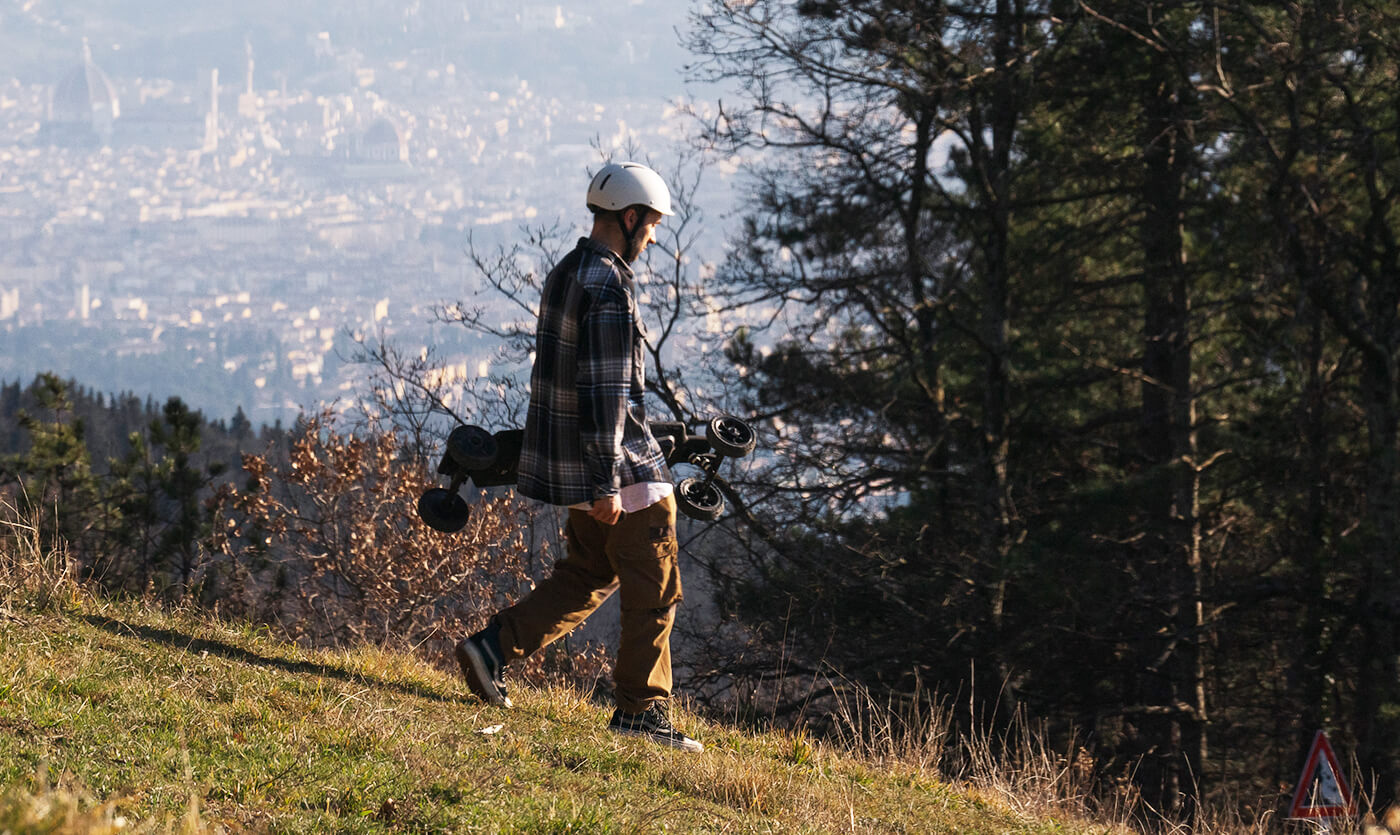
Maxfind FF AT is designed for riders who expect rougher surfaces than a standard street board can comfortably handle.
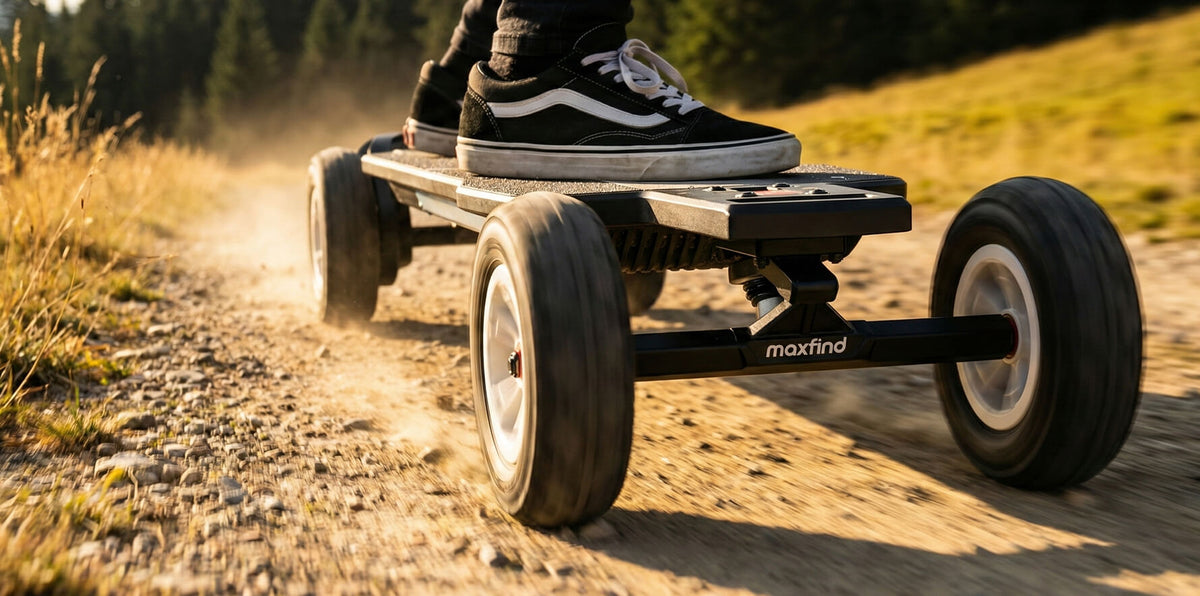
Its 165mm vacuum rubber wheels provide more ground clearance, grip, and shock absorption than smaller polyurethane street wheels. The board uses dual 1500W hub motors and has a listed top speed of 28 mph.
The standard battery option provides a listed range of 17 miles. Longer-range battery configurations are also available. Its fast-swap battery design allows compatible batteries to be replaced without changing the entire board.
The FF AT may be used on rough pavement, gravel, compact paths, and other suitable uneven surfaces, and other suitable uneven surfaces. Conditions such as deep mud, standing water, extremely loose or deep sand , steep rocks, and heavily damaged trails should still be avoided.
Best for:
Rough pavement
Park paths and compact dirt routes
Grass and light gravel
Riders who prioritize wheel size and shock absorption
Consider before buying:
Larger wheels make the board less compact
The standard range is shorter than the MAX6 and FF BELT
It is more expensive than an entry-level street board
It should not be treated as suitable for every possible terrain

Maxfind FF BELT is intended for riders who want stronger acceleration, belt-drive power, and a 25-mile standard range.
It uses dual 1500W belt motors and has a listed top speed of 28 mph. The standard version offers up to 25 miles of range, while extended-range configurations are available for riders planning longer journeys.
Its 105mm shock-absorbing wheels are designed for paved roads and can provide more comfort over cracks and uneven street surfaces than smaller, harder wheels.
The FF BELT delivers considerably more motor power than the MAX5S, so its higher motor power may make it more suitable for riders who already have board control and remote-braking experience.
Best for:
Experienced street riders
Strong acceleration
Longer paved routes
Riders who want belt-drive torque
Consider before buying:
It may be too powerful for a complete beginner
Belt components require inspection and occasional replacement
Longer-range configurations cost more
High speed requires more stopping distance and protective equipment
Choose based on your usual road conditions, riding distance, experience level, and need for portability. Street riders can focus on range and motor type, while riders using rough or unpaved routes should give more attention to wheel size, ground clearance, and ride comfort.
Spring weather can create changing road conditions, so inspect the board and route before every ride.
Rain, melting snow, mud, fallen leaves, and loose gravel can reduce wheel traction. Wait for the road to dry and avoid puddles or standing water.Water resistance does not mean a board is suitable for riding in rain or through deep water.
Before riding, check:
Wheels for damage or excessive wear
Belts for cracks, looseness, or trapped debris
Trucks and mounting hardware
Battery level
Remote connection
Braking response
Charging port cover
Lights and reflective equipment
Do not ride if the board makes unusual sounds, loses power, or responds inconsistently to the remote.
Do not plan a ride that uses the board's full listed range. Leave enough battery capacity for hills, wind, colder temperatures, detours, and the return journey.Actual range may be lower than the maximum figure shown on the product page.
A properly fitted helmet should be used on every ride. Wrist guards, knee pads, elbow pads, gloves, and visible clothing can provide additional protection.Higher speeds require more time and distance to stop, especially on unfamiliar or uneven roads.
Electric skateboard laws differ by state, city, park, campus, and trail. Some locations allow riding on certain roads or bicycle paths, while others restrict motorized boards.
Some models can handle both, but compromises are involved. Street boards are usually lighter and more efficient on pavement, while boards with larger wheels provide better comfort and clearance on compact dirt, gravel, and rough paths.
Larger and softer wheels generally provide more comfort and grip on cracked pavement. Standard street wheels feel more responsive on smooth roads, while larger wheels such as those on the FF AT are better suited to rougher surfaces.
Yes. Lower temperatures can temporarily reduce battery output and riding range. Allow the board to reach a moderate indoor temperature before charging, and leave extra battery capacity for the return trip on colder days.
Check the battery level, charger, wheels, bearings, trucks, belts, remote, and braking response. Charge the board with the correct charger and complete a slow test ride before returning to normal speeds.
The best electric skateboard for spring depends on your route, riding experience, and range needs. Compare the four models based on where and how you ride, then choose the board that best fits your daily use.

Share:
The Best Electric Longboard for $500-$600 – Influencers Weigh In!
Maxfind CYBER MINI Electric Skateobard Review: Tiny Board, Big Performance