

Autumn Miles. Limited-Time Deals 🏷️
--
Days--
Hours--
Mins--
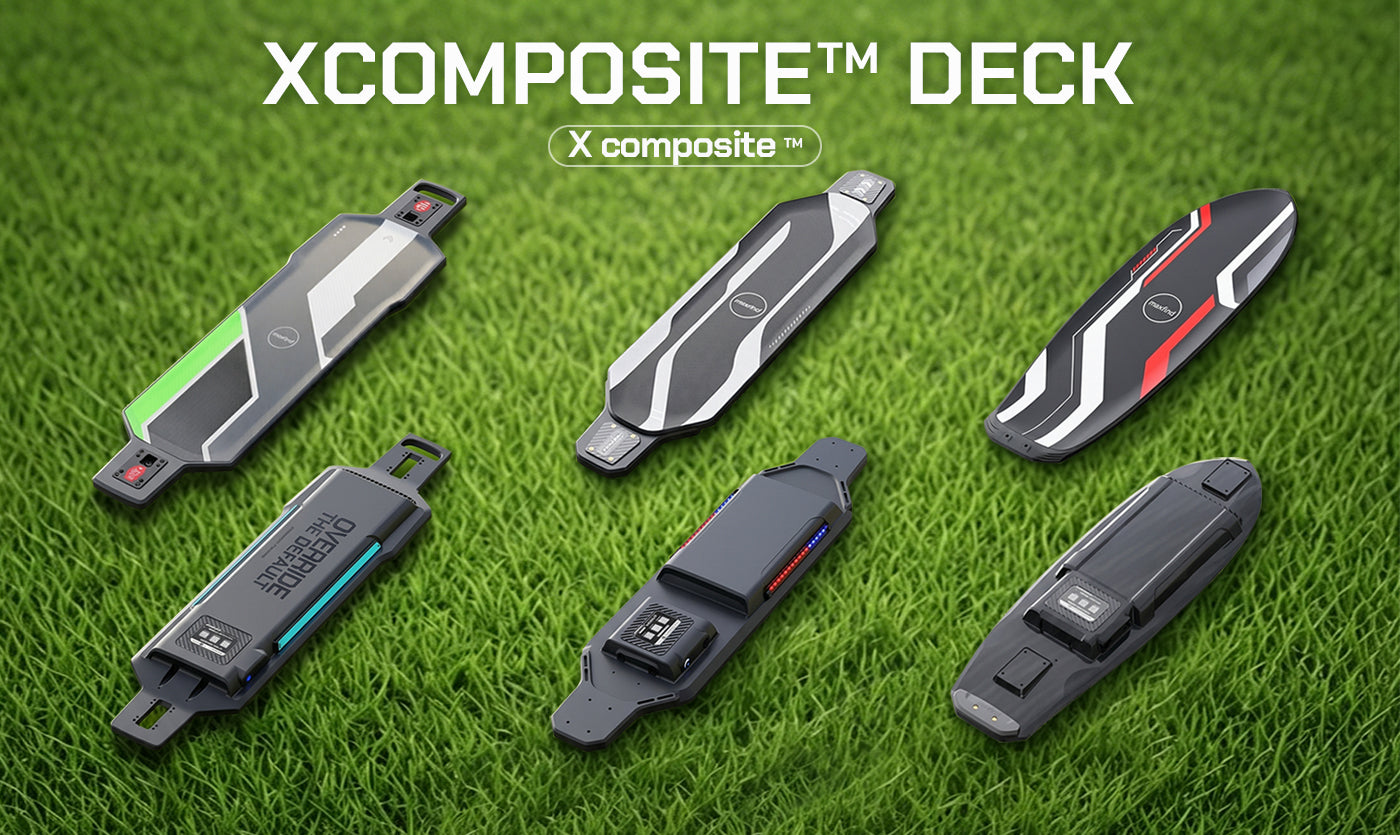
SecsMAXFIND's patented Xcomposite™ technology brings automotive manufacturing standards into the world of micro-mobility, redefining what an electric skateboard deck can be. By moving beyond the bamboo and maple splicing that has defined the industry for decades, this innovation gives riders a deck that is tougher, safer, and more sustainable in every condition.

Xcomposite™ is an advanced material solution that replaces traditional maple and bamboo with a high-performance polymer composite. Unlike standard decks that rely on layers of natural material, this technology uses one-piece injection molding to create a unified, durable structure with no screws and no seams.
It is built around aerospace-grade PPS (polyphenylene sulfide) polymer, producing a deck that is tougher than plastic, lighter than metal, and more durable than wood while maintaining the elasticity riders need for a smooth, responsive ride.

To understand why this technology matters, it helps to compare the physical properties of traditional materials against this new engineering standard.
|
Feature |
Traditional Wood and Bamboo Decks |
Xcomposite™ Technology Deck |
|
Safety |
Porous wood absorbs water, which leads to mold and irreversible loss of fiber strength. |
PPS polymer does not absorb water or develop mold, and provides warning through gradual deformation before failure. |
|
Lifespan |
Fibers become brittle after sun and rain exposure, limiting the structural life of the board. |
High weather resistance to acids, alkalis, and corrosion, with stable performance even after years of sun and rain exposure. |
|
Elasticity |
Good initial elasticity that fatigues within two years, leading to a loose, less responsive road feel. |
Stable material characteristics ensure the riding feel on day one is the same after three years. |
|
Environment |
Structure warps and mounting points loosen in extreme heat or cold. |
Performance remains stable from −40°C to 60°C. |
These limitations are not minor inconveniences. In the electric era — when decks must carry battery weight, absorb motor vibration, and stay reliable at speeds wood was never engineered for — these flaws become real safety concerns. The next section explains how Xcomposite™ rebuilds the deck from the material level up.
The manufacturing process for this deck technology follows automotive grade standards to ensure precision and reliability.
The Xcomposite™ process uses one-piece injection molding to integrate the battery compartment, motherboard housing, and carrying handle directly into the deck. This creates a unified structure with no splice seams, external shells, or unnecessary screw holes, helping the deck stay cleaner while reducing common entry points for water and mud.
The deck is built from a specialized formula combining aerospace-grade PPS polymer with anti-oxidation and toughening agents. This compound is naturally resistant to acid and alkali corrosion, does not absorb moisture, and retains its mechanical properties across a wide temperature range.
Production uses whole-mold steel precision processing treated with a nano coating, paired with a smart hot-runner system that monitors temperature to ensure absolutely uniform material injection across the mold. The entire process is fully automated, with a production cycle that takes only two days from raw material to finished deck — a level of consistency that hand-layered wood decks cannot match.
Laboratory testing has confirmed the structural performance of Xcomposite™ across multiple stress conditions:

The innovations behind Xcomposite™ are protected by three Chinese national utility model patents: ZL 2023 2 1117687.8, ZL 2023 2 1277761.2, and ZL 2023 2 1263996.6. Together, these patents form a technological moat that separates MAXFIND from the common public-mold designs found across the rest of the industry.
The engineering only matters if it changes what riding actually feels like. Here is what Xcomposite™ delivers in practice.
The Cyber series follows a principle that traditional manufacturing cannot support: structure should serve design, not the other way around. By eliminating external battery cases and visible screws, the deck achieves a continuous industrial aesthetic — clean lines that look intentional rather than interrupted by the requirements of assembly. Fewer screw holes also means fewer failure points, which is form following function rather than fighting it.
Where natural wood degrades quietly until it suddenly fails, this composite material behaves predictably — deforming gradually under unusual stress rather than fracturing without warning. That predictability is why MAXFIND backs the deck with a ten-year commitment against breakage, a level of confidence wood and bamboo cannot match.

The deck remains structurally stable from −40°C to 60°C. Its naturally sealed, seamless construction helps resist rain, mud, and splashes by reducing the seams and screw holes where water can enter. After muddy rides, the surface is also easier to clean than traditional wood decks.
Choosing Xcomposite™ reduces the environmental cost of skateboard production. The PPS material is fully recyclable and can be regenerated into future products, while the fully automated manufacturing process produces almost no material waste — a sharp contrast to the deforestation footprint and high offcut waste of maple and bamboo deck production.
MAXFIND applies Xcomposite™ across several listed product lines, including Cyber One, Cyber Mini, Cyber Max, Cyber Ultra, and Glider. Across these models, Xcomposite™ supports lightweight integration, waterproof protection, structural strength, temperature stability, impact resistance, and sustainable manufacturing.
|
Product |
Usage Scenario |
Xcomposite™ Core Value |
|---|---|---|
|
Teen electric skateboard and entry-level transport |
Lightweight integrated build, airline-friendly, long-term elastic stability |
|
|
Adult lightweight commuting and daily transport |
Integrated waterproof structure, sustained toughness, urban riding comfort |
|
|
Flagship long-distance urban commuter |
High structural strength, reliable weatherproofing, zero elasticity decay |
|
|
All-terrain off-road for urban and suburban routes |
Extreme temperature stability, high-impact resistance, sustained toughness |
|
|
All-terrain riding, off-road routes, and rough-surface commuting |
All-terrain grip, flex deck vibration damping, and long-term impact resistance |
|
|
High-performance street riding, fast acceleration, and carving |
Responsive flex, stable control, vibration damping, and long-term structural strength |
|
|
Long-range commuting, city riding, and daily transport |
Smooth ride comfort,swappable battery compatibility, and integrated waterproof and dust-resistant design |
The shift toward composite materials marks a real turning point for electric skateboards — moving away from hand-layered workshop methods toward engineered, automotive-grade manufacturing. MAXFIND continues to push material science forward to make micro-mobility more durable, more sustainable, and more fun to ride. You can read more about MAXFIND and the engineering behind its products.
Yes. Xcomposite™ is designed to keep a stable, responsive flex over time, while wood or bamboo decks may gradually lose stiffness after repeated weather exposure and riding stress.
Yes. Compared with natural wood that may weaken quietly over time, Xcomposite™ is designed to deform more gradually under unusual stress, giving riders a more predictable structural response.
Xcomposite™ is built for stronger impact resistance and long-term toughness, making it suitable for boards used on rougher urban surfaces, mixed terrain, and models designed for all-terrain riding.
One-piece molding reduces seams, screw holes, and separate outer shells. This helps improve structural consistency, keeps the deck cleaner, and reduces common entry points for water, mud, and debris.



Share:
Off-Road Electric Skateboard for Rough Roads and Park Paths
Electric Skateboard in City Traffic: What Every Urban Rider Needs to Know