


Black Friday Deals. Lowest Price of the Year 🏷️

You step off a train, weave through two blocks of crowded sidewalk, then still have another 2 to 5 miles before work. That is exactly where an electric skateboard can make a commute feel shorter and less draining. This article does not promote any product. The key conclusion is simple: urban commuting efficiency improves most when riders match board size, real-world range, hill-climb ability, and battery strategy to the route rather than chasing top speed alone.
For commuting, the category includes mini boards, longboards, and all-terrain setups. Each solves a different city problem. Current examples span claimed ranges from 11 to 37 miles across common commuter-oriented models, with one all-terrain setup stretching to 56 miles on a different wheel configuration. Top speeds across current examples run from 15 mph to 37 mph. Hill-climb ratings range from 10% to 35%. Those numbers sound exciting, but they only matter when they fit your actual route.
A short station-to-office run asks for something very different from a hilly outer-borough commute with rough pavement and no charging at the destination. In practice, the fastest board is rarely the most efficient one. The board that saves the most time is the one you will actually carry, trust, and ride comfortably every day.
Commuting efficiency is not just about speed. It is a balance of travel time, portability, comfort, and reliability. A board that cuts ten minutes off your trip but feels awkward on stairs or exhausting to carry through a station can easily become a weekend toy instead of a weekday tool.
Start with route distance. A last-mile trip under 3 miles each way usually favors a lighter, simpler setup. A mixed commute around 5 to 10 miles round trip needs more battery margin and better ride comfort. Once you move beyond that, battery planning becomes part of the commute itself, especially if your office or classroom does not offer convenient charging.
Then look at pavement quality, incline, transit transfers, and storage. Rough asphalt, brick sections, curb cuts, and expansion joints all punish small wheels. Steep ramps and bridge approaches expose weak hill-climb ratings quickly. If you need to carry the board onto a train, through a lobby, and under a desk, weight matters almost as much as range.
Comfort is not a luxury feature in this use case. It is an efficiency feature because it affects how often you ride and how much speed you can use confidently. Concrete Surfers described a novice-friendly lightweight board at 12 lb and called out its smooth ride and quality maple deck. The same review also treated 17 mph top speed and 8-mile range as underwhelming, which shows how portability alone does not solve commuting.
Daily riders often notice smaller details first. In one discussion, users said thicker wheels made rides more pleasant and less noisy. In another, a rider said a deck felt “very strong” and stable. Those comments matter because a board that feels planted on imperfect pavement usually lets you maintain a steadier pace with less fatigue.
The mistake many commuters make is treating claimed range as guaranteed range. That is where efficiency starts to fall apart.
Range planning is where smart commuting begins. Claimed range is a useful starting point, but it is not a promise for your body weight, your speed, your hills, your stoplights, or your temperature.
Third-party testing makes the gap very clear. Electric Skateboard HQ estimated the Maxfind Cyber Ultra closer to about 30 miles when ridden aggressively, despite a marketed 37-mile claim. The same outlet tested the Maxfind Max 5s at 7.8 miles even though its claimed range was 15.5 miles. [2] That is not unusual in this category. It is exactly why commuters should plan around a percentage of claimed range instead of the headline number.
A realistic rule of thumb is to budget 50% to 80% of claimed range. Heavier riders, faster riding, frequent stops, steep hills, rough surfaces, larger pneumatic wheels, and cold weather all push you toward the lower end. Lighter riders on flatter routes with moderate speed can often plan closer to the upper end.
Here is a practical planning guide:
| Commute pattern | Safe planning percentage of claimed range | Battery strategy | Recommended wheel/board style |
|---|---|---|---|
| Under 3 miles each way, mostly smooth streets | 70% to 80% | Charge overnight, no mid-day charging needed | Mini board or compact commuter board |
| 5 to 10 miles round trip, mixed pavement | 60% to 70% | Start full, keep reserve for detours | Stable longboard with comfort-focused wheels |
| Hilly route or frequent stop-start traffic | 50% to 65% | Plan conservatively and avoid arriving near empty | Longboard or all-terrain setup with stronger hill rating |
| No charging at destination, longer daily use | 50% to 70% | Consider removable or swappable battery system | Board format matched to route surface and carry needs |
One habit makes this even safer: never plan to arrive empty. Leave a reserve for wind, traffic, and route changes. Removable or swappable battery systems can be a real efficiency advantage for riders who cannot charge at work. highlighted easy battery removal for extended rides on one reviewed board, and that kind of setup changes the math for longer commutes.
Board format decides whether your commute feels easy or annoying. Mini boards work best when portability is the first priority. They are the easiest to carry onto transit, tuck under a desk, and maneuver through tight spaces. Current mini examples sit around 11 to 21 miles of claimed range and 15 to 24 mph top speed, which is enough for short transfers and compact city routes.
Commuter longboards are the middle ground most riders end up preferring. They give you more deck space, better stability, and a calmer ride on cracked pavement. Current longboard-style commuter examples cluster around 15 to 25 miles of claimed range. That is a practical zone for many round-trip city commutes, especially when the route includes bike lanes, bridge ramps, and imperfect asphalt.
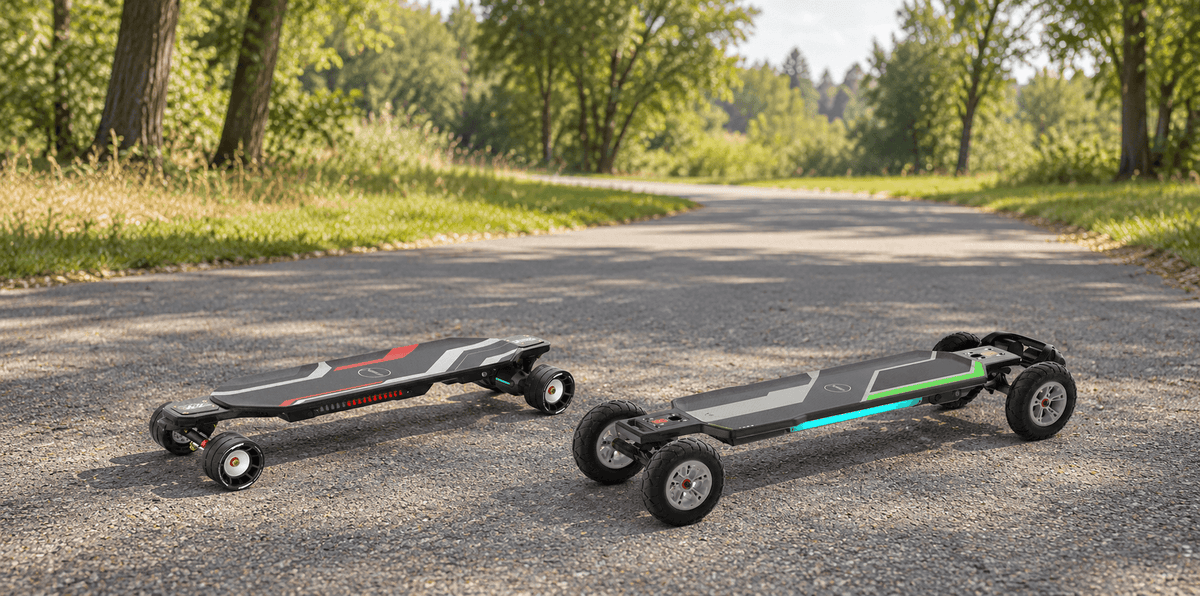
All-terrain setups make sense when the city itself is the obstacle. Broken pavement, rough curb cuts, patched streets, and mixed surfaces are where larger wheels start paying for themselves. Current all-terrain examples use 165 mm to 175 mm wheels and offer 17 to 37 miles of claimed range depending on wheel setup. Those boards are less convenient to carry, but they often preserve speed and comfort better on ugly roads.
Weather and durability matter too. Electric Skateboard HQ listed the Maxfind Cyber Ultra with IPX5 water resistance, and a rider described another deck as “very strong.” Neither point means you should treat wet streets casually, but both speak to the value of a commuter board that can handle splash, grime, and daily use without feeling fragile. [5]
Image note: a city commuter carrying a board onto public transit, or riding over patched pavement near a station entrance.

If you are shopping for an electric skateboard for commuting, use a checklist instead of a hype filter.
First, build in a real-world range buffer. If your route needs 8 miles, do not buy around an 8-mile claim. Buy around the range you can still trust after hills, cold mornings, and stop-start traffic. Second, check board weight honestly. A capable board that becomes miserable on stairs is not efficient for a train-and-office routine.
Third, match wheel size to pavement. Smaller wheels help compactness. Larger wheels usually improve comfort and confidence on rough streets. Fourth, look at hill-climb rating in the context of your route. A flat downtown grid and a bridge-heavy commute are different jobs.
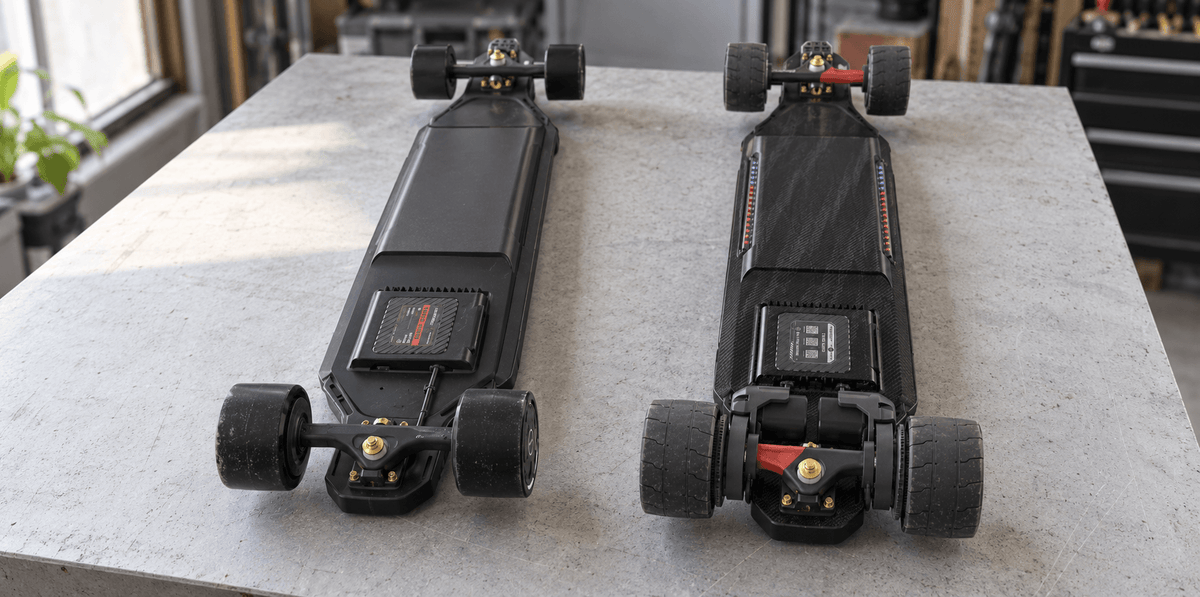
Fifth, pay attention to water resistance and deck construction. Electric Skateboard HQ said the Maxfind Cyber Ultra deck is built from PPS composite plus fiberglass, measures 43 inches by 13 inches, and has 7 mm concave. Those details matter because deck shape and construction affect stance comfort and control over longer rides. The same review listed IPX5 water resistance. [2] On the more affordable end, Electric Skateboard HQ said the Max 5s should be one of the most waterproof budget electric skateboards because of its integrated deck and hub motors, and it trusted that IPX5 splashproof rating more than many typical e-skate IP ratings.
Battery replacement strategy is another big one. Forbes highlighted removable battery convenience for extended rides, which is especially useful if you cannot charge at work. Remote ergonomics matter more than most first-time buyers expect, because you use that control constantly in traffic. Parts availability matters too. Electric Skateboard HQ noted forged trucks on the Max 5s as a safety and value plus, and finding CNC-forged trucks on a board in that price class stood out.
A lineup such as Maxfind can fit different commuting profiles because it spans mini, longboard, and all-terrain formats with claimed ranges from 11 to 37 miles. For a beginner, prioritize stability and moderate speed. For a transit commuter, prioritize carry burden and compactness. For a rough-road commuter, prioritize larger wheels, deck comfort, and battery margin.
Most commuting gains come from routine, not heroics. Charge overnight, and leave with a battery reserve instead of planning to roll in at 1%. A 20% reserve is a practical buffer for detours, headwinds, and battery drop late in the ride.
Before you leave, do a thirty-second check: wheels or tires, remote connection, brake response, and any unusual noise. That habit sounds basic, but long-term ownership feedback shows why it matters. In one ownership thread, a rider said “Really enjoying it” after about 2,000 km on an FF Belt, while also mentioning one rear bearing failure and a recent starting issue. That is a normal reminder that daily-use machines reward maintenance.
Route choice also changes efficiency. Smooth pavement often beats the shortest line on a map. Slow down on wet paint, metal covers, and polished crosswalk markings. If comfort matters more than compactness, choose larger wheels for rough pavement. They can reduce chatter and help you hold a steadier pace.
There is always a carry-versus-capability trade-off. Electrek reported the FF AT at 27 lb, with dual 1,500 W hub motors, 17-mile range, 28 mph top speed, and up to 35% hill climb. That is strong capability, but 27 lb is still 27 lb when you are climbing station stairs. Efficient commuting means choosing the amount of board you will actually want to live with every day.
A good starting point is to plan around 50% to 80% of claimed range, depending on hills, rider weight, speed, wheel type, and temperature. That rule fits what third-party reviews have shown. Electric Skateboard HQ estimated one 37-mile claim closer to about 30 miles when ridden aggressively, and it tested another board at 7.8 miles against a 15.5-mile claim.
Yes, if the route is short and carrying matters more than ride plushness. Mini examples in this category run from 11 to 21 miles claimed range and 15 to 24 mph top speed, which is enough for many station-to-office trips. They make the most sense when your daily ride is under about 3 miles each way and storage space is tight.
They improve comfort first, but comfort often becomes efficiency in real use. Larger all-terrain setups in current examples use 165 mm to 175 mm wheels, and they handle broken pavement, curb cuts, and patched streets better than smaller street wheels. Riders on Reddit also pointed to thicker wheels as making rides more pleasant and less noisy.
It matters because city commuting includes splash, grime, and surprise damp patches. An IPX5 rating is a useful benchmark for this kind of use. [2] Electric Skateboard HQ listed IPX5 water resistance on the Maxfind Cyber Ultra and also said it trusted the Max 5s IPX5 splashproof rating more than many typical e-skate IP ratings. [2] That still does not make wet metal covers or painted lines safe to attack at speed.
Only after route fit is solved. Current commuter-oriented examples span 15 mph to 37 mph, but most city efficiency gains come from stable handling, enough real-world range, and a board you can carry without resenting it. A board that is easy to live with usually saves more time over a month than one with a bigger headline speed number.
Urban commuting efficiency with an electric skateboard comes down to matching the board to the route. The right format, a realistic range plan, enough hill ability, and a battery strategy you can live with will do more for your daily trip than top speed alone.
For short transfer-heavy commutes, portability usually wins. For mixed city miles, stability and comfort matter more. For rough pavement and longer routes, larger wheels and stronger battery planning make the difference. Choose for the streets you actually ride, not the spec sheet you wish you rode.

Share:
What Is an Electric Skateboard With a Handle? What Riders Usually Mean
How to Make Rough-Pavement Electric Skateboard Commutes Feel Smoother