

¡Oferta de vuelta a clases! 🏷️ ¡Una excelente relación calidad-precio!

Quick Answer: For paved commuting with deliberate weekend dirt riding, the Maxfind Cyber Ultra’s belt-drive configuration with 175mm pneumatic tires is the first setup worth exploring. Maxfind describes those tires as widened and puncture-resistant, with cushioning intended for rough surfaces; its belt-drive 2 in 1 package also includes 107mm Space Wheels for a second wheel configuration. [1]
The case is a prospective one: a 220 lb rider wants an electric skateboard for weekday travel, weekend dirt and grass, and a 25% hill that has stopped their current board. Choosing the right setup starts with the surface, then the climb and route distance. A meaningful two-year ownership cost follows from actual expenses over 24 months, rather than an assumed replacement schedule.
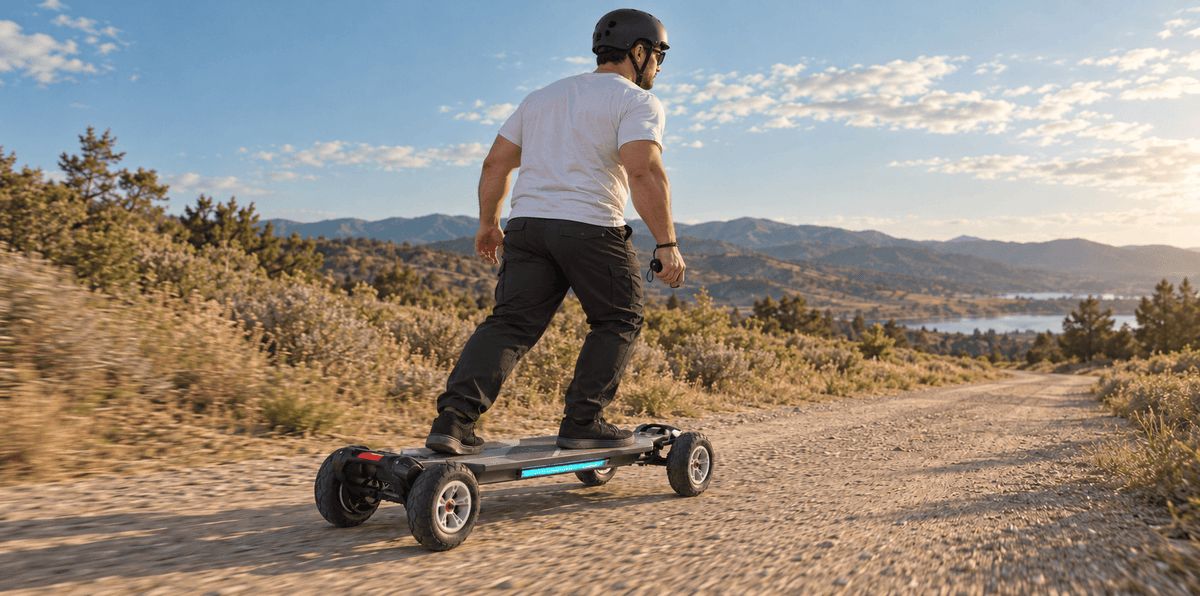
The distinction that matters most is whether dirt is an occasional crossing or the reason for the ride. For planned off-road outings, the Cyber Ultra offers two pneumatic configurations: 175mm tires with belt drive and 165mm tires with hub drive. [1] That gives the trail-focused rider a concrete starting point beyond conventional street wheels.
Maxfind describes the Ultra’s 175mm tires as having a widened contact surface for grip and stability, a puncture-resistant pneumatic design, and shock absorption for rough terrain. [1] Their water-channeling tread is intended to reduce splashing. [1] These construction claims explain why the belt-drive pneumatic setup is relevant to uneven routes, but they do not establish traction on wet grass. The same detailed construction description should not be transferred to the Ultra’s 165mm hub-drive tires.
Owner experiences help put the intended use into context. In a customer review on Maxfind’s website, Chris P. reports that the Ultra’s 175mm air tires soften small rocks on a short packed-gravel stretch and take the edge off rough pavement seams; the account does not identify the drive configuration, rider weight, speed or moisture conditions. [1] Marcus K. separately describes comfortable riding over gravel and rough dirt, without specifying the wheel or drive setup, load, grade or moisture. [1] These are useful owner observations, rather than controlled tests of loose trails or grass.
For predominantly paved commuting, Cyber Max and Cyber Mini Space Wheel variants offer another direction. Cyber Max base and LR versions pair hub motors with 90mm PU wheels, while PRO and X versions pair belt motors with 107mm Space Wheels. [2] Cyber Mini base and AIR versions use 90mm PU wheels and hub drive; PRO and X versions use 107mm Space Wheels and belt drive. [3]
Both the Cyber Max and Cyber Mini descriptions specify 74A urethane, a reinforced nylon core, concave tread and ten hollow pockets in their 107mm Space Wheels. [2][3] Maxfind explains that the pockets allow the soft polyurethane to flex for rough-road cushioning. [2][3] This makes those configurations relevant when broken pavement and road seams dominate the commute. Their cushioning comes from the documented urethane construction, rather than pneumatic inflation.
Ko F., a 135 lb Cyber Max PRO owner in Denver, reports smooth local riding with a little dirt or grass when needed, while describing the trucks as stiff and the board as favoring speed stability over maneuverability. [2] The account supports an occasional mixed-surface use case, with grade and moisture unspecified. It does not describe a sustained trail ride under a heavier load.
The smaller street-wheel setup deserves a different expectation. Karel S., a 90kg Cyber Mini owner whose review mentions delivery to the Czech Republic, reports crossing some bumps on 90mm wheels but losing comfort, and finding really smooth surfaces preferable for comfortable riding. [3] The variant is unspecified, so this is an individual 90mm-wheel experience rather than a result for every current Mini configuration.
The Ultra includes a drivetrain guard that Maxfind describes as shielding against rocks, gravel and debris. [1] Cyber Max and Cyber Mini instead have documented silicone bumper guards intended to protect the board from impacts. [2][3] Those features address different kinds of contact; neither supplies a measured safe obstacle height.
Before choosing a route with exposed roots, ruts or raised rocks, obtain loaded ground-clearance information for the exact wheel and drive configuration from Maxfind. Wheel diameter and overall board height do not reveal the clearance beneath the lowest component with the rider aboard. A guard is useful protection, but it does not tell you which obstacles the board can clear.
Weather also belongs in the setup decision. Maxfind lists IPX5 for Cyber Ultra, Cyber Max and Cyber Mini, while warning that water can damage each board, water resistance may decrease with prolonged use, and heavy rain should be avoided. [1][2][3] The Ultra’s tread design is therefore not a reason to treat wet grass or muddy trails as approved operating conditions.
For this commuter, explore the Ultra pneumatic options when weekend trail riding is a priority, and the Max or Mini PRO/X Space Wheel configurations when rough pavement dominates. The owner accounts support packed gravel and limited mixed-surface riding. They do not establish reliable passage through every loose-dirt or grassy surface, or freedom from bogging down and falls.
Cyber Ultra, Cyber Max and Cyber Mini each list a maximum load of 330 lb / 150kg. [1][2][3] A 220 lb rider is below that specification, though carried equipment must be included in total load. Load capacity is only the first check: completing a sustained steep climb also depends on drive force, grip and how long the system must deliver power.
The Ultra’s belt-drive version lists 2000W × 2 motor power and 12Nm × 2 torque, while the hub-drive version lists 1500W × 2 and 6Nm × 2. [1] Maxfind gives the Ultra a shared 35% hill-climbing claim. [1] Paired with its 175mm pneumatic tires, the belt version is the more relevant Ultra configuration to explore for this rider’s combined power-and-terrain concern. The hub version pairs its different output specifications with 165mm pneumatic tires. [1]
The Ultra’s electrical configuration includes an LG 21700 50LT battery rated at 15Ah and 648Wh, plus a HOBBYWING V7.0 FOC controller. [1] These identify the battery and controller you would be buying. Battery capacity alone cannot establish sustained current delivery, thermal endurance or loaded climbing torque.
Cyber Max PRO lists 900W × 2, 5Nm × 2 and 35% climbing; Cyber Max X lists 1800W × 2, 6Nm × 2 and the same 35% climbing claim. [2] The base and LR versions list 650W × 2, 5Nm × 2 and 30% climbing. [2] The X’s battery is specified as SAMSUNG 21700 12S2P, 9.6Ah and 415Wh, with a HOBBYWING V6.0 FOC controller. [2] These differences matter when selecting a paved-commute configuration with hills; the series’ highest figures do not belong to every version.
Cyber Mini’s variants differ more sharply:
The Mini battery configurations also stay separate. AIR uses a SAMSUNG 18650 10S1P pack rated at 2.75Ah and 99Wh; the base uses SAMSUNG 18650 10S2P at 4.4Ah and 158.4Wh. [3] PRO uses SAMSUNG 21700 10S2P at 9.6Ah and 346Wh, while X uses SAMSUNG 21700 12S2P at 9.6Ah and 415Wh. [3] Those capacities help distinguish the setups, but they do not provide a duration for climbing a particular hill.
On a grassy ascent, the tires must maintain enough grip to turn available drive force into forward movement. Higher specified motor output cannot establish that grip, and rough-road cushioning does not establish sustained grass-climbing ability. A dry, firm grassy slope and a damp, soft one can present very different demands.
One relevant owner account comes from Roberto G., who describes repeatedly completing a steep daily hill on a belt-drive Cyber Ultra while carrying a heavy work backpack. He reports slowing by a couple of mph near the top and using more battery on hills. [1] His numerical load, hill grade, surface, ascent length, wheels, starting speed and battery state are unspecified. [1] That makes the account encouraging for loaded everyday use, but not a match for a verified 220 lb, 25% grassy climb.
Starting conditions also matter. Mini AIR owner Mejri B. reports climbing what they describe as 30% with some momentum, without giving a grade-measurement method, load, surface, climb length or battery state. [3] This is an owner observation about a momentum-assisted climb, not a running-start recommendation or a replacement for AIR’s official 20% specification.
The documented specifications and these owner accounts do not establish completion of a sustained 25% climb with a 220 lb rider, or effortless climbing on steep grass. To resolve that particular hill, ask Maxfind for a matching loaded-climb account or test protocol identifying total load, measured grade, surface and moisture, ascent length, starting speed and battery state. The power-duration definition, torque measurement location, and sustained battery/controller limits would also help interpret the result.
For the setup itself, the Ultra belt-drive pneumatic configuration remains worth exploring: it combines the relevant tire construction with higher listed output than the Ultra hub configuration. Match that configuration to the actual hill rather than treating a headline grade as a guarantee.

Start the route plan with the wheels you intend to ride. Maxfind’s Ultra reference of 37 miles / 60km uses a 143–154 lb rider cruising at 12.5 mph on flat terrain, in temperatures above 77°F with no wind, and 175mm tires inflated to 40–42 PSI. [1] That pressure is part of the range-test conditions, not a prescribed setting for a 220 lb rider.
The Ultra’s detailed range specifications distinguish three setups: belt drive with 175mm AT wheels at 37 miles / 60km, hub drive with 165mm AT wheels at 37 miles / 60km, and belt drive with 107mm Space Wheels at 56 miles / 90km. [1] The 175mm test conditions should not be assigned to the other two wheel configurations; their separate protocols are unspecified.
An owner’s route adds a different kind of reference. Marcus K., at 190 lb, reports an 18-mile Cyber Ultra city ride with hills and traffic, finishing at around 25% battery. [1] The account does not identify initial charge, wheel setup, drive configuration, speed or weather, so it cannot be extrapolated into a full-range figure. [1]
For the Cyber Max, Maxfind gives a 37-mile / 60km manufacturer reference described as tested by a 90kg rider in gears 2/3/4, without identifying the variant, wheels, weather or terrain in that statement. [2] Anthony L. separately reports about 24 miles at approximately 180 lb, mostly in mode 2 and occasionally mode 3, on a mostly flat route with moderate hills, before choosing to recharge with some battery remaining. [2] Anthony’s variant and wheels are unspecified. [2] The two figures describe different conditions and endpoints, so they should not be treated as directly comparable depletion tests.
For Cyber Mini, use the variant-specific published ranges: AIR is listed at 9 miles / 15km, base at 15 miles / 25km, PRO at 31 miles / 50km, and X at 37 miles / 60km. [3] Maxfind also gives a 37-mile / 60km reference with a 90kg rider in gears 2/3/4, but that statement does not identify the tested variant, wheels, terrain or weather. [3]
For your commute, compare the intended distance against a reference with the closest load, surface and wheel configuration. For weekends, keep a separate route record of distance, terrain, total rider load, wheel setup, and start/end charge. The published figures do not support a numerical off-road range reduction or a universal return-charge threshold for this 220 lb rider. Shorter routes with straightforward return options provide a practical way to learn the chosen setup’s consumption without planning around a maximum-range claim.
The Ultra’s belt-drive 2 in 1 package includes both 175mm pneumatic tires and 107mm Space Wheels. [1] This is the documented package to explore if you want one electric longboard with distinct weekday and weekend wheel choices.
Amelia G., in an Ultra customer review on Maxfind’s website, reports using street wheels around campus during the week and switching to AT tires for weekends outside town. [1] The review does not specify wheel dimensions or an installation method, so it illustrates the two-use routine rather than a verified swap procedure.
Obtain the wheel-change instructions for the actual Ultra 2 in 1 configuration before planning that routine. The package listing establishes the two wheel sets, while installation hardware, belt adjustment, any controller or wheel-size settings, and completion checks require matching instructions. Keep the process for changing to pneumatic tires and returning to Space Wheels together; do not assume an automatic wheel-size adjustment or a tool-free quick swap.

A useful two-year cost case starts with the exact board, drive and wheel package. A commuter who stays on one wheel set and a rider who alternates between pavement and trails need records that preserve those differences.
Use this accounting framework:
24-month ownership expenditure = initial setup outlay + measured charging expenditure + actual maintenance and repair expenditure.
The amounts remain unknown until purchases and use occur. Dated receipts establish the initial outlay, including any setup items actually purchased. Measured charging energy, paired with the applicable electricity rate, establishes charging expenditure. Service receipts and parts purchases establish maintenance and repair expenditure without assuming component lifetimes.
Tie each expense to the usage record: date, mileage, wheel configuration, paved versus off-road riding, and the reason for the service event. This makes the final total useful. It can distinguish scheduled upkeep from damage repairs and show which expenses accompanied each riding routine.
Chris P. reports checking the Ultra’s tire pressure every week or two and adding air when needed. [1] That is one owner’s routine, not an official maintenance interval or evidence of a two-year service cost. Use Maxfind’s matching maintenance instructions for the selected configuration and record what upkeep actually costs.
There is no actual 24-month ownership total for this prospective case. A cost-per-mile or cheapest-to-own verdict would need the completed expense and mileage records. Choose the terrain configuration first, then let real charging, maintenance and repair expenses establish its ownership cost.
A 35% grade is approximately 19.3 degrees, not 35 degrees. Percentage grade is vertical rise divided by horizontal run, multiplied by 100. The angle is therefore arctan(0.35).
Maxfind advertises 35% climbing for the Cyber Ultra and selected Cyber Max and Cyber Mini variants. [1][2][3] Converting that percentage into an angle explains the geometry of the rating; it adds no loaded-climbing test result.
Maxfind’s Cyber Ultra, Cyber Max and Cyber Mini FAQs instruct owners to use a hairdryer to dry the charging port and motor after a wet ride. [1][2][3] Those FAQs also warn that water can damage the board and recommend avoiding heavy rain. [1][2][3]
The instruction gives no heat setting or drying duration, so it should not be expanded into a complete water-damage recovery procedure. [1][2][3]
Compartir:
Best Black Friday Electric Scooter Deals: MAXFIND G5 Guide