

Garantía de precio de «Black Friday» 🔒
--
Días--
Horas--
Minutos--
SegundosA high-performance electric skateboard can provide more range, stronger hill-climbing ability, larger wheels, and greater stability on demanding routes. However, the upgrade also brings extra weight, cost, and capability that many riders may never use. The right choice depends less on the largest numbers and more on where, how far, and how often you ride.
The categories are not defined by one universal specification. Motor output, battery capacity, drivetrain, wheels, deck dimensions, weight, and control behavior all contribute to how a board fits its intended rider.
An entry-level electric skateboard generally focuses on predictable operation, paved-road usability, manageable weight, and a lower purchase cost. This does not necessarily mean that the board is slow or limited to beginners. Some current compact boards can reach speeds that already exceed what many commuters need, so riders must still learn controlled acceleration and braking.
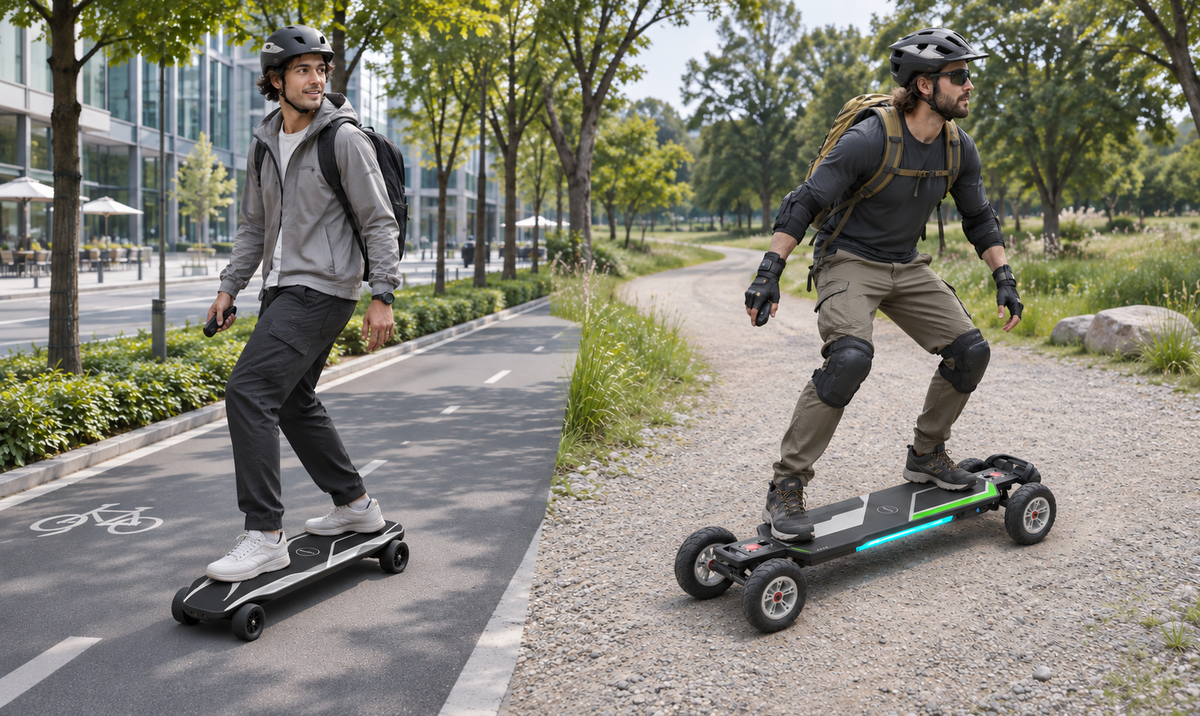
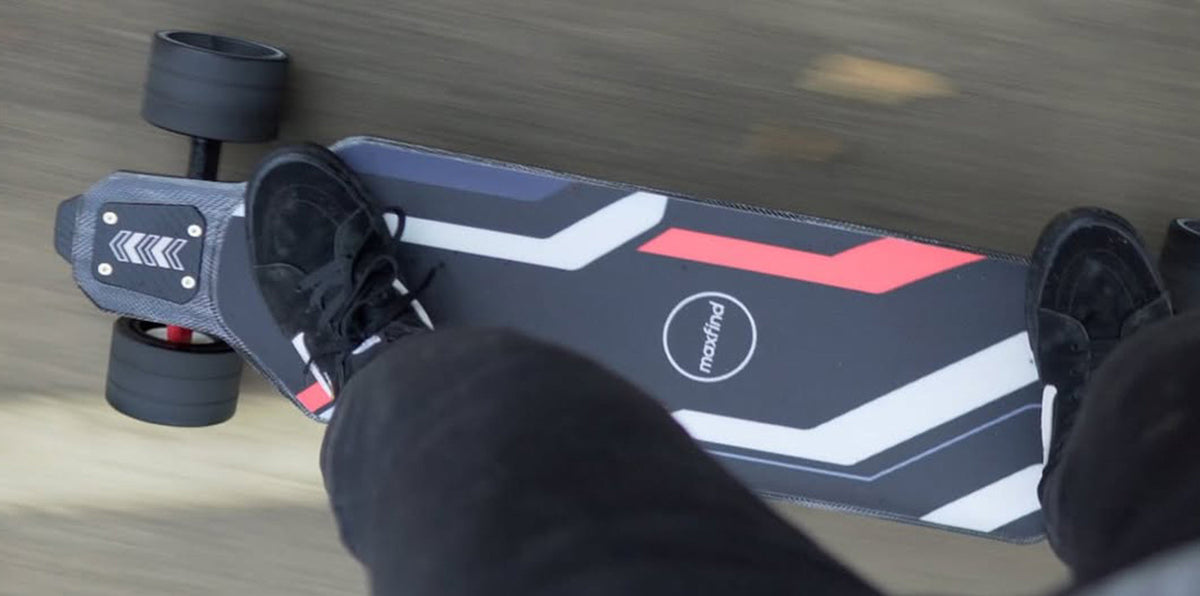
The standard MAXFIND CYBER MINI, for example, is listed with dual 650W motors, a manufacturer-rated top speed of 28 mph, a range of up to 15 miles, 90mm polyurethane wheels, and a weight of 16 pounds. Its shorter deck and lower weight make it easier to store or carry than a large all-terrain board, although the smaller wheels provide less isolation from broken pavement.
Riders comparing an electric skateboard for beginners should therefore examine the exact configuration rather than assuming every entry-level model has modest performance. Smooth controls, route suitability, carrying weight, and sufficient braking space matter more than the category name.
A high-performance electric skateboard usually combines a larger battery, more powerful motors, a longer or wider platform, and wheels intended for higher speeds or rougher surfaces. These changes can make longer journeys, sustained hills, and mixed-surface routes more practical, but they also make the board heavier and more demanding to transport.
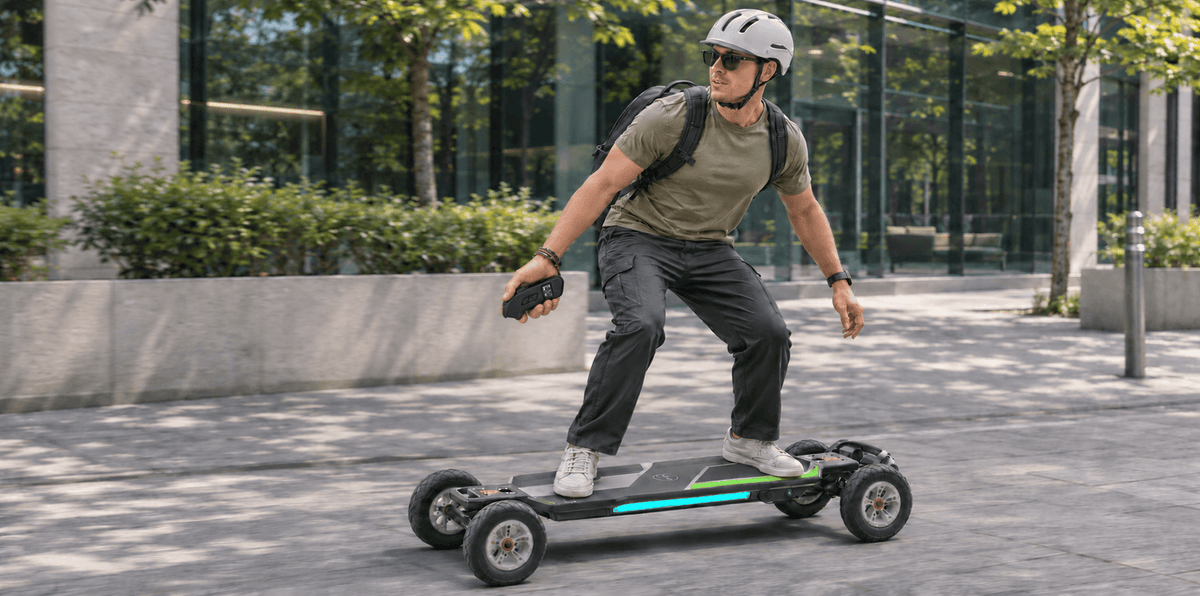
The MAXFIND CYBER ULTRA illustrates this difference. MAXFIND lists a 648Wh battery, a 29-pound weight, and several configurations. The belt-drive version is rated at up to 37 mph, with up to 37 miles of range on 175mm pneumatic tires or 56 miles with 107mm street wheels. These are manufacturer ratings rather than guaranteed results; rider weight, speed, hills, tire pressure, temperature, and surface conditions can substantially change actual range.

This comparison shows how the two categories generally differ in everyday ownership. Exact specifications still depend on the selected model and configuration.
| Decision factor | Entry-level board | High-performance board |
|---|---|---|
| Best suited to | Learning, short trips and paved routes | Long rides, hills and demanding surfaces |
| Motor response | Usually easier to manage at moderate speeds | Greater acceleration and power reserve |
| Battery | Smaller and easier to carry | Larger capacity but more weight |
| Typical wheels | Compact polyurethane street wheels | Larger street wheels or all-terrain tires |
| Rough-road comfort | More affected by cracks and coarse pavement | Better vibration isolation with suitable wheels |
| Portability | Generally easier to carry and store | Often inconvenient on stairs or public transit |
| Maintenance | Hub-drive setups can require less routine work | Belt drives and pneumatic tires need more attention |
| Purchase decision | Lower cost and fewer unused capabilities | Higher cost justified by demanding routes |
| Learning demands | Still requires practice and protective equipment | Extra performance increases the consequences of mistakes |
A larger battery does more than extend the advertised range. It can provide a wider planning margin for detours, cold weather, hills, and battery aging. Likewise, larger wheels may improve comfort and obstacle clearance, but they add weight and can change acceleration, braking feel, and energy consumption. Comparing electric skateboards by top speed alone misses most of these practical differences.
The upgrade becomes worthwhile when additional capability solves a repeated problem on your normal route. It is less compelling when the decision is based mainly on owning the fastest specification.
A high-capacity board makes sense when your normal journey approaches the useful range of an entry-level model. Riders should not plan a commute around the full advertised maximum because range testing conditions may differ from daily traffic, temperature, hills, and riding style. Keeping a reserve also reduces the chance of finishing a ride with weak performance or having to carry the board home.
Consider the complete journey rather than its one-way distance. A six-mile commute becomes a 12-mile round trip, and errands or route changes increase that figure. In this situation, a larger battery can reduce charging frequency and offer a useful buffer. If the board can be charged reliably at the destination, however, a lighter model may still be more practical.
Powerful motors and a larger battery can be valuable when a route contains sustained climbs. The benefit is not simply a higher maximum hill rating; it is the ability to maintain usable power without depending on the board’s limit on every climb. Rider weight, battery charge, wheel size, surface grip, and temperature all influence hill performance.
Published hill-climbing percentages should be treated as manufacturer ratings rather than promises for every rider. A short test slope under favorable conditions is different from a long climb followed by traffic stops. Riders facing frequent hills may benefit from a high-performance setup, while someone traveling across flat neighborhoods may gain little from the extra motor capacity.
Large wheels or pneumatic tires can make a more noticeable difference than additional speed when a route contains patched asphalt, cracks, compacted gravel, or uneven joints. Pneumatic tires absorb more vibration and roll over larger surface irregularities more easily than small polyurethane wheels. They also require pressure checks and can be punctured.
The CYBER ULTRA’s available all-terrain and street-wheel configurations show why wheel choice should be part of the upgrade decision. Its 175mm pneumatic tires prioritize mixed-surface comfort and clearance, while the 107mm street setup is rated for greater range on maintained roads. Riders seeking an off road electric skateboard should still distinguish firm paths from deep sand, loose gravel, mud, or technical trails. Larger tires improve capability, but they do not make every surface safe.
Longer decks, wider trucks, and larger tires may make a board feel more settled, but high-performance hardware does not automatically make high-speed riding safe. Stability also depends on truck adjustment, bushings, rider stance, road condition, wind, protective equipment, and experience.
The most useful upgrade is often greater stability at the speed you already ride—not access to a higher maximum speed. If an entry-level board feels unsettled because of unsuitable wheels, a short platform, or a mismatch with the rider’s route, a better-suited setup may provide more confidence without requiring the rider to travel faster.
An entry-level model remains the more sensible option when most rides are short, paved, relatively flat, and interrupted by carrying or storage. A 29-pound all-terrain board can be manageable when it travels directly from a garage to the road, but it is far less convenient when the trip includes apartment stairs, a train platform, or several indoor destinations.
Lower weight can provide more everyday value than unused range. A rider traveling three miles on smooth pavement may benefit more from a compact board that is easy to lift than from a large battery intended for journeys several times longer. Smaller street wheels can also be efficient on maintained surfaces, while hub-drive configurations generally avoid the exposed belts and pulleys associated with belt-drive maintenance.
New riders should not buy additional speed as a substitute for learning. Even an entry-level board can accelerate quickly enough to cause a fall. Practice starts, progressive braking, turning, and foot braking in a clear area while using an appropriate helmet, wrist guards, knee pads, and elbow pads.
Before paying for additional performance, evaluate the route and ownership demands in this order:
If the upgrade solves several recurring limitations—such as insufficient range, repeated hills, harsh roads, and poor stability—it may provide meaningful value. If it only increases the top-speed number, the lighter and less expensive board is usually the more rational purchase.

A high-performance electric skateboard is worth upgrading to when longer routes, sustained hills, rough surfaces, or mixed-terrain riding regularly exceed the practical limits of a lighter board. For short paved trips with frequent carrying, an entry-level model is usually easier to own and may deliver all the performance the rider can realistically use.
Not automatically. Larger wheels and a more stable platform may improve control on suitable surfaces, but greater speed, weight, and acceleration can increase risk. Safety depends on route choice, riding speed, equipment condition, protective gear, and rider skill.
Choose enough rated range to cover the full trip with a reserve rather than planning around the published maximum. Hills, fast acceleration, cold weather, rider weight, tire pressure, and rough surfaces can reduce actual range.
No. Belt drives can provide strong torque and more wheel options, but the belts and pulleys require inspection and eventual replacement. Hub drives are generally quieter and simpler to maintain, making them practical for many paved commutes.
A beginner should avoid using performance that exceeds their control skills. Some high-performance boards offer manageable riding modes, but their weight, acceleration, and speed potential still demand caution. A lighter board that fits the route is often easier to learn and handle.
More reading: Electric Skateboard for Beginners: What to Check
Compartir:
A Black Friday Electric Skateboard Gift They'll Actually Use
How to Plan Electric Skateboard Range So Battery Sag Does Not Cut a 20-Mile Ride Short