

Garantía de precio de «Black Friday» 🔒
--
Días--
Horas--
Minutos--
Segundos Quick Answer: Match the wheels to the roughest surface you ride regularly. Compliant street wheels suit occasional rough blocks, while pneumatic tires deserve priority for persistent coarse pavement. [1] Within Maxfind’s range, Cyber Mini and Cyber Max are street-to-rough-pavement choices depending on configuration, while Cyber Ultra with pneumatic tires is the closest fit for a mixed pavement-and-trail shortlist. [1][2] For dirt, grass, and steep climbs, base the decision on the actual surface and rider load rather than assuming an all-terrain label covers every route.
A cracked commute and a dirt trail create different problems. Continuous rough asphalt calls for cushioning. Deep gaps, raised edges, and debris may require a different line, a different route, or a short walk. [1] Making that distinction helps prevent a wheel upgrade from turning into an expectation that you can ride through every obstacle.
Start with a simple route check:
For weekend riding, describe the terrain precisely. A firm, visible dirt path is a different requirement from a rutted trail, deep loose material, or grass that conceals the ground. Wheel diameter and tire construction should be at the start of the shortlist. Traction, clearance, and the ability to inspect the route determine whether you should proceed.
Also check whether electric skateboards are permitted on the intended route. Suitable surface and suitable hardware only matter where riding is allowed.
The wheels meet each irregularity before the deck can soften the remaining movement. Larger diameter helps a wheel roll over small irregularities, while the material’s ability to deform adds cushioning. [1] That is why “large wheels” is an incomplete description: size and construction work together.
90mm polyurethane street wheels provide the smaller-wheel baseline for maintained asphalt and concrete. Large cracks, raised joints, gravel, and debris feel more pronounced than they do on larger-wheel setups. [1]
107mm hollow-pocket street wheels add both diameter and material compliance. Soft polyurethane can flex around the hollow pockets, providing cushioning within a street-wheel design. [1] This is a useful direction when most of a commute is paved and the rough sections are limited.
Pneumatic tires contain air and deform over the road surface. They become more relevant when coarse pavement or repeated transitions dominate the journey, provided you accept their upkeep and carrying bulk. [1] Tire pressure, rider load, speed, and pavement condition all affect the resulting feel. [1]
Deck flex is the second layer. The platform bends slightly under load, which can soften small movements and reduce a rigid feeling underfoot. It works best with wheels that already suit the route. [1] During a controlled trial, notice whether you can keep your knees relaxed, prepare for braking, and stand comfortably without constant bracing. [1]
For a commute longer than 10 miles, separate the repeated buzz of ordinary road texture from sharp impacts at joints. A flexible platform may soften the buzz; deep cracks and raised edges still require speed reduction and line choice. [1] Choose the setup that addresses the repeated surface problem, then plan around the isolated hazards.

For a heavier rider, “handles hills well” should mean completing the relevant climb with usable control and traction, not merely reaching a short steep section.
A 25% grade rises 25 units for every 100 units of horizontal distance. It is not a 25-degree slope. Record the grade, the length of the climb, and whether you must start from a stop partway up. Include your riding gear and carried load when considering the board’s load limit.
Read the climbing specification alongside the rest of the drive system:
For a 220 lb rider facing a daily 25% hill, prioritize the exact higher-output configuration and a controlled demonstration under comparable load and surface conditions. Keep a practical walking or rerouting option until the board’s behavior on that route is familiar, and plan the descent as carefully as the ascent.

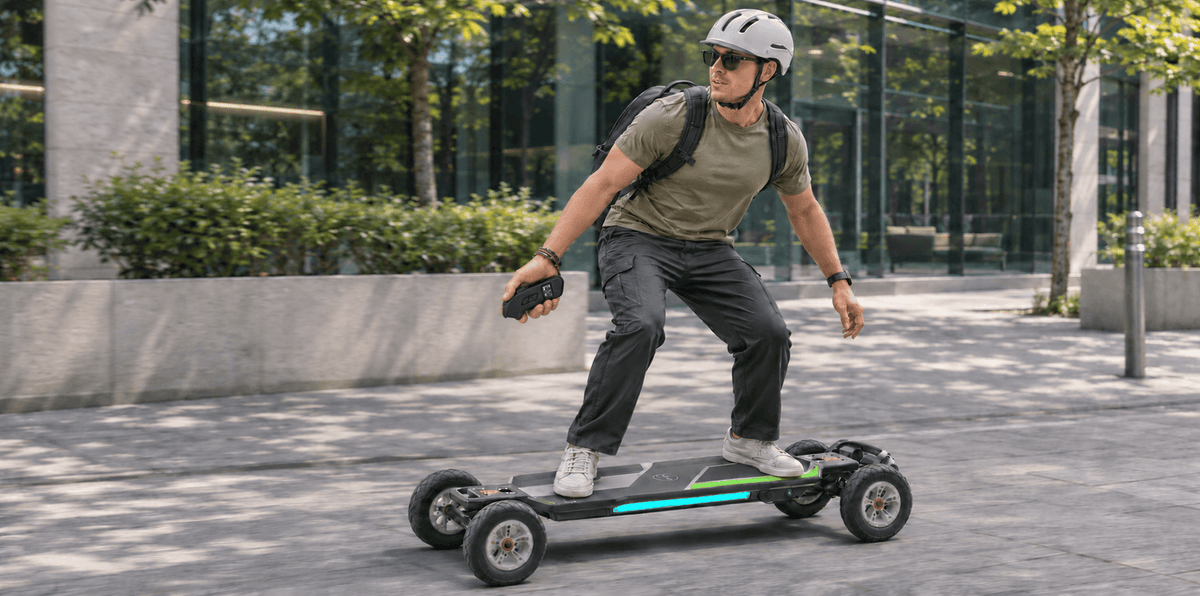
The three Cyber lines are most usefully separated by wheel configuration and intended role. Cyber Mini is the convenience-oriented shortboard, Cyber Max is the commuting electric longboard, and Cyber Ultra is the all-terrain-oriented option. [3]
| Product line | Concrete wheel configurations | Practical route fit |
|---|---|---|
| Cyber Mini | Mini and Air: 90mm PU wheels. Pro and X: 107mm Space Wheels. [4] | Smaller-format urban choice. Prioritize Pro or X when you want additional cushioning within this line while keeping the route mainly paved. [1] |
| Cyber Max | Standard and LR: 90mm PU wheels. Pro and X: 107mm Space Wheels. [5] | Paved commuting with limited rough stretches. Cyber Max X is the street-focused fit when avoiding inflation and puncture repairs matters. [1] |
| Cyber Ultra | Belt: 175mm pneumatic tires. Hub: 165mm pneumatic tires. Belt 2-in-1: 175mm pneumatic tires plus 107mm Space Wheels. [1] | Closest mixed-terrain shortlist option. The 175mm belt setup also fits persistent rough pavement when carrying is limited and tire upkeep is acceptable. [1][2] |
The 107mm Space Wheels described for Cyber Mini and Cyber Max use 74A urethane, a reinforced nylon core, and 10 hollow pockets that allow the polyurethane to flex. [4][5] That construction gives a concrete reason to consider those configurations for rough pavement, without equating them with pneumatic trail tires.
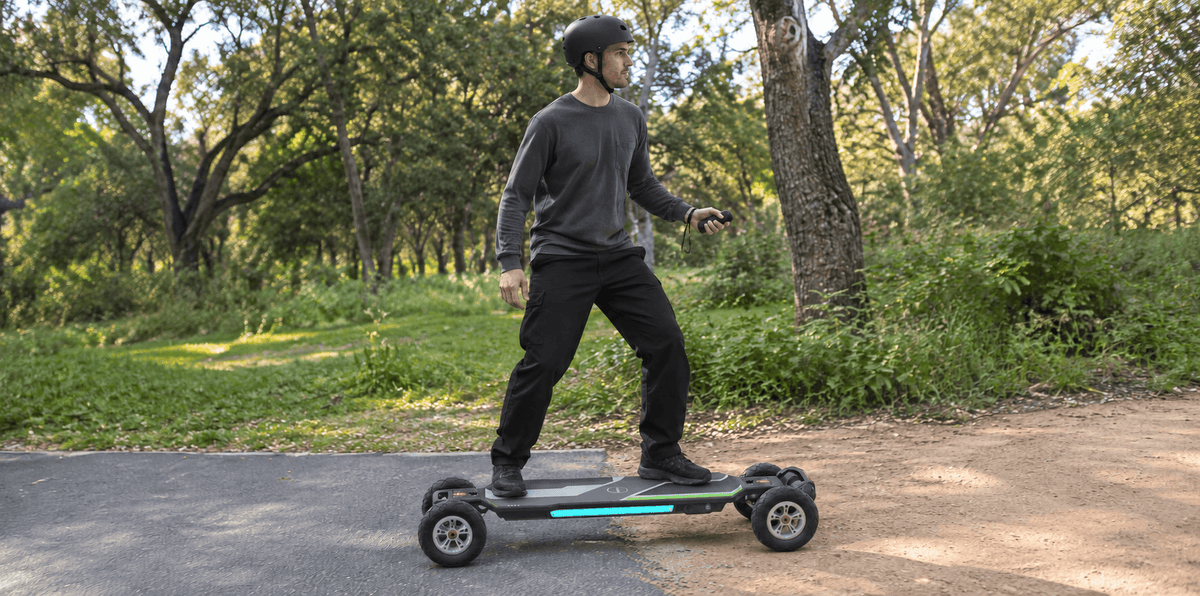
For a weekday commute plus occasional dirt-and-grass riding, Cyber Ultra’s pneumatic configurations are the more relevant starting point. Its belt 2-in-1 option provides off-road and street setups in one board. [2] Choose it for the ability to match the installed wheels to the ride, rather than expecting the street-wheel configuration to behave like the pneumatic one.
Carrying deserves an exact-model check, even within the compact line. Cyber Mini Air weighs 12.4 lbs, while Cyber Mini X weighs 20.3 lbs; Cyber Max X weighs 24.2 lbs. [4][5] If stairs or transit connections are routine, assess the version you intend to carry.
The following figures are Maxfind’s specifications, not measured results for a 220 lb rider on a sustained 25% climb.
| Product line | Motor power and motor torque by configuration | Hill-climbing specification |
|---|---|---|
| Cyber Mini | Air: 650W, 5Nm. Mini: 650W × 2, 5Nm × 2. Pro: 900W × 2, 6Nm × 2. X: 1200W × 2, 6Nm × 2. [4] | Air: 20%. Mini and Pro: 30%. X: 35%. [4] |
| Cyber Max | Standard and LR: 650W × 2, 5Nm × 2. Pro: 900W × 2, 5Nm × 2. X: 1800W × 2, 6Nm × 2. [5] | Standard and LR: 30%. Pro and X: 35%. [5] |
| Cyber Ultra | Belt: 2000 Watts × 2, 12Nm × 2. Hub: 1500 Watts × 2, 6Nm × 2. [2] | 35% in the line’s performance specification. [2] |
Battery capacity also varies substantially. Cyber Mini Air, Mini, Pro, and X have 99Wh, 158.4Wh, 346Wh, and 415Wh, respectively. [4] Cyber Max Standard has 158.4Wh, LR and Pro have 345Wh, and X has 415Wh. [5] These energy figures help distinguish configurations for route planning, but they do not establish continuous climbing output.
The stronger candidates within the street-oriented lines are Cyber Mini X and Cyber Max X. Cyber Ultra Belt has the highest specified motor power and motor torque in this comparison, which makes it the stronger candidate when steep climbing and pneumatic mixed-terrain use overlap. [4][5][2] Maxfind’s model guides likewise position belt drive for more torque and off-road power, and hub drive for lower maintenance and urban use. [4][5][2]
Reliable sustained climbing at 220 lbs on a 25% grade, including traction and thermal behavior, remains unresolved for these configurations. Use the specifications to narrow the shortlist, then evaluate the exact setup under comparable conditions rather than treating a 35% figure as a guarantee.
Wheel diameter alone does not specify clearance beneath the deck, enclosure, or motors. For routes with roots, rocks, or raised edges, check the lowest components with the rider aboard and assess whether the intended line leaves adequate space. A configuration-specific clearance and motor-protection comparison is still needed before choosing among these lines for obstacle-heavy off-road use. Favor visible, inspectable routes while making that assessment.
Cyber Mini and Cyber Max carry an IPX5 rating, but their water guidance warns that prolonged use can reduce water resistance and that water exposure can cause damage. Avoid riding either line in heavy rain. [4][5]
Cyber Ultra’s directional tread is designed to channel water outward and reduce splash-back. [2] That function does not establish wet braking distance. Choose a dry route when stopping grip is uncertain, especially where wet sections coincide with steep grades.
Whether shopping during Black Friday or at another time, compare the exact drive and wheel configuration. Those details determine the route fit.
Reduce speed before reaching rough pavement, keep your knees gently bent, and make substantial foot-position changes while stopped. Small pressure adjustments belong on smooth, controlled sections. [1]
Inspect unfamiliar ground on foot and account for the return journey: construction, debris, and visibility can change a familiar route. [1] On grass or dirt, proceed only where you can assess the surface and select a clear line. Walk sections that conceal hazards or leave insufficient room to maneuver.
NHTSA’s bicycle-safety guidance offers a useful general road-planning principle: select routes with less traffic and slower speeds, and look ahead for hazards such as potholes, grates, and train tracks. [6] For an electric skateboard route, apply that principle alongside local access rules and your own stopping and handling ability.
Improve one manageable factor at a time—for example, use a smoother connection or lower your speed through a rough block—and notice whether you arrive with less bracing and fatigue. Do not extend the ride to test how much discomfort you can tolerate. [1]
No. Hollow-pocket polyurethane adds cushioning within a street-wheel design, while pneumatic tires cushion through air-filled deformation. [1] Dirt-and-grass suitability also requires usable traction, adequate clearance, and an inspectable route. Large diameter is a starting criterion, not permission to ride through concealed obstacles.
Check total rider load, climb length, surface grip, drive type, wheel size, motor power and torque, and battery support. A 25% grade is a rise of 25 units per 100 horizontal units. Prioritize sustained climbing behavior under comparable conditions rather than relying on a hill percentage alone.
Cyber Mini is the compact convenience choice, with 107mm wheels on Pro and X for added street-wheel cushioning. [1] Cyber Max X fits mainly paved routes with limited rough stretches. [1] Cyber Ultra with pneumatic tires is the closest mixed-terrain option; its 175mm belt setup also suits persistent rough pavement when you accept pressure checks and flat preparation. [2][1]
Compartir:
How to Make a Maxfind Electric Skateboard Commute Feel Smoother on Rough Pavement