

¡Oferta de vuelta a clases! 🏷️ ¡Una excelente relación calidad-precio!
--
Días--
Horario--
Minutos--
SegundosIs an electric scooter a motor vehicle? In the United States, there is no universal answer. Federal classification depends partly on the scooter’s design and intended use, while states and cities apply their own definitions. Those separate rules determine licensing, registration, insurance, speed limits, and where you may ride.
A stand-up electric scooter is not treated as a motor vehicle requiring compliance with federal motor vehicle safety standards under NHTSA’s current import guidance. However, state and local laws may classify the same device as an electric scooter, motorized scooter, vehicle, moped, or another regulated category.
Federal status does not establish whether a scooter is legal to operate on a particular street. Riders must check the rules covering the exact scooter and location. This article provides general information, not legal advice.
The term “motor vehicle” has different meanings in different laws. Federal manufacturing rules and state operating rules answer separate legal questions.
For federal motor vehicle safety purposes, 49 U.S.C. § 30102 defines a motor vehicle as a mechanically powered vehicle manufactured primarily for use on public streets, roads, and highways. This definition applies within the federal motor vehicle safety framework; it does not determine state licensing, registration, or road access.
NHTSA’s current import guidance distinguishes stand-up scooters from motorcycles and motor-driven cycles. It lists scooters without seats that are operated in a stand-up mode among the devices that are not motor vehicles required to meet federal motor vehicle safety standards and be certified for importation.
For purposes of NHTSA’s importation and federal safety guidance, a top speed of at least 20 mph, together with equipment associated with on-road use—such as lights, mirrors, and turn signals—may indicate that a small scooter was manufactured primarily for public-road use.
These federal statements concern manufacturing, certification, and importation. They do not grant permission to operate a scooter on state or local roads.

States establish their own vehicle definitions and traffic rules. A state can exclude a qualifying scooter from its “motor vehicle” definition while still imposing speed limits, equipment requirements, traffic duties, and restrictions on streets or sidewalks. Cities may add further regulations where state law authorizes local control.
The differences among California, Texas, Florida, and New York City demonstrate why the scooter’s location and maximum capability matter as much as its general product category.
California defines a motorized scooter as a two-wheeled device with handlebars, a floorboard designed to be stood upon, and an electric motor or another power source. According to the California Vehicle Code § 21235, an operator must have a valid driver’s license or instruction permit and may not ride on a sidewalk except when entering or leaving adjacent property. Operation is limited to 15 mph, and additional restrictions apply on roads with speed limits above 25 mph.
California does not require standard DMV registration for a qualifying motorized scooter. The current Vehicle Code requires a properly fitted and fastened bicycle helmet when the operator is under 18. Although some California agency pages provide inconsistent summaries of the helmet rule, § 21235(c) expressly limits the statutory helmet requirement to operators under 18; wearing one remains a sensible safety measure for every rider.
Texas creates a separate category called a motor-assisted scooter. Under Texas Transportation Code §§ 551.351–551.352, motor vehicle provisions generally do not apply to a device that meets the statutory definition. Bicycle operating provisions apply unless the scooter-specific law provides otherwise.
Texas law permits a qualifying motor-assisted scooter only on a street or highway with a posted speed limit of 35 mph or less, although the rider may cross a faster road at an intersection. It may also be operated on a bicycle-only path or sidewalk. However, the state, a county, or a municipality may prohibit operation in particular places when it determines that a restriction is necessary for safety.
Florida Statutes § 316.003 defines a motorized scooter as a motor-powered vehicle with no more than three wheels that is incapable of exceeding 20 mph on level ground. A scooter meeting that definition is excluded from the general motor vehicle definition.
Under Florida Statutes § 316.2128, qualifying motorized scooters do not require motor vehicle registration, insurance, or a driver’s license. Their operators receive many of the rights and duties applicable to bicycle riders, while local governments may regulate operation on streets, highways, sidewalks, and sidewalk areas.
A scooter capable of exceeding 20 mph does not fit Florida’s statutory motorized scooter definition. Its owner must determine whether another classification or operating restriction applies rather than assuming the exemptions above remain available.

The New York City Department of Transportation identifies an e-scooter as a device weighing under 100 pounds with a maximum capability of 20 mph. A qualifying e-scooter does not require a driver’s license, license plate, VIN, or DMV registration.
Qualifying e-scooters may be operated in bicycle lanes and on streets with speed limits no greater than 30 mph, but not on sidewalks. NYC limits actual riding speed to 15 mph. Riders must be at least 16, and riders who are 16 or 17 must wear a helmet.
A model capable of more than 20 mph falls outside this e-scooter definition even if its rider intends to travel below the 15 mph operating limit. Maximum vehicle capability determines whether the device fits the category; actual riding speed determines whether the operator is complying with the speed rule.
Top speed can affect a scooter’s state or local category, but speed cannot answer the entire legal question by itself. Design, weight, motor specifications, seating, pedals, equipment, and intended use may also matter.
When a statute defines an electric scooter as a device “incapable” of exceeding a stated speed, the relevant figure is the vehicle’s maximum capability—not simply the speed selected during one trip. Riding a 25 mph-capable model at 15 mph does not necessarily convert it into a scooter legally limited to a 20 mph maximum capability.
Removing a speed limiter, installing a different controller, increasing motor power, or making another performance modification may affect the category into which the scooter falls. Riders should evaluate the scooter in its current configuration rather than relying exclusively on its original retail description.
Names such as electric scooter, commuter scooter, seated scooter, and moped-style scooter are not legal classifications. NHTSA expressly notes that marketing terms do not decide which federal motor vehicle safety standards apply. State statutes likewise control over the terminology used in advertisements.
Classification can determine several practical requirements. These rules must be checked separately because an exemption in one area does not automatically create an exemption in another.
Registration, title, and license plate requirements
Driver’s license or permit requirements
Liability insurance requirements
Minimum rider age and helmet rules
Maximum vehicle capability and operating speed
Access to streets, bicycle lanes, paths, and sidewalks
Required brakes, lights, reflectors, or warning devices
Local parking and shared-scooter restrictions
For example, a qualifying scooter may be exempt from registration while its operator remains subject to traffic signals, direction-of-travel rules, speed limits, and impaired-riding laws.
The safest legal check starts with the exact model and ends with current official rules for the intended route. A general statement about electric scooters cannot replace that process.
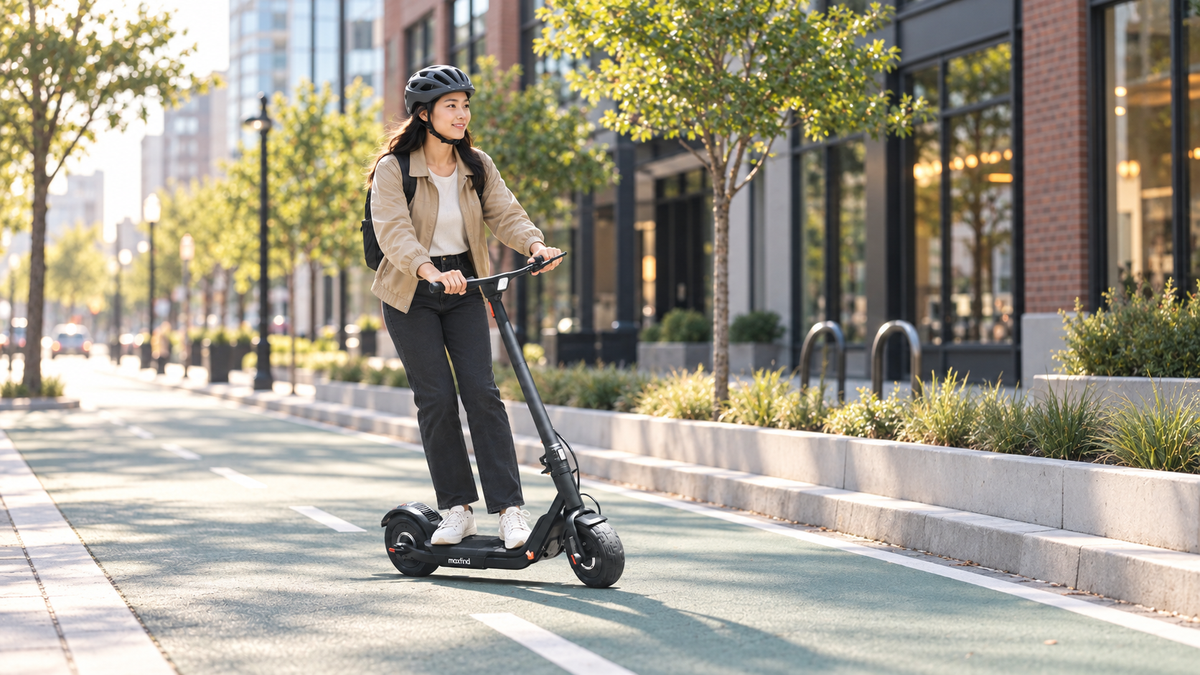
Record the scooter’s maximum powered speed, weight, number of wheels, motor rating, seat configuration, deck design, pedals, lighting, and any modifications. The current MAXFIND GLIDER G5 Series, for example, lists variants with published top speeds of 22 or 25 mph. Those maximum speeds exceed the capability allowed under some state and local electric scooter definitions, including the Florida and New York definitions discussed above.

Owners should check whether their exact variant qualifies as an electric or motorized scooter, falls into another vehicle category, or is restricted from public-road use in their jurisdiction. Its published speed alone does not establish its classification under every law, and selecting a lower riding mode does not necessarily change the vehicle’s legally relevant maximum capability.
Start with the current state code, followed by official DMV or transportation department guidance. Search for all potentially relevant categories, including electric scooter, motorized scooter, motor-assisted scooter, moped, motor-driven cycle, and motorcycle. Read the statutory definition before relying on the operating rules attached to a category.
Check municipal transportation pages and ordinances for sidewalk restrictions, street speed limits, bicycle-lane requirements, parking rules, and minimum ages. Campuses, parks, greenways, transit systems, and private properties may maintain separate access policies.
When official materials do not clearly cover a model, contact the relevant DMV, transportation authority, or local enforcement agency. Provide the exact specifications and request written guidance, particularly when registration, insurance, licensing, or public-road eligibility remains uncertain.
Is an electric scooter a motor vehicle? A stand-up scooter is not a motor vehicle requiring federal safety certification under NHTSA’s current import guidance, but state and local classifications vary. Check the scooter’s maximum capability, design, and local rules before riding it in public.
NHTSA’s current import guidance lists scooters without seats that are operated standing up as devices that are not motor vehicles required to comply with federal motor vehicle safety standards. State traffic laws may still classify and regulate them separately.
It depends on the jurisdiction and the scooter’s specifications. California, Florida, and New York City provide registration exemptions for scooters meeting their respective definitions, but a faster or differently designed model may fall outside those categories.
Requirements vary. California requires a valid driver’s license or instruction permit for a motorized scooter, while Florida and New York City do not require a driver’s license for devices that meet their electric or motorized scooter definitions.
The answer depends on state and local law. California and New York City prohibit sidewalk riding, while Texas permits qualifying motor-assisted scooters on sidewalks unless the relevant government authority adopts a safety-based prohibition.
More reading: How to Ride an Electric Scooter Safely for Beginners

Compartir:
Electric Skateboard Remote Guide: Compatibility, Pairing, and Replacement