

Ofertas del Black Friday. El precio más bajo del año 🏷️
La MAXFIND CYBER MAX es una longboard eléctrica de tamaño completo diseñada para pasear por la calle, hacer carving y recorrer trayectos diarios cortos. Esta reseña se centra en la versión estándar con motores en los ejes y evalúa sus probables características de conducción a partir de las especificaciones publicadas por Maxfind y los detalles de diseño, en lugar de una prueba independiente en carretera.
La línea CYBER MAX incluye varias versiones con diferentes motores, baterías, ruedas y límites de rendimiento. Es importante distinguir estas configuraciones al evaluar el modelo estándar.

Esta reseña analiza la CYBER MAX estándar, con dos motores de buje de 650 W, ruedas de poliuretano de 90 mm y una batería Samsung de 158.4 Wh. Maxfind indica para esta versión una velocidad máxima de hasta 28 mph, una autonomía de hasta 15 millas y una capacidad para subir pendientes del 30 %. Las cifras más altas anunciadas para la línea de productos CYBER MAX corresponden a configuraciones mejoradas, como la CYBER MAX X.
|
Especificación |
CYBER MAX estándar |
|
Motores |
Dos motores de buje de 650 W |
|
Velocidad máxima indicada |
Hasta 28 mph |
|
Autonomía indicada por el fabricante |
Hasta 15 millas |
|
Batería |
Samsung 18650 10S2P, 158.4 Wh |
|
Ruedas |
Ruedas de poliuretano de 90 mm |
|
Tamaño de la tabla |
38 × 11 pulgadas |
|
Ejes |
Ejes forjados Max III de 12 pulgadas y 45° |
|
Modos de conducción |
4 |
|
Tiempo de carga indicado |
Aproximadamente 2 horas |
|
Peso de la tabla |
19.8 lb |
|
Carga máxima |
330 lb |
|
Grado de resistencia al agua |
IPX5 |
La velocidad, la autonomía y la capacidad para subir pendientes reales pueden variar según el peso del rider, la temperatura, el terreno, el modo de conducción y el estado de la batería. El tiempo de carga también puede cambiar según la carga restante, la temperatura, la antigüedad y el estado de la batería, así como el cargador utilizado.
La CYBER MAX estándar está pensada principalmente para carving recreativo, paseos por el vecindario, desplazamientos por el campus y trayectos cortos sobre pavimento en buen estado. Su tabla de tamaño completo y su sistema de motores en los ejes tienen más sentido para quienes priorizan un manejo predecible en la calle y un mantenimiento sencillo que la máxima autonomía o un rendimiento agresivo.
La CYBER MAX combina una plataforma del tamaño de una longboard con una apariencia más angular y orientada a la tecnología. Las dimensiones de la tabla, su forma cóncava, la geometría de los ejes y la electrónica integrada también influyen en cómo se paran los riders y controlan la tabla.
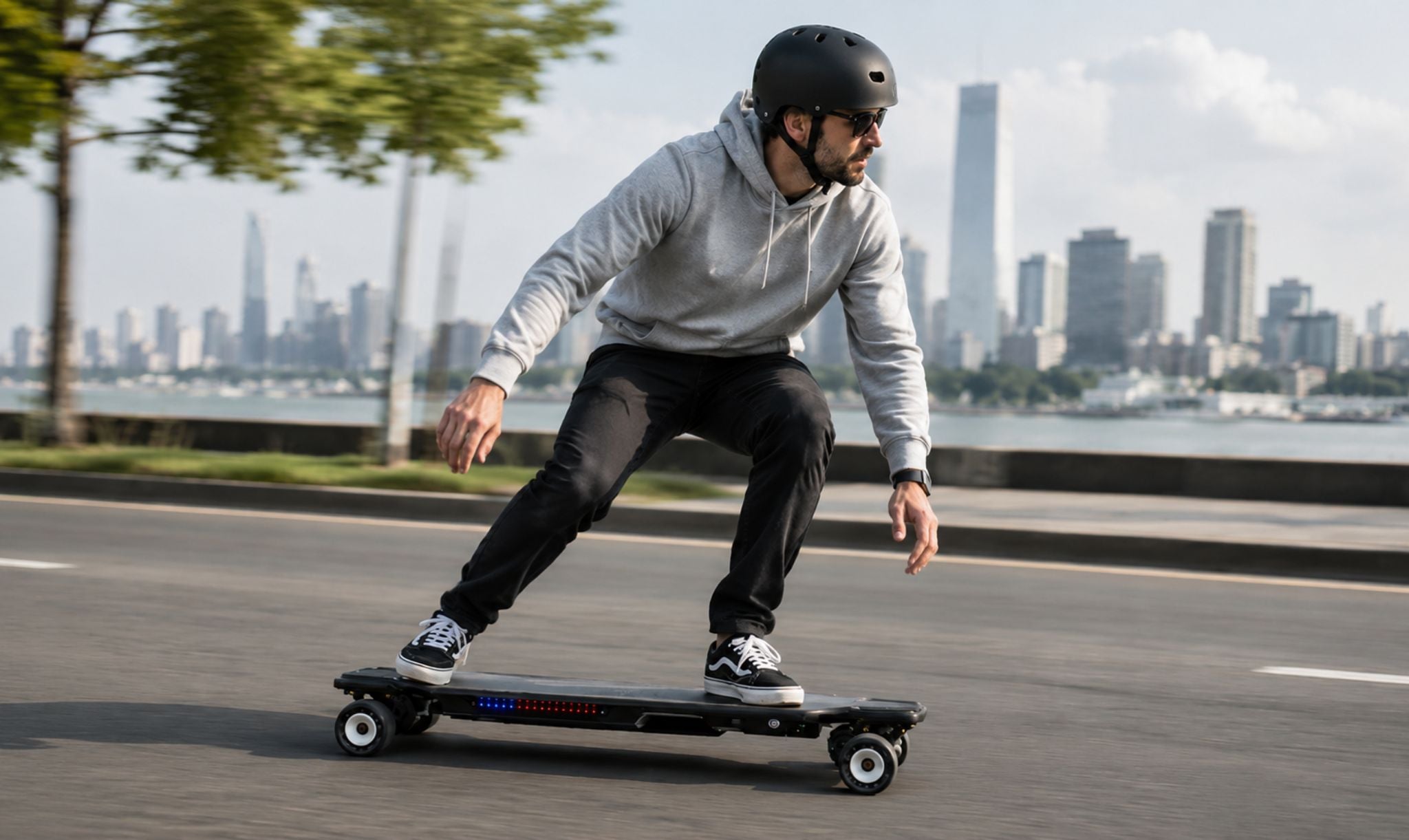
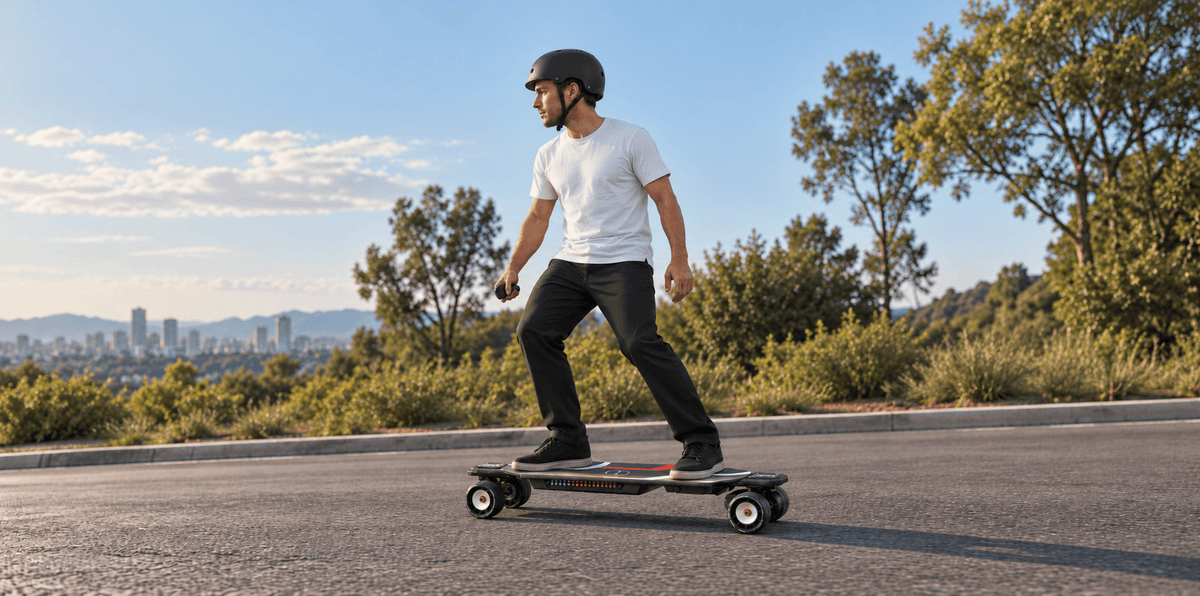
Con 38 pulgadas de largo y 11 de ancho, la tabla ofrece bastante más espacio para pararse que una patineta eléctrica compacta. Los riders pueden adoptar una postura con los pies separados al ancho de los hombros sin apretujarse contra la punta o la cola, y les queda espacio suficiente para ajustar el ángulo de los pies y prepararse para acelerar o frenar.
La tabla combina el compuesto PPS patentado y fibra de vidrio con una superficie mate con aspecto de fibra de carbono. Los protectores de silicona resguardan los extremos, mientras que la carcasa integrada da a la parte inferior un aspecto más limpio que el de las tablas con varios alojamientos de componentes expuestos. El diseño geométrico y la iluminación RGB crean un aspecto distintivo, aunque a quienes prefieren las longboards tradicionales de madera el diseño puede parecerles visualmente agresivo.
Un apoyo para los pies de 7 mm de profundidad y una superficie de agarre con patrón de rombos ayudan a definir dónde se coloca el rider y ofrecen palanca durante los giros de talón y de punta. El perfil cóncavo debería facilitar la percepción de los bordes de la tabla, pero quizá haya que ajustar la postura según la estatura, la talla del calzado y las preferencias de conducción.
La comodidad de marcha depende del efecto combinado de la tabla, las ruedas, la superficie del camino, la velocidad y la postura del rider. El modelo estándar está configurado para circular por la calle, no para aislar de caminos irregulares.
La tabla flexible de Xcomposite cede más que una plataforma corta y rígida, lo que le permite absorber algunos movimientos leves de los pavimentos habituales. Esto puede reducir las vibraciones de alta frecuencia, pero la flexión de la tabla no puede eliminar el impacto de los baches profundos, las juntas elevadas ni el asfalto rugoso. Cuando cambia el estado de la superficie, sigue siendo necesario reducir la velocidad.
Las ruedas de poliuretano de 90 mm son adecuadas para asfalto, caminos de hormigón y otras superficies bien mantenidas. Su diámetro menor mantiene la tabla relativamente cerca del suelo y favorece una respuesta ágil en la calle, pero los baches grandes, la gravilla, las juntas elevadas y los residuos se notarán más que con ruedas de mayor diámetro.
La plataforma ancha y el apoyo para los pies bien definido reducen la necesidad de cambiar constantemente la posición de los pies. Sin embargo, las ruedas de 90 mm aún pueden transmitir las irregularidades del camino durante sesiones largas. Mantener las rodillas relajadas, moderar la velocidad, cambiar ocasionalmente la presión de los pies y elegir bien la ruta suele influir considerablemente en la fatiga.

La CYBER MAX estándar está configurada como una longboard eléctrica estable, no como una mini tabla extremadamente ágil. La respuesta al girar depende de los ejes anchos, el ángulo de la base, los bushings, la concavidad de la tabla y la postura del rider.
La tabla utiliza ejes forjados Max III de 12 pulgadas, con un ángulo de base de 45 grados y bushings de 95A. Junto con la tabla larga, esta configuración favorece los giros amplios y controlados y los carving relajados, en lugar de una dirección muy sensible.
El hueco para los pies permite hacer palanca sobre ambos bordes de la tabla, pero los giros más cerrados requieren aplicar presión deliberadamente con el talón y la punta del pie. La plataforma ancha ofrece espacio para ajustar la postura, mientras que las ruedas de calle mantienen la tabla más baja que las versiones PRO y X, con ruedas más grandes. Los usuarios principiantes deben ir desarrollando poco a poco la capacidad de hacer giros más cerrados, en lugar de aflojar los ejes de inmediato.
Aflojar los ejes suele mejorar la respuesta al girar, pero puede reducir la seguridad al avanzar en línea recta. Apretarlos suele aumentar la estabilidad, aunque exige más esfuerzo para hacer giros amplios. Ajusta ambos lados con pequeños incrementos uniformes y prueba el resultado a baja velocidad antes de usar un modo de conducción más rápido.
La CYBER MAX estándar combina dos motores de buje con un controlador electrónico de velocidad Hobbywing V6.0 FOC y freno electrónico regenerativo. Estos sistemas determinan cómo responde la tabla a las órdenes del control remoto.
La configuración de tracción en el buje y el controlador Hobbywing están pensados para ofrecer una entrega progresiva de potencia. El modo de conducción más bajo es el adecuado para aprender a controlar el acelerador, colocar los pies y calcular la distancia de frenado. Los usuarios deben adoptar una postura estable antes de acelerar, en lugar de intentar ajustar ambos pies después de que se activen los motores.
El control remoto OLED incluye cuatro modos de conducción, que permiten a los usuarios aumentar la respuesta a medida que mejora su control. Los dos motores de 650 W ofrecen potencia suficiente para circular normalmente por la calle, aunque no igualan la mayor potencia de motor de las versiones PRO y X. Los modos más rápidos también generan una mayor transferencia de peso al arrancar y subir pendientes, por lo que los usuarios deben probarlos gradualmente.
El freno regenerativo está diseñado para reducir progresivamente la velocidad de la tabla cuando se acciona el control remoto con suavidad. La distancia de frenado variará según la velocidad, la pendiente, el peso del usuario, la tracción disponible y el estado de la batería. Probar el freno a velocidad de caminata ayuda a los usuarios a familiarizarse con su respuesta antes de circular entre el tráfico, por pendientes o en zonas concurridas.
Más allá de las especificaciones técnicas, la facilidad de uso diario depende de lo sencillo que les resulte a los usuarios mantener la velocidad, leer el control remoto, ajustar la configuración y guardar la tabla entre paseos.
La tabla larga, los ejes anchos, los bujes firmes y la geometría de 45 grados de los ejes favorecen una configuración relativamente estable para ir de paseo. Esto resulta útil en tramos rectos más largos, donde una sensibilidad excesiva al giro puede causar cansancio. Aun así, los usuarios deben evitar tratar la velocidad máxima indicada de 28 mph como una velocidad de paseo habitual sin comprobar antes la configuración de los ejes, las condiciones de la vía y la distancia de frenado disponible.
El mando OLED permite controlar la aceleración, el frenado, los modos de conducción y la activación de la tabla sin necesidad de usar el teléfono durante el recorrido. La correa de muñeca debe permanecer sujeta para reducir las probabilidades de que se caiga el mando durante una parada inesperada o al bajarse de la tabla.
El CYBER MAX es compatible con la aplicación inteligente Tuya de Maxfind, mientras que el mando OLED sigue siendo el principal control durante la conducción. Las funciones disponibles en la aplicación pueden variar según la versión del firmware y de la aplicación, por lo que los usuarios deben seguir la guía de conexión más reciente de Maxfind.
El modelo estándar tiene la batería más pequeña de la gama CYBER MAX actual. Está pensado para recorridos repetibles de distancia corta a media, no para trayectos largos sin acceso a un punto de carga.
Maxfind indica que la batería de 158,4 Wh ofrece una autonomía de hasta 15 millas. Los usuarios deberían planificar recorridos bastante más cortos que ese máximo y dejar un margen de reserva, en lugar de depender de toda la distancia anunciada. Sus usos más realistas son los desplazamientos cortos, los recorridos por el campus, las salidas por el vecindario y los paseos recreativos.
La velocidad alta, las aceleraciones frecuentes, las cuestas, el clima frío, el pavimento irregular y las cargas más pesadas suelen reducir la autonomía disponible. Quienes dependan de la tabla para desplazarse deben calcular el recorrido completo de ida y vuelta y no considerar la autonomía anunciada por el fabricante como un resultado garantizado en todas las condiciones.
El tiempo de carga indicado es de aproximadamente dos horas con el cargador UL de 1,5 A incluido. El tiempo real dependerá de la carga restante de la batería, la temperatura, la antigüedad y el estado. La tabla debe cargarse en un lugar seco y ventilado, con el cargador especificado y siguiendo las instrucciones vigentes para el cuidado de la batería.
Un longboard eléctrico de tamaño completo puede ser cómodo en carretera, pero menos práctico cuando hay que cargarlo o guardarlo. El CYBER MAX incluye un asa extraíble, aunque sus dimensiones generales siguen siendo importantes.
El modelo estándar pesa 19,8 libras. Para muchos usuarios, llevarlo desde un vehículo hasta un edificio debería ser manejable, pero caminar durante mucho tiempo o subir varios tramos de escaleras puede resultar cansado. El asa extraíble ofrece un agarre más seguro que sujetar la tabla por un eje y se puede quitar cuando no se necesita.
La tabla de 38 por 11 pulgadas cabe en muchos maleteros, debajo de escritorios más grandes o apoyada contra una pared, pero no en una mochila ni en una taquilla compacta. Quienes combinen la tabla con el transporte público deben pensar cómo llevarla y manejarla en espacios concurridos.
El CYBER MAX incluye diez modos de iluminación ambiental RGB. Estas luces pueden mejorar la visibilidad para las personas cercanas cuando hay poca luz, pero no sustituyen a la ropa reflectante, una luz para el casco ni a la iluminación exigida por la normativa local. Tampoco debe interpretarse la clasificación IPX5 como permiso para circular bajo la lluvia o por agua estancada sin riesgo.
|
Pros |
Contras |
|
Tabla espaciosa de 38 pulgadas |
La autonomía indicada puede ser insuficiente para rutas más largas |
|
Estables ejes forjados de 12 pulgadas |
Transportar la tabla puede resultar agotador por su peso |
|
Diseño mecánico sencillo con motores de buje |
Las ruedas de 90 mm favorecen el uso en pavimento en buen estado |
|
Cuatro modos de conducción y control remoto OLED |
Menor potencia del motor que el PRO y el X |
|
Tiempo de carga indicado: aproximadamente dos horas |
Sus dimensiones de tamaño completo requieren más espacio de almacenamiento |
|
Asa de transporte extraíble |
Las luces RGB no sustituyen a la iluminación de seguridad específica |
Las principales ventajas del modelo estándar son su tabla espaciosa, su manejo pensado para la calle y su configuración de transmisión por buje relativamente sencilla. Sus limitaciones son más relevantes para quienes necesitan más autonomía, mayor potencia del motor, ruedas más grandes o transportarlo con frecuencia.
La versión adecuada del CYBER MAX depende de la ruta, las características de conducción deseadas y la frecuencia con la que haya que transportar la tabla. Las especificaciones superiores no son automáticamente mejores para todos.
La versión estándar es adecuada para quienes usan principalmente calles en buen estado, carriles bici, campus y caminos vecinales. Sus dos motores de buje y su plataforma de tamaño completo ofrecen una opción sencilla para paseos tranquilos, giros previsibles y un mantenimiento habitual más simple.
El CYBER MAX LR conserva los motores de buje y las ruedas de 90 mm, pero aumenta la autonomía indicada a 31 millas con una batería de 345 Wh. Es más adecuado para quienes circulan por rutas pavimentadas, pero suelen recorrer distancias superiores a las que la batería estándar puede cubrir cómodamente. La batería más grande añade peso.
El PRO y el X tienen motores de correa y ruedas Space de 107 mm, lo que les proporciona una mayor potencia del motor y una mejor capacidad para lidiar con pavimento irregular. El PRO tiene dos motores de 900 W y una autonomía indicada de hasta 34 millas. El X tiene dos motores de 1800 W, un par indicado de 6 Nm por motor y una autonomía de hasta 37 millas y una velocidad máxima de 37 mph. Su mayor rendimiento implica más peso y un mantenimiento más complejo de la transmisión por correa.

El estándar MAXFIND CYBER MAX ofrece una tabla espaciosa, la sencillez de los motores de buje y una configuración pensada para circular por calles de forma controlada. Es una opción práctica para quienes valoran un manejo predecible y no necesitan la autonomía ampliada ni la mayor potencia de las configuraciones más caras.
El LR, PRO y X siguen siendo mejores opciones cuando se priorizan rutas más largas, un rendimiento superior o mayor comodidad sobre pavimento irregular.
Compartir:
Cómo montar una patineta eléctrica en postura goofy
Configuraciones de transmisión y par motor de Maxfind para desplazamientos silenciosos por el campus