

¡Oferta de vuelta a clases! 🏷️ ¡Una excelente relación calidad-precio!

Quick Answer: For an urban commuter who wants to avoid belt upkeep, the Maxfind Cyber Max standard and LR configurations are the natural starting points: both use hub motors, which Maxfind positions as its lower-maintenance urban option. [1] The Cyber Max family has an advertised IPX5 water-resistance rating and a warning to avoid heavy rain. [1] When sustained rain, standing water or flooded curb lanes are likely, choose another way to travel. [2]
Choosing an electric skateboard for everyday use means matching its drivetrain to your pavement—and keeping its battery, controller and exposed interfaces in good condition. The Cyber line offers several relevant construction choices, while a configuration-specific inspection routine helps you spot problems before the next commute.
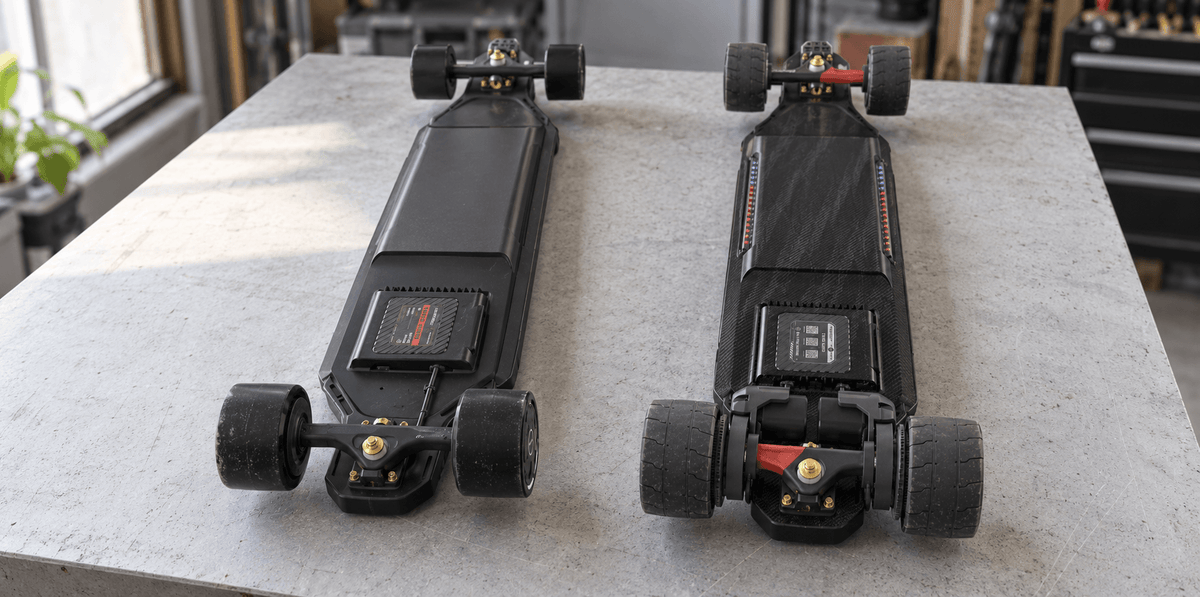
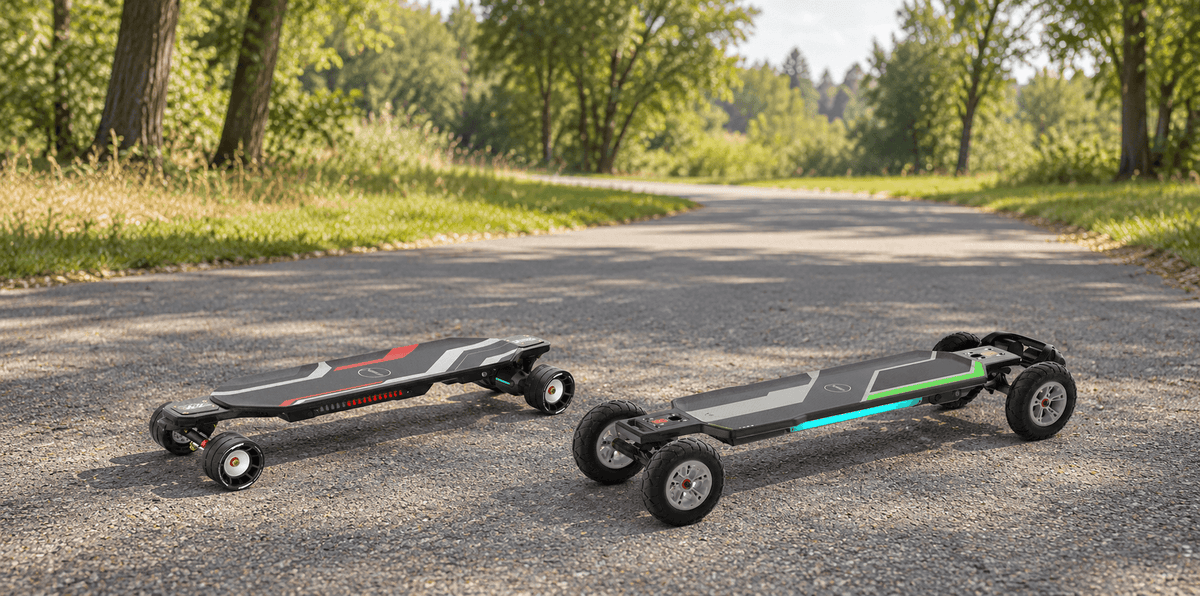
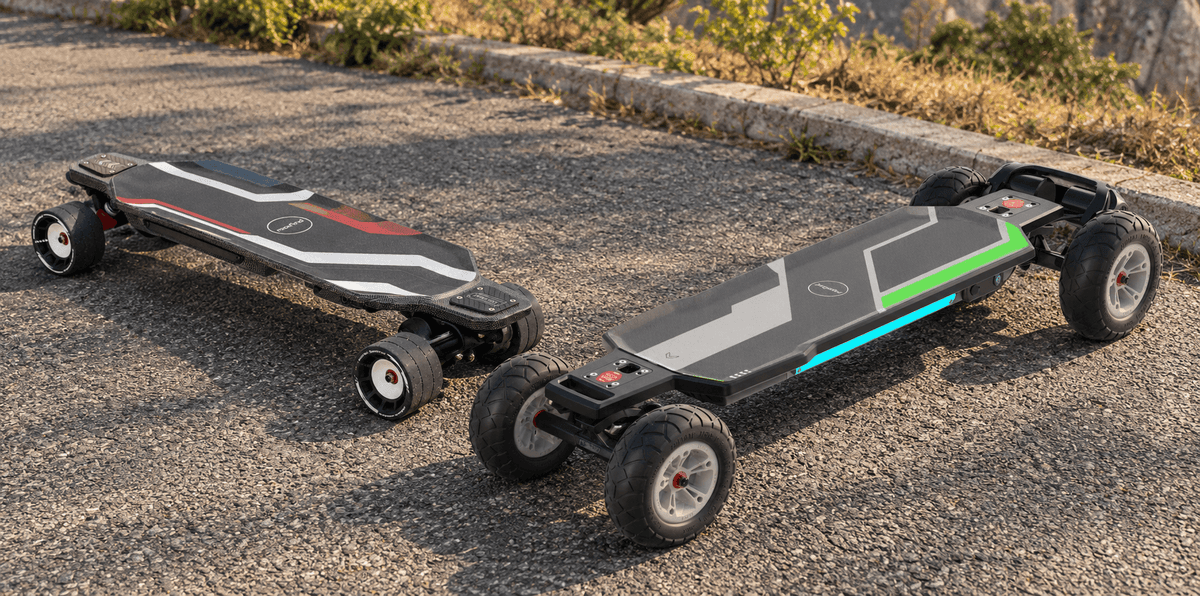
The Cyber Max standard and LR use hub motors with 90mm PU wheels. The Cyber Max PRO and X use belt motors with 107mm Spacewheels. [1] If avoiding belt adjustment and replacement is your main priority, start with the standard or LR: their hub-drive layout removes belts from your maintenance list. Maxfind describes this drive choice as lower maintenance and suited to smoother urban riding. [1]
Rough pavement introduces a different consideration. In his August 26, 2025 review for Electric Skateboard HQ, Paxson Lim reported that the Cyber Max X’s 107mm Spacewheels absorbed road vibration and handled sticks, pebbles and minor potholes comfortably. His reviewed board was the X belt-drive configuration, so the observation applies to that setup rather than the 90mm hub versions. [3] It is useful evidence about ride comfort, not protection against water or grit entering components.
For a mostly smooth commute, the hub configurations align directly with a dislike of belt work. For uneven urban surfaces, explore the PRO or X wheel-and-drive setup if the comfort priority outweighs your preference to avoid belts. The available descriptions and riding report do not quantify repair-frequency differences or establish years of maintenance-free motor operation; routine wheel, bearing and hardware checks remain part of either choice.

Maxfind advertises IPX5 water resistance for the Cyber Max family. Its product FAQ also says prolonged use may reduce that protection and warns that water exposure can damage the board. [1] Treat that rating as a documented product specification with operating limits, rather than a promise that a daily rain commute will leave the electronics unharmed.
Several Cyber Max features address distinct parts of everyday protection:
The battery and electronic speed controller deserve particular care. Maxfind’s general warranty policy explicitly states that internal components are not waterproof. [5] The Cyber Max’s integrated-deck description does not, by itself, explain its battery seals, controller seals, cable entries or connector protection. For those details, request guidance matched to the exact Cyber Max configuration rather than opening an enclosure to investigate.
Owner experience provides some context without resolving those engineering questions. In a September 21, 2026 customer review on Maxfind’s website, Jason C. reported occasional rainy-day riding, an upgraded battery and an expectation of reaching the thousand-mile mark by the end of the following week. The review does not identify the variant, rain intensity or internal component condition. [1]
The practical reliability limit is therefore specific: the family-level IPX5 claim and that owner report do not establish configuration-specific ingress performance, dust protection or a long-term water-damage failure rate. They support considering the Cyber Max alongside careful exposure management—not assuming that its battery and controller are protected under every commuting condition.

Maxfind’s general commuter checklist suggests about two minutes before each commute and about ten minutes for weekly checks. Those are suggested inspection durations, not measured total maintenance time or a limit on how long a repair may take. [4] Use the following workflow with the manual for your exact board and installed drivetrain.
Decide whether the route is suitable before leaving. Check both the forecast and the actual pavement. Maxfind advises leaving the board at home if standing water, sustained rain or flooded curb lanes are likely. [2] Its shared guidance also says to avoid intentional water exposure. [4] This decision protects more than electronics: Maxfind warns that wet surfaces change traction and braking, with rain riding particularly risky during acceleration, braking and turning. [4][5]
Inspect closures and visible components. Confirm that the charging-port cover sits flush and fully closed. Where a removable battery is fitted, check that its latch and enclosure are secured. [2] Look over the wheels, axle areas, trucks and visible hardware for fresh impact damage, moisture, contamination, warning indicators or a new odor. [4] At the enclosure and charging area, also look for deformation or corrosion and pay attention to behavior that differs from the board’s normal baseline. [4] These observations are especially relevant after gritty routes or a knock to the underside.
Check wheel rotation with the power off. Rotate each wheel by hand and check for roughness, side play, rubbing or a sound that repeats once per revolution. [4] Cyber Max has a documented fully integrated bearing system. [1] Use changes in feel or sound as reasons to investigate; the feature description does not supply a bearing-cleaning or lubrication procedure. Follow configuration-matched service instructions before attempting that work.
Manage unexpectedly damp pavement conservatively. If you encounter damp sections, avoid puddles and reduce speed on painted lane markings, metal covers, wet leaves and slick crosswalks. Keep throttle and braking inputs smooth, allow more stopping distance and avoid abrupt carving or acceleration. [2] These precautions address an encountered condition; they do not turn the IPX5 rating into permission to plan a rain commute. If the board gets wet, use the post-exposure sequence in the FAQ before charging or returning it to service.
Give the installed drivetrain a weekly check. Maxfind recommends checking PU wear, bearing feel, wheel play and drive-system condition, along with the charging port, charger cable, remote, lanyard and connectors. [4] On a standard or LR Cyber Max, match the drivetrain inspection to the hub-motor setup; on a PRO or X, include the applicable belt-drive hardware. [1][4] Review new noises, warnings, unusual heat behavior or interrupted commutes rather than treating each as ordinary wear. [4] Belt tension, belt replacement and PU sleeve replacement should follow instructions for the exact configuration, not a generic adjustment value.
Keep observation separate from repair. Use the product manual’s fastener procedure and specified torque values. Overtightening can damage threads, bearings, bushings, composite parts or mounting surfaces; do not add thread-locker, substitute hardware or modify an electrical enclosure unless Maxfind instructs you to do so. [4] Missing hardware, repeatedly loosening fasteners, cracked truck components or movement at a wheel or motor mount make the board not commute-ready. [4] For unresolved problems, Maxfind offers a technician-review route: supply photos and videos, then receive the necessary parts and a maintenance tutorial for an approved self-repair. [5]
This routine keeps the work focused on visible condition, changes from normal operation and the components actually fitted to your electric longboard. It also gives you a clear stopping point when a task requires model-specific service guidance.
The Cyber Mini is worth exploring if you are interested in another Cyber-line board with integrated composite construction. Its own specifications list a PPS-composite and glass-fiber deck with a carbon-fiber coating. [6] Its FAQ advertises IPX5 protection, warns that protection may decline with prolonged use and recommends avoiding heavy rain. [6] That makes deck construction a useful selection feature, without establishing stronger wet-weather protection than Cyber Max.
Cyber Ultra adds a different set of protection-focused details. Its 15Ah LG 21700 50LT battery configuration has BMS monitoring and an aluminum shell that Maxfind describes as waterproof. [7] The BMS addresses electrical battery management, including overcharge and over-discharge protection; the shell is the physical enclosure. [7] These serve different functions, so battery monitoring should not be interpreted as water-ingress protection.
For routes with loose debris, the guard-equipped Cyber Ultra has a drivetrain guard advertised to shield against rocks, gravel and debris. [7] Confirm that the chosen variant includes that guard, since the description does not establish coverage across every selectable configuration.
Cyber Ultra’s all terrain and off road positioning expands the surface-use discussion, but its own FAQ still specifies IPX5 and warns against heavy rain. [7] The manufacturer’s shell description does not override that operating guidance.
Start with Cyber Max standard or LR when avoiding belt upkeep is the leading priority. Explore Cyber Mini for its independently documented integrated-deck construction, or a guard-equipped Cyber Ultra when physical drivetrain shielding matters to your route. Ask Maxfind to confirm the exact drive, wheel and guard configuration before choosing.
Power the board off, wipe the deck, trucks, wheels and underside, and let it air-dry in a ventilated place. [2] The charging port—and removable-battery interface where fitted—must be fully dry before connecting a charger or swapping a battery. [2] Do not charge a board that is wet or may have water damage. [4]
The Cyber Max FAQ recommends using a hairdryer to dry the charging port and motor after wet exposure, but it does not specify a temperature, distance or drying duration. [1] Maxfind’s shared care guidance prohibits high heat on the battery, charging port, seals or electronics. [2] Do not improvise heat settings to accelerate drying; use the ventilated air-drying guidance and ask Maxfind for configuration-specific clarification if needed.
A dry exterior does not complete the return-to-use decision. Maxfind instructs owners to stop routine use after water exposure until the board has been properly assessed. [4] The Cyber Max FAQ does not provide a complete post-ingress assessment or objective restart-clearance procedure. [1] Obtain exact-model instructions or manufacturer assessment before resuming riding, rather than using a trial power-on to decide whether the board is safe.
Maxfind’s published warranty policy requires purchase through its official website for warranty service. It excludes damage caused by misuse, modifications, unauthorized repairs, failure to follow the manual, neglect or abuse. [5] Before working on a sealed electrical component, obtain authorization for the proposed repair so the work follows the manufacturer’s service route.
Wear parts—including wheels, belts, grip tape and PU sleeves—are excluded, with an exception for a defect reported within seven days of delivery. [5] That distinction matters when budgeting for ownership: ordinary belt or sleeve wear is different from a delivery defect.
The policy warns that puddles or submersion can damage electrical components and that internal components are not waterproof. [5] Those warnings alone do not determine whether a particular Cyber Max water-damage claim will be covered. Review the current terms applicable to your US purchase and submit the incident for case assessment before assuming either free repair or automatic rejection.
Maxfind does offer technician-guided self-repair after reviewing owner-supplied photos and videos. [5] Confirm coverage, any costs and authorization for the specific work before proceeding.
Compartir:
Hub vs Belt vs Gear Drive
Range by Rider Weight & Hill Grade