

Garanzia del prezzo del "Black Friday" 🔒
--
Giorni--
Orari--
Minuti--
sAll-terrain electric skateboards are not automatically safer than street boards. Large pneumatic tires may handle cracks, gravel, and uneven pavement more comfortably, while a lower and lighter street board can feel more predictable on smooth roads. The safer option is the board that matches the surface, speed, rider skill, and maintenance conditions.
In an all-terrain vs. street electric skateboard comparison, neither format wins in every situation. All-terrain wheels can improve surface tolerance on rough routes, but their added height, weight, tire maintenance, and performance capability introduce different risks. Street boards are generally more efficient and portable, but small hard wheels are less forgiving when they encounter debris, deep cracks, or broken pavement.
|
Safety factor |
Street board |
All-terrain board |
|
Best-matched surface |
Smooth, maintained pavement |
Rough pavement, packed gravel and suitable trails |
|
Typical wheel system |
Smaller polyurethane or hollow street wheels |
Larger pneumatic tires |
|
Small-obstacle tolerance |
More sensitive to cracks and debris |
Better able to roll over some irregularities |
|
Ride height |
Generally lower |
Generally higher |
|
Weight |
Usually easier to carry |
Usually heavier |
|
Tire maintenance |
No air-pressure checks on PU wheels |
Pressure, tread, valves and punctures require attention |
|
Energy efficiency |
Usually higher on smooth pavement |
Usually lower with large pneumatic tires |
|
Primary limitation |
Abrupt response to poor surfaces |
Added mass, height and maintenance |
These are general tendencies rather than guarantees. Deck shape, trucks, bushings, tire pressure, drive system, controller tuning, rider weight, speed, and braking technique can change how either board behaves.
Wheel size receives most of the attention, but safety depends on the complete board and the conditions in which it is used. A larger tire cannot make an unsuitable route safe, and a street board cannot compensate for excessive speed or poor rider judgment.

Smaller polyurethane wheels provide direct road feedback and low rolling resistance on maintained pavement. Their limited diameter gives them less ability to roll over deep cracks, loose stones, raised joints, and other abrupt obstacles. Contact with a wheel-stopping hazard can slow the board suddenly while the rider’s body continues forward.
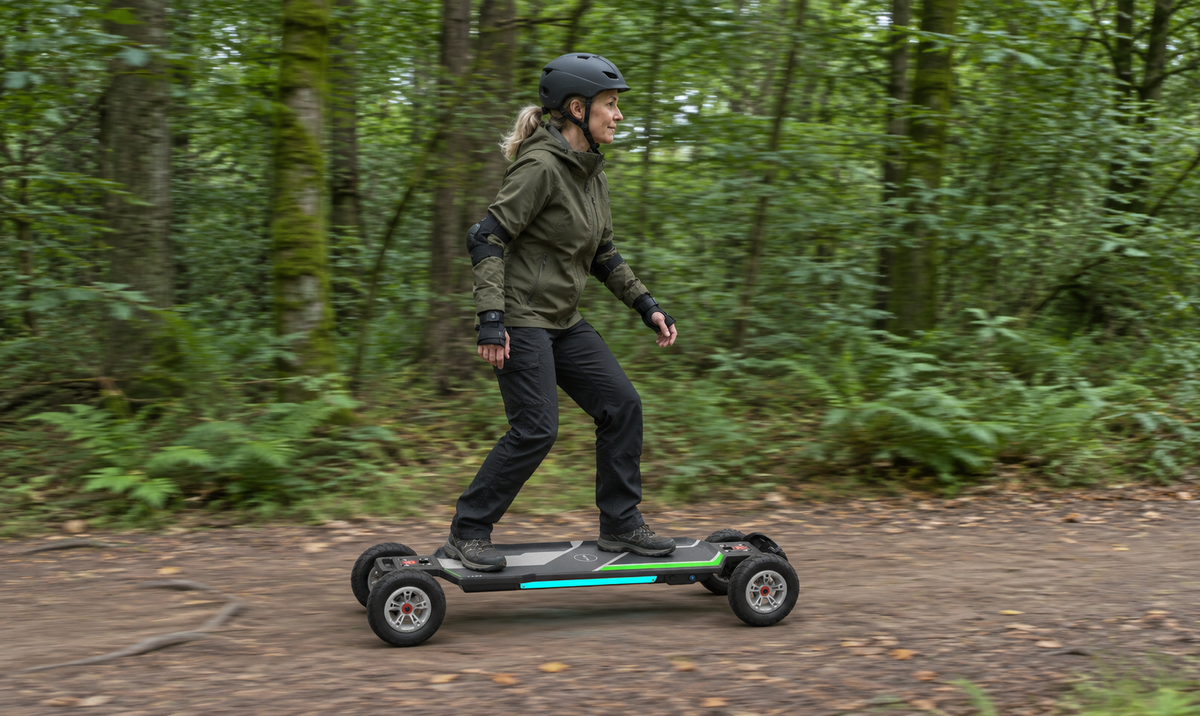
Larger pneumatic tires can deform around shallow surface irregularities and filter more vibration. Their diameter also gives them a better approach angle when meeting some cracks or debris. This makes an all-terrain setup more suitable for rough pavement and firm, predictable off-road surfaces, but it does not mean the rider can ignore potholes, roots, loose gravel, sand, mud, standing water, or unexpected changes in elevation.
Pneumatic performance depends on correct inflation. Low pressure can increase rolling resistance, reduce steering precision, and raise the chance of tire or tube damage. Excessive pressure can make the ride harsher and change the tire’s contact with the ground. Pressure should follow the tire or product instructions rather than being estimated by squeezing the tire.
All-terrain boards are normally heavier and sit higher above the ground because of their larger tires and drivetrain. Extra mass can make the board feel settled over minor irregularities, but it also requires more effort to carry, reposition, or recover after stopping. A higher platform may feel unfamiliar to a rider accustomed to a low street deck.
Street boards usually have a lower center of gravity and less rotating mass. On smooth pavement, this can produce a more direct and efficient riding experience. Their lower weight may also be helpful when a commute includes stairs, station transfers, or sections where riding is prohibited.
Truck design matters alongside wheel size. A responsive truck can turn easily at low speed but may require careful setup and rider adaptation. Truck nuts should not be tightened or loosened without considering rider weight, bushing design, manufacturer guidance, and the effect on steering. A board that turns differently from the rider’s previous setup should be practiced at low speed before normal use.
A board’s maximum speed is not a safety target. Higher-powered all-terrain models may reach speeds that exceed what the surface, visibility, stopping distance, or rider experience can support. Street boards can also become unstable or difficult to stop when ridden too quickly for the available space.
Electric skateboards commonly use electronic or regenerative braking. Braking performance depends on speed, slope, wheel traction, battery and controller behavior, rider stance, and the installed drive configuration. Large tires do not guarantee a shorter stopping distance, and small street wheels do not automatically provide weaker braking. There is no substitute for testing brake response at low speed on a dry, open surface.
Loose materials can reduce usable grip even when a tire has deep tread. Gravel can move under the tire, wet leaves can become slippery, and painted road markings or metal covers can lose traction when damp. Riders should slow before entering a questionable surface instead of relying on the board to correct a poor line after contact.
The U.S. Consumer Product Safety Commission warns that traffic, excessive speed, and loss of control contribute to skateboard injuries. Its general skateboarding guidance recommends protective equipment and riding on smooth paved surfaces away from traffic. Large all-terrain wheels do not remove those basic precautions. CPSC skateboarding safety guidance
MAXFIND currently offers several configurations, so comparisons must use the exact model and installed wheel system. Product-family headline specifications should not be assigned automatically to every version.
|
Specification |
Standard CYBER MAX |
CYBER ULTRA |
|
Main positioning |
Street-oriented electric longboard |
All-terrain electric skateboard |
|
Published wheels |
90mm PU wheels |
175mm pneumatic belt setup or 165mm pneumatic hub setup |
|
Optional wheel format |
Other CYBER MAX versions use different wheels |
Belt 2-in-1 version includes 175mm pneumatic and 107mm street wheels |
|
Published weight |
19.8 lb / 9 kg |
29 lb / 13.2 kg |
|
Published braking system |
Electronic regenerative braking |
Electronic regenerative braking |
|
Practical advantage |
Lower weight and street efficiency |
Greater tolerance for rough approved surfaces |
|
Main trade-off |
Smaller wheels are less forgiving of surface hazards |
Heavier and requires pneumatic-tire maintenance |
The standard MAXFIND CYBER MAX uses 90mm polyurethane wheels and is listed at 19.8 pounds. This configuration makes more sense for maintained streets, bike paths, campuses, and other routes where smaller wheels will not repeatedly encounter deep cracks or loose surfaces. Its lower weight also makes short carries more manageable than a 29-pound all-terrain board.
The MAXFIND CYBER ULTRA uses 175mm pneumatic tires with its belt-drive configuration and 165mm pneumatic tires with the hub version. MAXFIND also lists a belt-drive 2-in-1 option that combines 175mm pneumatic tires with 107mm street wheels. This provides more flexibility for riders who alternate between rough routes and maintained pavement, but wheel changes do not eliminate the need to inspect compatibility, mounting, tire pressure, and brake behavior.
These published specifications describe hardware differences; they are not comparative crash tests or verified stopping-distance results. Riders browsing current electric skateboards should confirm the exact motor, battery, wheel, truck, and weight configuration rather than making a decision from the product-family name alone.

The correct choice begins with the route rather than the board. Inspect the full journey in daylight and identify pavement quality, traffic exposure, intersections, hills, drainage grates, loose material, construction, visibility, and places where riding is prohibited.
Choose a street board when the route consists mainly of continuous, maintained pavement and portability matters. A lower, lighter setup may be the more controlled choice when the rider does not need pneumatic tires and regularly carries the board indoors or onto public transportation.
Choose an all-terrain board when the approved route includes rough pavement, firm gravel, or recurring surface irregularities that are unsuitable for small street wheels. Accept that the board will be heavier and that pneumatic tires introduce pressure checks and puncture risk. “All-terrain” should never be interpreted as suitable for every trail, weather condition, obstacle, or speed.
Before every ride:
Wear a properly fitted helmet and appropriate protective equipment.
Inspect wheels or tires, trucks, visible fasteners, the deck and drivetrain.
Confirm pneumatic tire pressure using the specified method.
Check the board and remote battery levels.
Test acceleration and braking at low speed.
Avoid traffic, standing water, ice, deep sand and unfamiliar hazards.
Reduce speed before rough surfaces, turns, slopes and intersections.
Stop riding if the board develops unusual movement, noise, heat, braking behavior or power loss.
Do not use water-resistance ratings as permission to ride in rain or through puddles. Wet surfaces can reduce traction even when water does not immediately enter the electronics, and hidden water damage may affect the board later.
All-terrain boards can be more suitable for rough approved surfaces, while street boards can be more predictable, efficient, and portable on smooth pavement. Neither is inherently safer. Choose the wheel system that matches the route, ride below the conditions’ limit, wear protective equipment, and maintain the exact configuration you use.
Pneumatic tires can improve comfort and obstacle tolerance on rough surfaces, but they require correct pressure and can puncture. Polyurethane wheels are simpler to maintain and work well on smooth pavement but are more sensitive to cracks and loose debris.
No. Large tires cannot make deep sand, mud, ice, standing water, severe potholes, unstable gravel, prohibited paths, or traffic-heavy routes safe. “All-terrain” describes capability, not unrestricted use.
Additional weight may make a board feel settled in some conditions, but weight alone does not establish stability. Trucks, bushings, wheel setup, deck geometry, speed, rider stance, and surface conditions also matter. A heavier board is also harder to carry and reposition.
A street board may suit a beginner who practices on smooth, open pavement at low speed, but small wheels require careful surface selection. A beginner should prioritize gentle riding modes, predictable braking, protective equipment, and supervised practice over board category.
More reading: How to Evaluate an Electric Skateboard Commute Route

Condividi:
Hub vs. cintura CYBER KIT per la tua build del Black Friday
A Black Friday Electric Skateboard Gift They'll Actually Use