

Promozione per il ritorno a scuola! 🏷️ Ottimo rapporto qualità-prezzo!

Quick Answer: The Maxfind Cyber Max X’s 107mm Spacewheels received favorable qualitative comments about hard-braking grip and light-surface riding from Electric Skateboard HQ reviewer Paxson Lim. His observations do not establish measured wet-versus-dry stopping distances on dirt or grass. Use them to assess the configuration’s relevance to your route, not to choose a stopping-distance allowance. [1]
For weekend off-road rides, the useful question is whether a braking result matches your electric skateboard, surface and load. That becomes especially important for a 220-lb rider approaching a steep grassy hill. The steps below explain how to interpret the available observations and what to resolve before relying on a board to stop on that route.
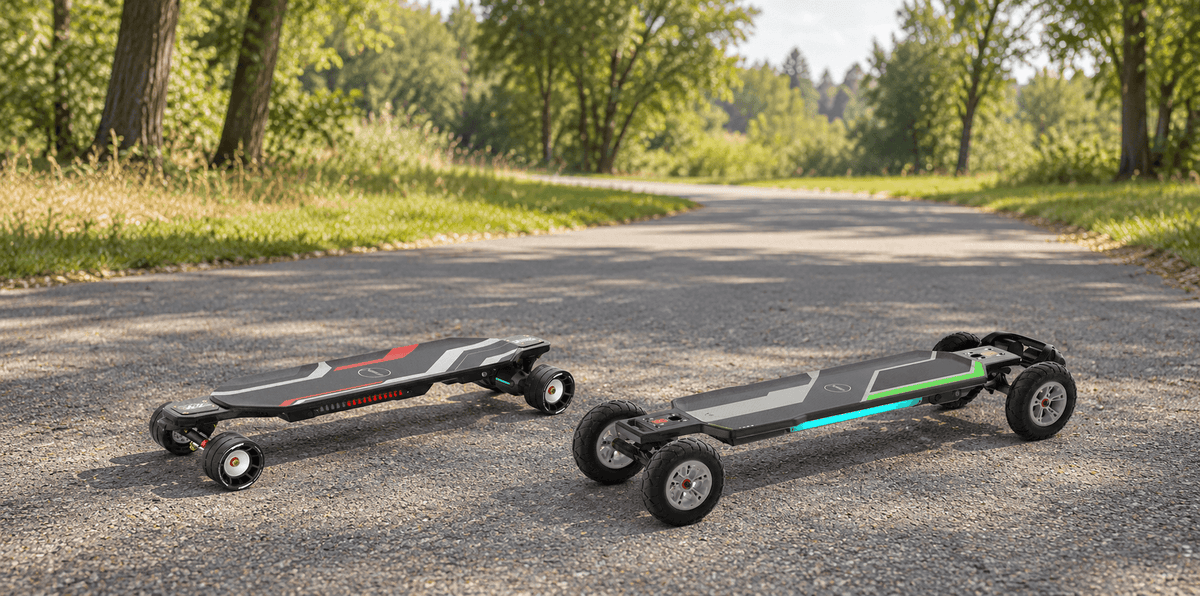
Start with the exact setup. Maxfind lists the Cyber Max X with belt motors and 107mm Spacewheels. [2] In its Cyber Max wheel description, Maxfind identifies urethane around a reinforced nylon core, 10 hollow pockets that allow the polyurethane to flex, and a concave tread intended to improve grip. [2] These details explain the manufacturer’s approach to wheel compliance and traction; they provide no numerical stopping endpoint.
Paxson Lim’s Cyber Max X review offers a separate account of riding the 107mm configuration. He reported that the wheels absorbed road vibration and offered good grip during carving and hard braking. [1] He also described crossing small debris, short grass and loose gravel without much trouble, while judging the board’s torque and clearance insufficient for actual trail riding. [1] That trail limitation is the reviewer’s assessment, rather than a measured loaded-clearance result.
The review’s wheel observations leave rider load and surface moisture unspecified. [1] Its hard-braking comment therefore supplies neither a verified dry-distance baseline nor a wet-versus-dry comparison. It also does not establish that the hard braking occurred on the grass or gravel mentioned elsewhere in the passage.
For your route, treat this as support for considering the Cyber Max X for occasional light-surface riding. A short-grass observation cannot determine how far the board will take to stop on wet grass, loose dirt or a particular trail. To interpret a distance claim, look for paired results that identify starting speed, total rider load, surface and moisture, grade, braking input, wheel condition, and where the measurement begins and ends. Without those conditions, a difference between two distances may reflect more than moisture.

Cyber Max carries an IPX5 water-resistance rating. [2] Maxfind warns that water resistance may decline with prolonged use, that water exposure can damage the skateboard, and that riders should avoid heavy rain. [2]
This guidance governs equipment exposure. It supplies no tire-grip measurement or stopping-distance allowance. A route that is wet after rainfall still needs a surface-specific assessment; the rating alone cannot answer whether the board will brake adequately there.
Before relying on the Cyber Max for wet dirt or grass, ask Maxfind for wet-use and braking guidance applicable to your exact configuration. Identify the surface you intend to ride, rather than asking only whether the board is “waterproof.” The unresolved question is how that setup may be used and braked under those conditions. This is a documentation inquiry—not a reason to perform wet emergency-stop experiments.
A demanding hill requires separate answers about stopping while moving, completing the climb, and responding if the board stalls. Assess them together before committing to the route.
Establish the total carried load. Maxfind lists a Cyber Max load limit of 330 lbs / 150 kg. [2] A 220-lb rider is below that allowance, but clothing, protective equipment and a backpack also belong in the route assessment. The load specification does not provide a braking distance at that weight.
Describe the route so a result can be matched to it. Maxfind’s guide Range by Rider Weight & Hill Grade advises identifying the exact wheel-and-drive configuration, total load, grass condition, measured grade, climb length, starting speed and battery state when assessing a steep grassy climb. [3] For a braking inquiry, also specify direction of travel and ask how braking input and the stopping endpoint were recorded. An uphill stop and a downhill stop answer different route questions. These details help evaluate an existing result; they are not a validated test procedure for you to carry out.
Keep moving braking separate from post-stall behavior. Maxfind’s guide explains that Cyber Max’s V6.0 FOC HOBBYWING ESC protection labels, including “Stall Guard,” leave activation thresholds, sustained-climb limits, recovery procedures and braking behavior after a stall unspecified. [3] Do not interpret Stall Guard as a promise that the board cannot stall or as authorization to restart on an incline. [3] A normal braking observation cannot resolve that separate operating state.
Request condition-matched results and operating guidance. For a 220-lb rider plus equipment on a measured 25% grassy grade, the available specifications and observations do not resolve wet or dry stopping distance, sustained climb completion, or a mid-hill restart. Approaching with momentum and restarting partway up are distinct demands. Maxfind advises seeking matching operating guidance or a documented comparable climb recording completion, slowing and thermal limitations, rather than improvising a stall-and-restart test. [3] For repeated use, ask whether the results cover repeated climbs and stops, not only a single attempt.
The practical criterion is a result that matches the route closely enough to inform your decision, accompanied by applicable operating instructions. A load allowance, motor-power figure or general hill claim alone is insufficient grounds for relying on a particular stopping distance.

Not automatically. Match the full model variant, drive system and installed wheels before applying a result to your electric longboard.
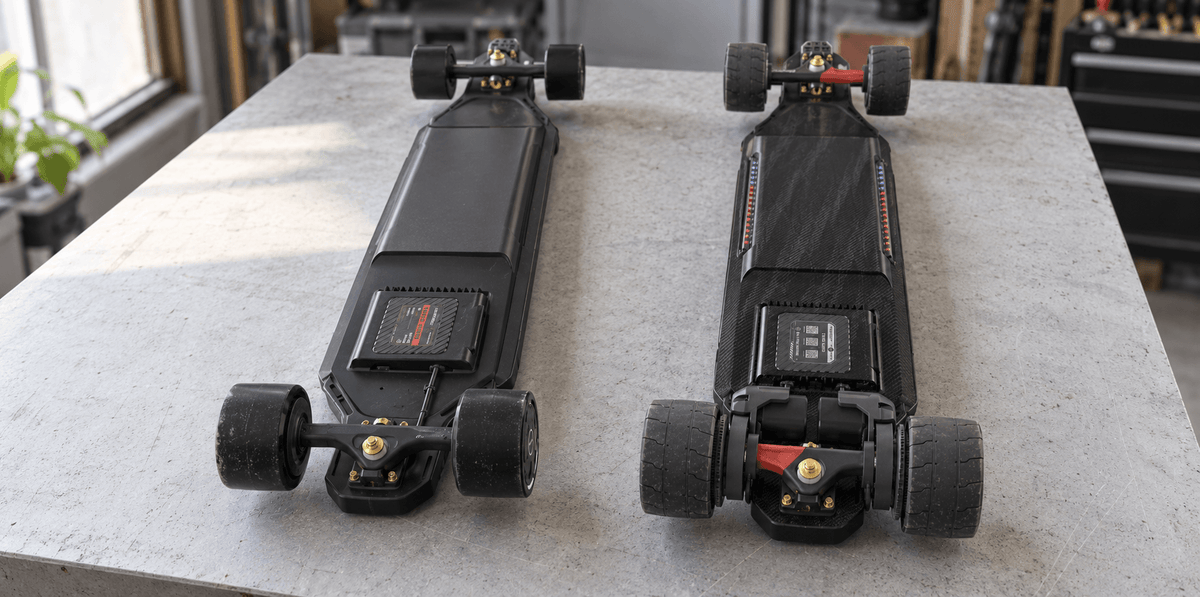
For a 2-in-1 setup, the result must identify which wheels were installed. Sharing a wheel name or diameter also does not make two boards equivalent. These configuration specifications establish what to match; they do not establish that one setup stops sooner or that a Cyber Max X ride observation applies to a Cyber Mini or Cyber Ultra.
No. Maxfind advertises 30% hill climbing for Cyber Max Standard and LR, and 35% for PRO and X. [2] Those figures describe claimed climbing capability; the specification passage provides no stopping-distance endpoint, wet-surface condition or downhill braking measurement. [2]
A 25% route being numerically below an advertised 35% climbing figure therefore gives you no wet or dry stopping-distance guarantee. For the braking decision, use a direction-specific braking result with applicable conditions—not the climbing percentage or an all-terrain label.
Condividi:
Range by Rider Weight & Hill Grade