

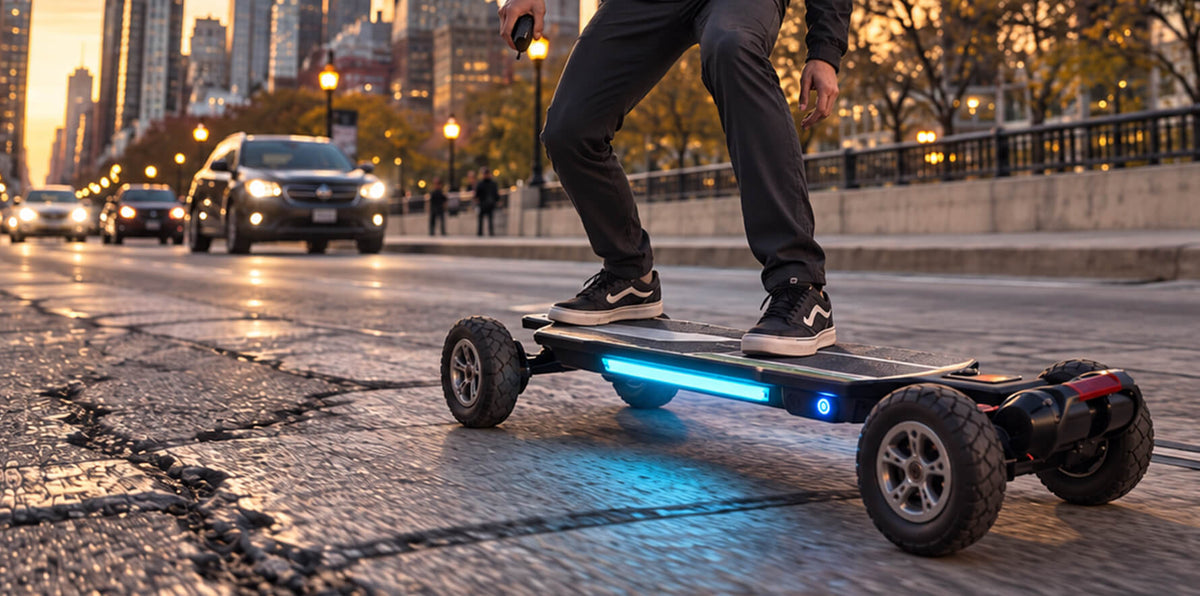
If your commute includes cracked asphalt, expansion joints, patched bike lanes, and rough intersections, vibration usually becomes the real limit before range does. The biggest comfort gains usually come from moving up in wheel and tire capability: 165mm pneumatic tires do the most to calm harsh pavement, 107mm street wheels are the practical middle ground, and 90mm PU wheels are still the least forgiving on broken city surfaces. You are here to make a practical setup decision, not to be sold a board, so the focus stays on four things that actually matter on a daily ride: vibration management, stability, portability, and whether the setup still fits your routine.
A lot of riders start by thinking foot fatigue is just part of skating. It often is not. On rough pavement, the wheel and tire system usually changes comfort more than small differences in top speed or battery size. That is why a compact board that feels great on smooth concrete can become tiring after ten minutes on patched streets, while a larger setup can feel calmer even before you notice any other spec.

Road buzz is not one single problem. It is the combined effect of wheel diameter, wheel material, tire construction, deck behavior, truck stability, and pressure setup. Sector 9 puts the first part simply: larger wheels roll over cracks and rough pavement more easily. That matters because a bigger wheel meets the edge of a crack at a shallower angle, so the impact that reaches your feet is reduced.
Wheel material changes the feel just as much. PU wheels are polyurethane street wheels. They are common on commuter boards because they roll efficiently and keep the board compact. But harder street wheels feel rougher on imperfect pavement, while softer wheels absorb more vibration. Ride Propel makes the same point from the electric-skate side: hard wheels are quicker on smooth surfaces, but soft wheels absorb vibrations and improve comfort. [1]
Pneumatic tires go a step further because they add an air chamber between the road and the deck. That air volume helps filter chatter from rough asphalt and expansion joints in a way solid PU wheels cannot. The trade-off is obvious once you carry the board upstairs: more tire and wheel volume usually means more weight, more ride height, and more bulk.
Deck flex is the part riders often misunderstand. A flexier deck can take the edge off repeated small impacts, but too much flex can feel vague when speed rises or the pavement gets unpredictable. TechGearLab’s testing summaries also note that padded grip and more capable larger-wheel setups can make smaller bumps and cracks less noticeable. In practice, deck comfort helps, but it rarely overrules wheel and tire choice.
Short wheelbase matters too. A shorter board is easier to carry and store, but it generally feels harsher over expansion joints because the front and rear wheels hit road imperfections in quicker succession. That faster, tighter feedback loop is why compact boards can feel lively on smooth pavement and tiring on broken pavement.
The easiest way to think about comfort is as a ladder. At the bottom is the classic 90mm PU setup: compact, efficient, and easy to live with, but least forgiving when the road gets ugly. In the middle sits the 107mm street-wheel class, which adds rollover and some comfort without turning the board into a bulky all-terrain machine. At the top is the 165mm pneumatic setup, which is the strongest answer when rough pavement is your daily reality.
Here is the practical difference in commuting terms:
| Wheel/tire class | Typical pavement feel | Crack-handling ability | Stability feel | Portability impact | Best commuting scenario |
|---|---|---|---|---|---|
| 90mm PU wheels | Direct and lively on smooth pavement, harsh on patched asphalt | Limited on expansion joints and rough seams | Fine on cleaner bike lanes, less forgiving on broken streets | Lowest carry burden | Smoother pavement, short carries, compact commuting |
| 107mm street wheels | Noticeably calmer than 90mm without feeling oversized | Better rollover on cracks and rough patches | More planted than small wheels while staying street-oriented | Moderate increase in bulk and weight | Mixed city pavement where you still need portability |
| 165mm pneumatic tires | Most cushioned and least buzzy on rough pavement | Strongest performance over cracks, patched asphalt, and uneven surfaces | Stable and confidence-building on poor pavement | Highest carry burden and storage penalty | Rough-city commuting where comfort matters most |
That ladder lines up with the available CYBER-series hardware. [2] The baseline street setup uses 90mm PU wheels. The compromise option moves to 107mm street wheels. The rough-road solution uses 165mm AT pneumatic tires. The logic is simple: larger and softer rolling systems usually reduce fatigue, but they also add weight, ride height, and carrying inconvenience.
This is why riders sometimes feel underwhelmed when they upgrade only for speed. If the road itself is the problem, the comfort jump from 90mm to 107mm can be meaningful, and the jump to 165mm pneumatic can be bigger still. The catch is that every step up in comfort usually asks for more tolerance for bulk.
Start with your worst daily surface, not your best one. If most of your route is smooth and only a few blocks are rough, a portability-first setup still makes sense. If half your ride is patched asphalt and expansion joints, comfort hardware deserves priority.
For portability-first commuting, the compact shortboard category is the easiest to carry into offices, onto transit, and up stairs. That convenience is real. But it usually comes with a harsher ride on rough pavement, especially when the setup stays on smaller PU wheels. This is the right choice only if carrying and storage pressure are stronger than comfort needs.
For a balanced comfort-and-carry approach, the sweet spot is usually the larger street-wheel class. If your route is inconsistent rather than truly terrible, this is often the most realistic answer.
For rough-pavement comfort first, pneumatic tires are the strongest fit. In the CYBER lineup, MAXFIND CYBER ULTRA uses 165mm AT pneumatic tires and is built around rough roads, hills, and mixed terrain, while CYBER MINI PRO and CYBER MINI X use 107mm wheels as the compromise option, and CYBER KIT makes more sense as a customization path than a turnkey comfort answer.
The custom-tuning path is worth considering only if you already know what bothers you. Some riders need a little more wheel diameter. Others need softer wheels, different truck tightness, or a deck feel that takes the sting out of repeated chatter. A kit route can solve that, but it asks for more setup knowledge and more patience than most commuters want.
Comfort-focused setups are rarely free. More wheel and tire volume can improve crack absorption, but it also increases carry burden, storage difficulty, and ride height. That matters if your commute includes apartment stairs, train platforms, or carrying the board through a grocery store.
The compact end of the CYBER MINI range is reported at roughly 12.4 lb to 20.3 lb depending on variant. [3] That spread is wide enough to matter in real life. A board near the low end feels much easier to carry one-handed for a block or two than one near the high end. The commuter-style longboard side is heavier: selected CYBER MAX variants are listed by a third-party retailer at about 19.8 lb, 20.9 lb, and 24.2 lb depending on version. [2] Those numbers help explain why a more planted ride often feels less convenient the moment the wheels stop rolling.
Board length changes stability too. A longboard platform generally feels calmer on rough pavement because it spreads your stance and smooths the timing of impacts. A short board is more nimble and easier to stash, but less forgiving when the street gets choppy. One Reddit rider described a compact hub board this way: it “rides okay and is really light,” while build quality was “just OK.” That is anecdotal, not lab testing, but it captures a common commuter truth: portability can be excellent even when ride comfort is only acceptable.
Ride height is the other hidden trade-off. Larger wheels and pneumatic tires raise the deck. That can improve obstacle clearance, but it also changes pushing, mounting, and the overall feeling of control for some riders. If you are already comfortable on taller setups, that is no big deal. If you want a low, easy-on-and-off commuter feel, it matters.
You can often improve comfort before replacing the whole board. The first thing I would check is wheel compatibility. If your platform allows a larger wheel size, that is usually the most direct way to reduce harshness without changing your entire commuting routine. Even a moderate jump in wheel size can help with crack rollover.
If you are staying with PU wheels, softer compounds are usually the better choice for rough pavement. Sector 9 notes that soft-to-medium urethane helps reduce vibration and fatigue, and Ride Propel similarly highlights the comfort advantage of softer wheels over harder ones. [4] You may give up a little efficiency or wear pattern preference, but many commuters will gladly trade that for less foot numbness.
On pneumatic setups, tire pressure is the adjustment that changes feel fastest. Lower pressure can improve comfort because the tire deforms more over rough surfaces. The trade-off is reduced efficiency and less sharp handling if you go too low. Small pressure changes are smarter than dramatic ones.
Truck tightness deserves attention on broken pavement. If the trucks are too loose, the board can feel twitchy when the road is already unsettled. If they are too tight, the ride can feel rigid and tiring. The goal is not maximum carve or maximum stiffness. It is a stable platform that does not amplify every seam in the road.
Deck and grip comfort matter more than many riders expect. TechGearLab’s testing summaries suggest that padded grip and larger-capability setups can make smaller bumps and cracks less noticeable. If your feet are getting beaten up before your legs do, the contact layer between shoe and deck may be part of the problem.
Independent review coverage is strongest where the hardware difference is biggest. Electric Skateboard HQ reviewed the CYBER ULTRA as “The Polished All-Terrain Board for $999,” which is useful because it confirms that outside reviewers also saw it through the rough-road lens rather than as a pure street commuter. That review-time price is not a current MSRP, but the framing matters: this is the setup class reviewers associate with mixed-terrain comfort.
User sentiment points in the same direction, though it should be read carefully. A Trustpilot reviewer wrote, “They made everything right and plus some. I love my new cyber ultra.” That tells you something about owner satisfaction after service recovery, but it is still sentiment, not controlled ride testing. [5]
Reddit is even more limited. It is useful for hearing how riders describe daily use, but it is anecdotal by nature. Comments about compact boards feeling light yet only okay in ride quality fit the broader pattern seen in wheel-size and board-length guidance, but they are not a substitute for repeatable testing.
The evidence base is thinner for some variants than many shoppers would like. Independent US review coverage is limited for parts of this lineup, so the safest conclusions should lean on wheel class, tire construction, deck intent, and terrain role rather than hype. [5] In other words, trust the physical setup first and rider chatter second.
For rough city pavement, the most defensible comfort hierarchy is still pneumatic first, larger street wheels second, and small PU wheels last. That order matches both the basic mechanics of wheel rollover and the real-world trade-offs riders feel in their feet, knees, and carrying hand.
If your commute regularly includes broken asphalt, patched lanes, and expansion joints, prioritize wheel and tire capability before secondary specs. That one decision usually changes comfort more than chasing a little more speed or a different battery figure. If you carry your board often, though, be honest about the other half of the equation: compact setups are easier to live with off the road, and they usually give up some comfort to get there.
The right answer is not the biggest setup you can buy. It is the least harsh setup that still fits your stairs, storage space, transit habits, and confidence level. When the road is rough, comfort is not a luxury feature. It is what decides whether the ride feels manageable on day five, not just day one.
Share:
MAXFIND MINI P Review: Is This Compact Folding E-Bike Worth It?