

Autumn Miles. Limited-Time Deals 🏷️
--
Days--
Hours--
Mins--
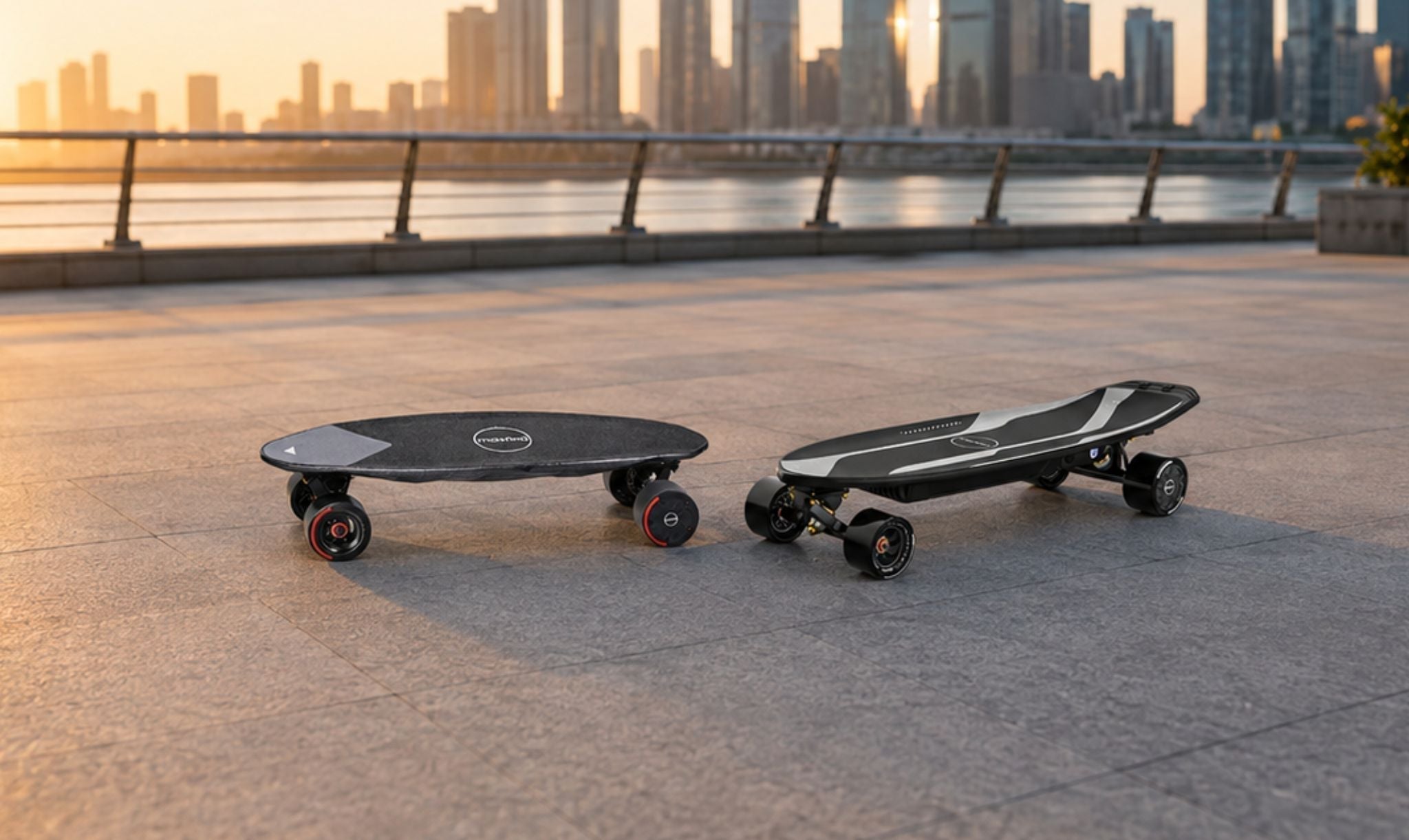
SecsThe MAXFIND MAX2 PRO and CYBER MINI are both compact electric skateboards, but they serve different priorities. MAX2 PRO focuses on simple, portable commuting, while CYBER MINI offers a wider range of configurations, including higher-range and higher-performance options. This comparison helps you choose the better fit for your route and riding needs.
The MAXFIND MAX2 PRO is positioned primarily around campus use and short commuting, while the CYBER MINI lineup stretches from a lightweight 99Wh AIR model to longer-range belt-drive PRO and X versions.
|
Comparison |
MAX2 PRO |
CYBER MINI |
|
Main Focus |
Compact campus and short-distance commuting |
Compact riding with broader performance options |
|
Available Versions |
Single, Dual, X |
AIR, Standard, PRO, X |
|
Published Range |
15–21 miles depending on version |
9–34 miles depending on version |
|
Published Top Speed |
20–24 mph depending on version |
20–37 mph depending on version |
|
Drivetrain Options |
Hub-drive lineup |
Hub on AIR/Standard; belt on PRO/X |
|
Wheel Options |
90mm |
90mm or 107mm depending on version |
|
Published Weight |
14.5 lb family specification |
12.4–20.3 lb depending on version |
|
Controls |
Hobbywing V5.0 FOC, OLED remote, four modes |
Hobbywing V6.0 FOC, remote on-off, smart app |
|
Extra Features |
Luminous grip tape on X |
RGB lighting, smart taillight, app, removable handle |
|
Best Fit |
Simpler compact commuting |
Riders wanting more configuration flexibility |
Both product names cover multiple configurations, so the right comparison depends on the version you are considering. Understanding how the lineup is structured first makes the later differences in range, weight, wheels, and drivetrain easier to evaluate.

MAXFIND currently offers three MAX2 PRO configurations. Single is the most basic option, Dual increases the published top speed, and X extends the range for riders who need more distance. All three remain within the same compact commuter platform, so the main decision is how much speed and range your normal route actually requires rather than assuming the highest version is automatically the best choice.

The CYBER MINI lineup covers a wider range of priorities. AIR focuses on minimum weight and short-distance riding, Standard adds dual-hub performance, PRO moves into a longer-range belt-drive setup, and X sits at the top of the lineup for range and performance. This wider spread makes CYBER MINI more flexible, but it also makes comparing the specific version more important.
Compact electric skateboards are often chosen because the rider expects to carry them through buildings, onto transit, or up stairs. For that use, weight can matter as much as deck length.
MAXFIND lists the MAX2 PRO at 14.5 lb, putting it in a relatively manageable range for short carries. CYBER MINI varies considerably: AIR is lighter at 12.4 lb, but the standard model rises to 16 lb, PRO to 18.7 lb, and X to 20.3 lb. That means CYBER MINI is not automatically lighter or heavier than MAX2 PRO; the answer depends entirely on the version. If carrying is a daily part of your trip, the AIR deserves attention for minimum published weight, while the PRO and X make more sense when their added range or performance solves a real need.
The MAX2 PRO measures 31 × 10.6 inches, while CYBER MINI AIR and Standard measure about 32.87 × 10.63 inches; PRO and X keep the same length but widen to 12 inches. CYBER MINI also features a removable ergonomic carry handle that can be installed when needed and removed for riding. In practice, the length difference between the two families is modest, so commuters using lockers, offices, car trunks, or public transit should pay close attention to total weight and width instead of assuming the shorter board will always be easier to manage.
Range matters differently on a compact board because more battery can also mean more weight to carry.
More range is useful only when your normal route requires it. A rider covering a few miles between home, campus, a train station, or an office may have little practical reason to carry the larger battery associated with a 31- or 34-mile board. MAX2 PRO Single or Dual and standard CYBER MINI already list 15 miles, while MAX2 PRO X extends that to 21 miles. CYBER MINI PRO and X become more relevant when longer continuous rides are a regular part of the plan. Advertised range should still be treated as a manufacturer rating rather than an exact distance every rider will achieve, because actual battery use changes with speed, hills, rider weight, temperature, acceleration, and route conditions.
The CYBER MINI lineup makes the range-versus-weight trade-off especially visible. Moving from the lightweight AIR to the longer-range PRO or X provides substantially more published range, but it also creates a heavier board to carry. If you ride most of the journey, that trade may be reasonable. If a large part of your commute involves stairs, station transfers, or indoor walking, buying more battery than your route requires can work against the reason you wanted a compact board in the first place.
Neither family is an all-terrain board, but wheel choice affects how much road feedback reaches the rider and how easily the board deals with everyday pavement imperfections.
MAX2 PRO uses 90mm wheels across the current lineup, while CYBER MINI AIR and Standard also use 90mm PU wheels. This size keeps both boards oriented toward normal street riding and compact handling. Maintained asphalt, bike lanes, campus paths, and ordinary urban pavement are the most natural use cases. Small cracks and pavement seams still require attention, and a compact street wheel should not be treated as protection against deep potholes or large debris.
CYBER MINI PRO and X move to 107mm Space Wheels made with 74A urethane and a hollow-pocket construction designed to flex under load and reduce vibration. The larger, softer setup is more forgiving when pavement becomes coarse or frequently cracked, but it also contributes to a physically larger wheel package than the 90mm configurations. Riders choosing PRO or X are therefore moving the CYBER MINI away from minimum-weight portability and toward greater range, performance, and rough-pavement comfort.
Larger street wheels can make imperfect pavement easier to manage, but they do not turn a shortboard into an all-terrain electric skateboard. Repeated gravel, dirt, grass, badly broken roads, deep potholes, or loose surfaces place different demands on traction and obstacle rollover. If those conditions make up a significant part of your normal route, choosing between MAX2 PRO and CYBER MINI may be solving the wrong problem; a dedicated all-terrain setup is more appropriate than selecting a compact board solely because one version has larger wheels.
The MAX2 PRO keeps its focus on hub-drive simplicity, while CYBER MINI uses its higher variants to introduce belt drive. That difference matters more for maintenance and customization than for simply declaring one system better.
Hub motors place the motor within the wheel assembly and avoid external belts and pulleys. MAX2 PRO is built around a hub-drive platform, while CYBER MINI AIR and Standard also use hub motors. For everyday commuters, the main practical advantage is having fewer exposed drivetrain components that require belt inspection, tension adjustment, or replacement. The trade-off is that compatible motor-wheel options can be more constrained than on many belt-drive systems.
CYBER MINI PRO and X use belt-drive systems, paired with dual 900W and dual 1200W motors respectively. They also use 107mm Space Wheels rather than the 90mm hub-wheel configurations on AIR and Standard. Belt drive can give riders more flexibility around wheel and drivetrain configuration, but it also introduces belts and pulleys that need periodic inspection. The PRO and X therefore make more sense for riders who actively want the additional performance and hardware flexibility rather than someone whose main priority is minimizing ownership complexity.
CYBER MINI’s published hill ratings rise from 20% on AIR to 30% on Standard and PRO and 35% on X, reflecting the different performance levels within the lineup. For either family, however, a hill-climbing number should not be treated as a guaranteed result for every route. Rider weight, battery level, slope length, surface conditions, and approach speed all affect climbing behavior, so riders with hilly commutes should consider the demands of the full route rather than relying on a single percentage.
Beyond range and drivetrain, CYBER MINI places more emphasis on connected and visual features, while MAX2 PRO keeps the control system more conventional.
MAX2 PRO uses a Hobbywing V5.0 FOC controller, OLED remote, and four adjustment modes, with luminous grip tape added specifically to the X version. CYBER MINI uses Hobbywing V6.0 FOC with remote on-off support and the Tuya smart app, while the lineup also includes 10-mode RGB atmospheric lighting, a smart taillight, removable carry handle, and quick-release wheel features. These additions make CYBER MINI the more feature-heavy family for riders who value app connectivity, lighting, and a more configurable ownership experience.
Smart controls, lighting, and higher-performance configurations only add value when you actually use them. A rider whose main requirement is a compact board for a short daytime commute may care more about weight, required range, and simple operation than RGB lighting or a belt-drive upgrade. In that case, the MAX2 PRO or a lower CYBER MINI configuration can meet the core transportation need without moving toward the heavier, more performance-focused end of the lineup.
The best choice depends less on which family has the highest specification and more on which configuration solves your actual route, carrying, and performance requirements.
Choose the MAX2 PRO when you want a straightforward compact commuter and its available range already covers your normal route. It is the more logical direction when simple operation, street-focused riding, and everyday portability matter more than maximizing performance or adding extra smart features.

Choose CYBER MINI when you want more freedom to prioritize low weight, longer range, larger wheels, or higher performance within the same compact-board category. Its broader lineup makes it easier to move from a lightweight short-distance setup to a more capable belt-drive configuration without leaving the shortboard format.
If portability is your first priority, compare individual variants rather than choosing by family name. CYBER MINI AIR sits at the lightweight end of the current lineup, while the higher-performance CYBER MINI versions add progressively more weight. The right question is not simply “MAX2 PRO or CYBER MINI?” but how much range and performance you are willing to carry when the board is no longer under your feet.
Choose the MAX2 PRO if you want a simpler compact commuter and its available range already covers your typical route. Choose CYBER MINI when you want more flexibility in weight, range, drivetrain, wheels, or performance—but compare the specific AIR, Standard, PRO, or X version rather than assuming every CYBER MINI offers the same advantages.
A shorter platform can feel more responsive than a full-size longboard, but stability also depends on truck setup, bushings, rider stance, speed, and experience. Riders should become familiar with the board at lower speeds before moving into faster riding modes.
Wheel compatibility depends on the specific drivetrain and wheel system. MAX2 PRO currently uses 90mm wheels, CYBER MINI AIR and Standard use 90mm PU wheels, and PRO/X use 107mm Space Wheels; do not assume that every third-party wheel fits every version without checking compatibility first.
Check the wheels, trucks, visible hardware, battery level, remote connection, and board for obvious damage or loose components before riding. A quick inspection is particularly useful if the board is used frequently or carried between multiple locations.
Keep the board in a cool, dry indoor location away from excessive heat, freezing temperatures, and moisture. For longer periods without use, follow the manufacturer’s current battery-storage guidance rather than leaving the battery fully depleted for an extended period.
More reading: Hub Motor vs Belt Drive Electric Skateboards

Share:
How to Judge Battery Sag and Range Consistency on an Electric Skateboard
What Is an Electric Skateboard With a Handle? What Riders Usually Mean