

Autumn Miles. Limited-Time Deals 🏷️
--
Days--
Hours--
Mins--
SecsCracked asphalt, brick sections, and patched bike lanes can turn a fun ride into a slow build of foot buzz, ankle fatigue, and sore knees. If your goal is pavement vibration management inside the Maxfind electric skateboard lineup, the evidence points in one clear direction: CYBER ULTRA is the only CYBER model with a well-supported rough-road comfort case, while CYBER MAX and CYBER MINI stay much more street-oriented. [1]
That does not make CYBER ULTRA the automatic winner for every rider. It means this is the Maxfind model with the right combination of larger tire options, a semi-flex composite deck, and a battery sized for longer rides where vibration fatigue starts to matter.

The short answer is simple: for rough city pavement, CYBER ULTRA is the only model in the CYBER family that clearly supports a comfort-first argument. It combines a 43 x 13 in deck, a PPS composite + fiberglass construction, and a 648Wh battery that better suits longer rides where repeated vibration adds up. [2]
That matters because rough-road comfort is not one thing. It is the sum of tire compliance, deck behavior, platform stability, and how long you stay on the board before fatigue catches up. CYBER MAX and CYBER MINI can absolutely commute, but both sit on smaller street-focused wheel setups and do not have the same hardware case for broken pavement.
This is also not a “best overall” ranking. Exway has stronger cited evidence in one specific comfort lane: paved-road vibration reduction through a flexible composite deck. CYBER ULTRA has the stronger Maxfind case when the road gets rougher and the impacts get bigger. Setup matters more than logo when rough roads are part of your weekly ride, and that is exactly how Evolve frames rough-surface riding: tire type and truck geometry are the two main factors, with pneumatic tires absorbing vibration before it reaches your feet. [3]

Inside this lineup, the split is pretty clear. CYBER MINI is built around portability. CYBER MAX is the lower-cost commuter longboard. CYBER ULTRA is the all-terrain flagship. CYBER KIT is a drivetrain for custom builds, so comfort depends on the deck and wheels you pair with it.
Here is the practical comparison.
| Model | Starting price | Wheel/tire setup | Battery | Top speed | Range | Deck/deck note | Comfort implication |
|---|---|---|---|---|---|---|---|
| CYBER MINI | From $379 | 90mm PU wheels on AIR/Standard | 99Wh-415Wh depending on version | 20-37 mph | 9-37 miles | Carbon fiber coating noted on product materials | Portability-first; not a verified rough-pavement comfort setup |
| CYBER MAX | From $399 | 90mm PU wheels | 158.4Wh | Up to 28 mph | Up to 15 miles | 38 x 11 in deck | Street commuter setup; less forgiving on broken pavement |
| CYBER ULTRA | From $999 | 165mm AT pneumatic tires, 107mm 2-in-1 option | 648Wh | 37 mph | 37-62 miles | 43 x 13 in deck; PPS composite + fiberglass; semi-flex character | The only CYBER model with confirmed AT hardware and third-party deck comfort evidence |
| CYBER KIT | Not stated here as a complete board | Custom-build drivetrain | Not applicable as a complete board | Not stated | Not stated | Depends on the user’s deck | No verified comfort outcome on its own |
That table tells the real story. CYBER MINI and CYBER MAX both rely on 90mm PU street wheels in the versions documented here. Those setups are fine on smoother pavement, but they do less to isolate the rider from cracks, expansion joints, and patched sections. CYBER ULTRA is the one model with confirmed pneumatic all-terrain hardware and a third-party review describing the deck as semi-flex. [2]
Electric Skateboard HQ reviewed the belt version and described the board as having “no glaring weaknesses and no standout strength—which is actually a good thing.” That is a useful comfort clue. It suggests a balanced ride rather than a twitchy or overly stiff one, which is exactly what many commuters want from a rough-road board.
Yes, the Maxfind flex deck can help with pavement vibrations, but the supportable claim is narrower than “all Maxfind boards are comfortable.” The strongest evidence applies to CYBER ULTRA specifically.
Electric Skateboard HQ described the CYBER ULTRA deck as PPS composite + fiberglass with “a soft, semi-flexible character.” The same review measured the deck at 43 x 13 in with 7mm concave. [2] That matters because deck flex can take the edge off high-frequency chatter that comes through rough pavement, especially the constant small buzz you feel through your arches and calves on long city rides.
Category evidence points the same way. OMW says bamboo’s natural flexibility gives a smooth, cushioned ride with great shock absorption, and it also notes that bamboo/fiberglass hybrids improve vibration absorption. OMW contrasts that with stiffer constructions, explaining that stiff carbon decks can transmit more vibration and contribute to foot and knee fatigue. CYBER ULTRA is not a bamboo deck, but the broader lesson still holds: a deck with some give usually feels calmer than one built only for stiffness.
The limit is important. There is not enough verified material to claim the whole CYBER lineup shares the same deck behavior. CYBER MINI’s carbon fiber coating is a surface detail, not proof of comfort flex. CYBER MAX has a confirmed deck size of 38 x 11 in, but not the same third-party flex description. So if you are asking, “Does the Maxfind electric skateboard flex deck really help with pavement vibrations?” the best evidence-backed answer is: yes, on CYBER ULTRA, deck flex likely helps reduce chatter, but it is only one part of the comfort equation.
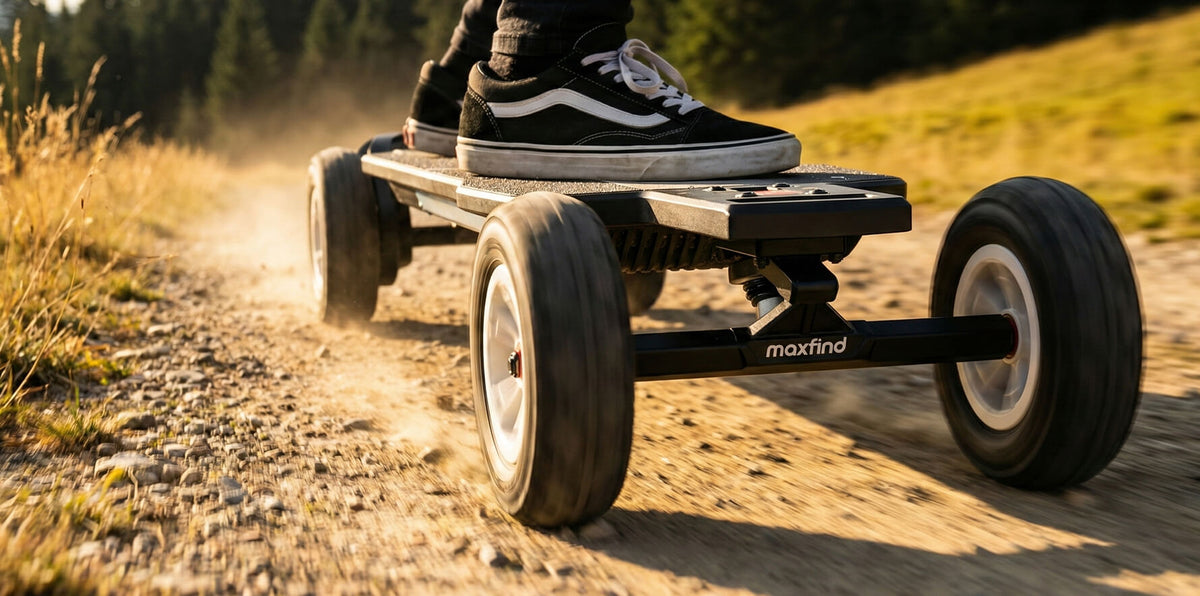
If your knees, ankles, or feet start complaining on rough roads, the wheels usually matter more than the deck. Pneumatic tires reduce impact transfer before the vibration ever reaches the board, and that is why CYBER ULTRA’s wheel setup is the biggest reason it stands apart.
The official hardware is unusually clear here. CYBER ULTRA is offered with all-terrain pneumatic tires. It also has a 107mm option available in a 2-in-1 configuration. Those are not small differences from the 90mm PU street wheels used on CYBER MAX and CYBER MINI versions documented in this lineup.
Evolve’s rough-road explainer makes the mechanism easy to understand. Pneumatic tires absorb vibration before it reaches the rider’s feet. Evolve also says boards built around pneumatic tires and wide trucks handle broken pavement, gravel, and cracked concrete without drama. [3] That is category-level evidence, but it lines up neatly with what CYBER ULTRA is built to do.
So how effective are the shock-absorbing wheels on a Maxfind electric skateboard for joint pain? The careful answer is that larger pneumatic tires can reduce transmitted vibration and repeated impact exposure, which should make rough rides less fatiguing for many riders. [4] That is not the same as a medical claim, and it should not be framed as treatment. What the hardware supports is a comfort benefit: less harshness from cracks, brick, and patched asphalt over time.
By contrast, 90mm PU wheels are simpler, lighter, and often feel quicker on smooth pavement. They are just less forgiving when the road surface gets ugly. On broken city streets, CYBER ULTRA’s tire setup is doing more of the comfort work than deck flex alone ever could.
Maxfind vs Exway is not a one-line answer, because the more comfortable ride depends on what “rough roads” actually means in your daily route. If you mean patched but still paved city streets, Exway Flex Pro has the stronger cited deck-flex comfort case. If you mean rougher surfaces with bigger impacts, CYBER ULTRA has the stronger hardware case.
Here is the cleanest comparison supported by the available evidence.
| Model | Price | Comfort hardware | Wheel size/type | Deck material/flex evidence | Best use case |
|---|---|---|---|---|---|
| CYBER ULTRA | From $999 | 165mm pneumatic setup, 648Wh battery | 165mm AT pneumatic tires / 107mm 2-in-1 option | PPS composite + fiberglass; semi-flex character | Rougher streets and mixed surfaces |
| Exway Flex Pro | $930 | Flexible composite deck, 345Wh battery | 90x64mm 76A wheels | Bamboo, maple, fiberglass deck; flexible deck “acts as a suspension” | Paved rough roads where deck flex matters most |
| Exway Atlas Pro | Price not stated here | Rough-road intent with pneumatic tires | 160mm pneumatic all-terrain tires | Material not stated here | Rough-road focused riding, but no source-backed head-to-head vibration result captured |
Electric Skateboard HQ gives Exway Flex Pro a very specific comfort argument. The review says its flexible deck “acts as a suspension and can allow the board to conquer rough road vibrations.” It also says rough-road cruising “won’t feel so bad” because of the flexible deck, and notes that the 90mm wheels should help cushion the ride. [1] That is strong, direct language for paved-road comfort.
CYBER ULTRA answers differently. Its case is less about a suspension-like deck feel and more about bigger pneumatic hardware. Electric Skateboard HQ described the Maxfind deck as semi-flex, and a YouTube review snippet called the board “planted and stable” on pavement, rough roads, and light off-road terrain thanks to the large pneumatic tires and wide deck. Another YouTube review highlighted comfort from “the deck and the big fat tires.”
So which one has a more comfortable ride on rough roads? On paved rough roads, Exway Flex Pro has the stronger cited case. On rougher streets and mixed surfaces, CYBER ULTRA has the stronger supportable hardware case because larger pneumatic tires should absorb bigger impacts better. There is no fair direct test here proving one is universally superior.
A board can feel good for 15 minutes and still wear you down after an hour. Long-ride comfort is partly about vibration, but it is also about whether the setup matches the distance and surface you actually ride.
CYBER ULTRA carries a 648Wh battery and an official range claim of 37-62 miles. Electric Skateboard HQ tested the belt version with all-terrain wheels and reported that aggressive riding was closer to 30 miles in real use. [5] That is still a meaningful number for a rough-road setup, because larger pneumatic tires usually trade some efficiency for comfort and control.
Exway Flex Pro uses a 345Wh battery, a flexible composite deck made from bamboo, maple, and fiberglass, and 90x64mm 76A wheels. [1] Its marketed speed is 31 mph and its marketed range is 25 miles. [1] That setup makes sense for riders who stay mostly on pavement and want the deck itself to smooth out the ride.
Between Maxfind and Exway, which electric skateboard is better for dampening vibrations during long rides? On paved rough roads, Exway Flex Pro may feel smoother because the deck is explicitly described as acting like suspension. [1] For longer rough-surface rides, CYBER ULTRA is the more supportable Maxfind choice because the optional all-terrain setup and larger 648Wh battery are better matched to broken city pavement over distance.
There is no direct fatigue test comparing the two. The sensible conclusion is an evidence-based inference: Exway Flex Pro looks stronger for paved-road flex comfort, while CYBER ULTRA looks better suited to longer rides once the surface gets rough enough that tire compliance matters more than deck feel.
If your route includes cracked pavement, brick, patched asphalt, or mixed-surface commuting, choose CYBER ULTRA first. It is the only model in this family with confirmed pneumatic tires, a semi-flex PPS composite + fiberglass deck, and a 648Wh battery that makes longer rough-road rides realistic. [2][1]
If your riding is mostly smoother pavement and budget matters more than vibration control, CYBER MAX makes more sense. It starts at $399, uses dual 650W hub motors, runs 90mm PU wheels, and is rated up to 28 mph with up to 15 miles of range. That is a straightforward commuter formula, not a rough-road comfort build.
If portability matters most, CYBER MINI is the better fit. Depending on version, it spans 12.4-20.3 lb, 20-37 mph, and 9-37 miles, with 99Wh-415Wh battery options. That is useful if you carry the board often or need a compact footprint, but it is not the lineup’s best answer to pavement buzz.
Treat CYBER KIT differently. It is a custom project, not a comfort recommendation by itself, because the final ride depends on the deck and wheels you build around it.
Yes, CYBER ULTRA is the strongest option in this lineup for reducing pavement vibration. It has confirmed 165mm all-terrain pneumatic tires, a 43 x 13 in deck, and a semi-flex PPS composite + fiberglass construction. [2] CYBER MAX and CYBER MINI use 90mm PU street wheels in the documented versions here, which are less forgiving on cracks, brick, and patched asphalt.
Usually not. Deck flex helps with high-frequency chatter, and Electric Skateboard HQ says Exway Flex Pro’s flexible composite deck acts like suspension on rough pavement. [1] But on truly rough city streets, tire type does more of the work. Pneumatic tires absorb vibration before it reaches your feet, which is why CYBER ULTRA’s pneumatic setup is a bigger comfort advantage than deck feel alone. [3]
It depends on the surface. Exway Flex Pro has the stronger cited case for paved-road comfort because its bamboo, maple, and fiberglass deck is specifically described as flexible and helpful on rough-road vibrations. [1] CYBER ULTRA has the stronger hardware case for rougher streets because its pneumatic tires should absorb larger impacts better. There is no direct head-to-head fatigue test proving one wins everywhere.
Start with the wheels, then the route, then the deck. If you are riding 90mm PU wheels over cracked pavement, that is the first thing to question. Larger pneumatic tires usually reduce transmitted vibration more effectively. After that, look at ride length and battery. CYBER ULTRA’s 648Wh battery and rough-road wheel options make more sense for longer broken-pavement rides than a smaller street-wheel setup.
Pricing reflects listings at the time of writing; confirm current prices before buying.


Share:
Best Electric Skateboard for Hilly City Commutes
Lightweight Electric Skateboard for Stairs, Apartments, and Public Transit