

Autumn Miles. Limited-Time Deals 🏷️
--
Days--
Hours--
Mins--
SecsA portable electric skateboard has to work after the ride ends. If your commute includes apartment stairs, narrow hallways, train platforms, or crowded buses, board weight and storage size can matter more than maximum speed. This guide explains how to choose a lightweight setup and where the CYBER MINI AIR and CYBER MINI fit into a mixed commute.
Portability is not determined by weight alone. A practical board must also be manageable through doors, on stairs, inside transit vehicles, and wherever it needs to be stored.

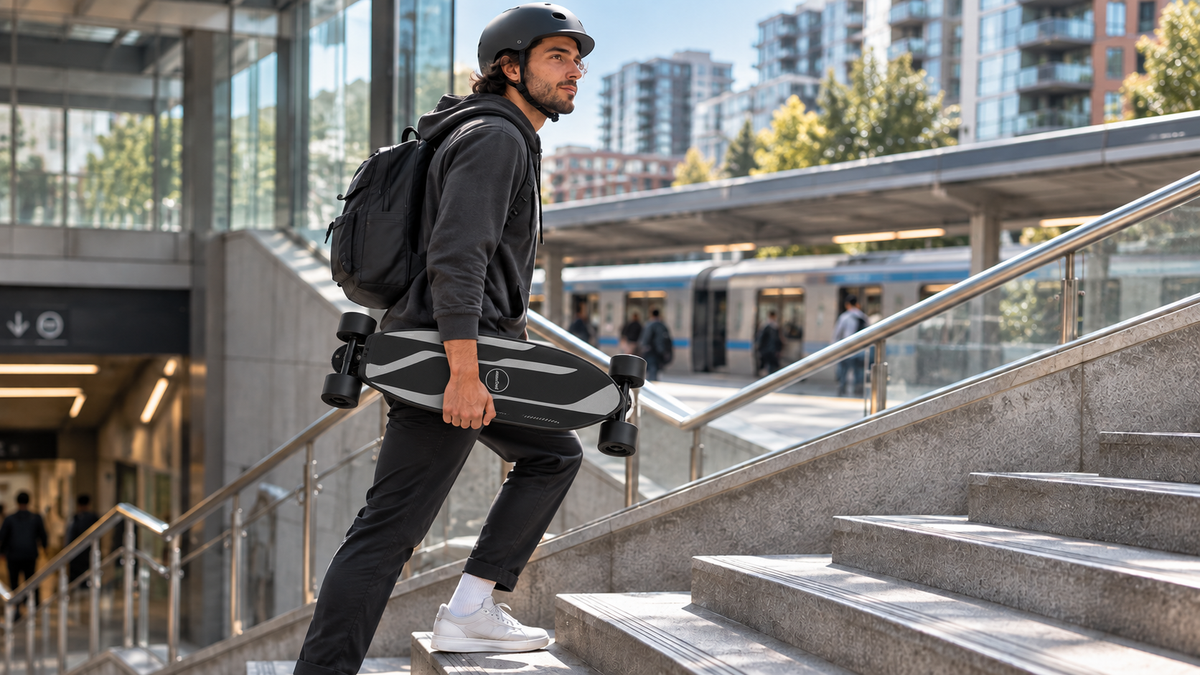
A difference of several pounds may seem minor on a specification sheet, but it becomes more noticeable when you carry the board up multiple flights of stairs or through a large station. Consider how often you must lift the board, how long each walking section lasts, and whether you will also be carrying a backpack, laptop, helmet, or groceries. A 16-pound board may be manageable for short transitions, while a lighter option can make more sense when carrying is a repeated part of every trip. Riders with long walking connections may still prefer a carrying strap or backpack because even a relatively lightweight board can become tiring in one hand.
A compact board is easier to turn through stairwells, fit beside a seat, place under a desk, or store near an apartment entrance. Overall length is only part of the calculation: deck width, truck width, wheel position, and the way the board balances in one hand also affect portability. A short board with wide trucks can still catch door frames or nearby passengers, while an unbalanced board may tilt toward the floor when lifted. Before buying, measure the intended storage space and compare it with the complete board dimensions rather than relying on labels such as mini or portable.
Each environment creates a different portability problem. The best setup is the one that fits the complete route rather than performing well in only one part of it.
Walk the route from the street to your apartment and count every place where the board must be lifted. Narrow staircases, heavy entrance doors, sharp landings, and buildings without elevators increase the value of lower weight and compact dimensions. A removable handle may improve grip during short carries, but it does not reduce the load and should not interfere with your stance, wheels, cables, or other components. Leave enough space near the entrance for dry storage, and avoid positioning the board where it blocks a hallway or emergency exit.
A portable electric skateboard can fit beneath a desk, beside a cabinet, or against a wall more easily than a longboard, but its battery and motors still require suitable storage. Choose a dry location away from direct heat, moisture, and places where the board could be knocked over. Do not assume that standing the board vertically is safe unless it remains stable and does not place damaging pressure on the motors, guards, remote, or charging port. Access also matters: if reaching the board requires moving furniture every morning, the storage arrangement may become less practical than the dimensions initially suggest.
Public transit adds ticket gates, escalators, platforms, vehicle steps, crowded aisles, and periods when the board must remain beside you. Check the transit operator’s current rules before traveling because policies for powered boards and lithium batteries vary. Dismount before entering stations or crowded areas, keep the board under control, and never leave it where passengers could trip over the deck or wheels. A compact board is easier to position near your feet, but a backpack or shoulder strap may be more practical when both hands are needed for railings, doors, or luggage.
The current CYBER MINI product page lists the AIR and standard MINI as two compact hub-drive configurations with the same overall dimensions. Their main difference is the balance between carry weight and riding capability.
The MAXFIND CYBER MINI product page provides separate specifications for the AIR and standard MINI. The values below are manufacturer-published ratings rather than independent test results.
| Specification | CYBER MINI AIR | CYBER MINI |
|---|---|---|
| Board weight | 12.4 lb / 5.6 kg | 16 lb / 7.3 kg |
| Dimensions | 32.87 × 10.63 × 6.3 in | 32.87 × 10.63 × 6.3 in |
| Published range | 9 miles / 15 km | 15 miles / 25 km |
| Published top speed | 20 mph / 32 km/h | 28 mph / 45 km/h |
| Published hill climbing | 20% | 30% |
| Motor power | 650 W | 650 W × 2 |
| Motor torque | 5 Nm | 5 Nm × 2 |
| Battery | Samsung 18650, 10S1P, 2.75 Ah, 99 Wh | Samsung 18650, 10S2P, 4.4 Ah, 158.4 Wh |
| Published charging time | 1.8 hours | 1.8 hours |
| Wheels | 90 mm PU | 90 mm PU |
| Drive system | Hub motor | Dual hub motors |
Actual range will vary with rider weight, speed, hills, stops, temperature, wind, pavement, and battery condition. Riders should therefore avoid planning a commute around the full published maximum without leaving enough reserve for delays or route changes.
At a published 12.4 pounds, the CYBER MINI AIR is 3.6 pounds lighter than the standard MINI while using the same listed deck dimensions. That difference is meaningful when the board must be carried upstairs twice a day, lifted onto a bus, or moved through several train connections. The trade-off is a single 650 W motor, a published 9-mile range, a 20 mph top speed, and a 20% hill-climbing rating. This configuration makes more sense for shorter, smoother routes where carrying frequency matters more than extra speed, range, or hill reserve.
The standard CYBER MINI increases the published range to 15 miles and uses two 650 W hub motors, with a listed 28 mph top speed and 30% hill-climbing capability. Those specifications provide more reserve for longer routes and repeated inclines, but the board weighs 16 pounds. That remains relatively compact for an electric skateboard, yet the extra 3.6 pounds will be noticeable during repeated stair climbs or long station walks. Choose it when the riding portion of the commute demands more capacity and the board will be carried only for shorter transitions.
Riders who want to compare compact formats can also browse the current mini electric skateboard collection. Check individual product pages before choosing because a collection may contain several models and configurations with different availability, weight, range, and intended users.

A lighter board is not automatically the best commuter if its wheels, range, or stability do not suit the route. Portability must be considered alongside pavement quality and riding distance.
Both configurations use a deck measuring about 32.87 inches long and 10.63 inches wide with 90 mm PU wheels. The compact length helps with storage and transit, while the listed width provides more standing room than an extremely narrow mini board. However, 90 mm street wheels are better suited to relatively smooth pavement than deep cracks, potholes, gravel, raised joints, or broken asphalt. Riders should inspect the route before buying and plan to dismount around hazards that the smaller wheels cannot cross predictably.
Published range should be compared with the complete riding distance rather than the distance between home and the nearest station. Include detours, missed connections, errands, hills, cold weather, and the possibility that charging is unavailable at the destination. The AIR’s 9-mile rating is better aligned with short first- and last-mile segments, while the MINI’s 15-mile rating offers more flexibility when riding replaces a larger portion of the trip. Neither rating should be treated as a guaranteed daily result, and relying on the last portion of the battery leaves little margin for changing conditions.
Maximum speed is not the main benefit of a portable board. Station approaches, shared paths, crossings, and busy city streets require conservative speed and sufficient stopping distance regardless of the board’s capability. The standard MINI’s higher published speed does not make it automatically better for public transit, while the AIR’s lower top speed does not remove the need for protective equipment, route planning, and careful braking practice. Use a lower riding mode while learning and follow the rules that apply to each road, path, campus, building, and transit system.
The right decision depends on how much of the commute is spent riding and how much is spent carrying. Evaluate the route in both directions before selecting a configuration.
Choose the CYBER MINI AIR when the route is short, relatively smooth, and interrupted by several stairways, station walks, or indoor transitions. Choose the standard CYBER MINI when longer riding sections, more hills, or additional range reserve justify carrying a heavier board. If the route contains extensive broken pavement, deep cracks, or long uninterrupted riding distances, a larger board or wheel setup may provide a better ride even though it is less convenient on stairs. A portable board is most useful when the route genuinely rewards compact storage and frequent carrying.
Practice lifting and positioning the board before using it during a busy commute. Keep fingers away from dirty wheels and moving components, secure the remote, and prevent loose straps or clothing from catching around the trucks. At home, allow the board to dry before storage if it has encountered moisture, inspect the wheels and visible hardware, and charge it according to the manufacturer’s instructions. Before leaving, check the board battery, remote connection, wheel condition, fasteners, and braking response so a portability advantage is not undermined by an avoidable equipment problem.
Wear a suitable helmet and consider wrist, knee, and elbow protection, especially while learning. Do not ride on station platforms, through crowds, inside buildings, or anywhere operation is prohibited. Test the route during a quiet period before relying on the board for a time-sensitive commute, and identify places where you will dismount, carry, store, or charge it. Local riding laws and transit policies can change, so confirm them directly instead of assuming that a compact board is permitted wherever it physically fits.
The CYBER MINI AIR is the stronger portability choice for repeated stair climbs and mixed-transit trips, while the standard CYBER MINI trades additional weight for more published range, motor power, and hill capability. Choose according to the entire route, including every section where the board must be carried rather than ridden.
There is no universal limit, but carrying frequency matters more than one ideal number. A 12- to 16-pound board may be manageable for short transitions, while repeated stairs or long station walks make the lighter end of that range more practical.
That depends on the transit operator and location. Check the current rules for powered boards and lithium batteries before traveling, and keep the board switched off, controlled, and clear of doors, aisles, and other passengers.
The AIR is better suited to riders who prioritize lower carry weight and shorter trips. The standard MINI provides more published range, motor power, speed, and hill capability but weighs 3.6 pounds more.
They can suit smooth streets and maintained paths, but they provide less tolerance for potholes, deep cracks, gravel, and raised joints than larger wheels. Inspect the route and dismount around hazards the wheels cannot cross safely.
More reading: What Is an Electric Skateboard With a Handle?

Share:
Maxfind Pavement Vibration Management: Which CYBER Board Makes Rough Roads Easier?