

¡Oferta de vuelta a clases! 🏷️ ¡Una excelente relación calidad-precio!

You leave home on dry pavement, hit two rough intersections, roll over a patch of cracked asphalt, then face a short hill before the train station. On the way back, the road is damp and traffic is tighter. That is what commuting really looks like, and this guide does not promote any product. The useful answer is simpler than most marketing pages make it sound: daily safety and reliability come down to braking predictability, realistic range, hill reserve, wheel choice, and how easy the board is to carry and store far more than headline speed.
For commuting, this category is best understood as a compact electric vehicle for short-to-medium urban trips, not a toy and not a downhill longboard replacement. A good commuter setup should feel calm in stop-and-go traffic, stay composed on mixed pavement, and leave enough battery and braking confidence for the ride home. [3] If a board claims 37 mph but feels abrupt when you need to slow for a crosswalk, that top number matters less than people think.
The first filter is braking behavior. In city riding, the board that feels easiest to trust is usually the one that slows in a smooth, repeatable way when you feather the remote, rather than one that launches hard and demands constant correction. The second is range under real conditions. In this commuter class, claimed range figures around 34 to 37 miles are common decision anchors, but those numbers only help if you treat them as upper-end estimates rather than your guaranteed daily result.
Hill reserve is next. A 35 percent hill-climbing claim is a meaningful benchmark for riders who deal with bridges, parking ramps, and neighborhood grades. Even if your route is flatter than that, extra climbing headroom usually translates into less strain and better consistency when the battery is no longer full.
Then comes ride comfort on rough pavement. Wheel size changes how the board handles expansion joints, pebbles, and patched asphalt. Finally, portability decides whether the board fits your actual life. A carry weight of 12.3 pounds is a strong benchmark for multimodal commuting because it is light enough to bring up stairs, onto transit, or into an office without turning the last mile into a shoulder workout.
Top speed still matters, but mostly as a sign of power reserve. In urban traffic, control and stopping predictability are what keep a commute manageable.
Most riders notice acceleration first, but commuters learn to care more about deceleration. Regenerative braking and electronic braking systems are valuable because they can deliver controlled slowing without the grabby feel that makes traffic riding tense. The best setup is not the one that feels most aggressive off the line. It is the one that lets you trim speed smoothly before a bike lane merge, a turning car, or a wet crosswalk.
Electric Skateboard HQ reported that the Cyber Ultra uses a Hobbywing ESC. [2] Ziyad Khairi wrote that Hobbywing “isn’t flashy or aggressive, but it’s reliable.” He also wrote that the system provides “smooth acceleration” and “predictable braking.” His most practical line for commuters may be this one: “The smooth acceleration curve means beginners won’t get thrown off the deck at launch, and experienced riders appreciate the predictability.”
That matters because traffic rewards consistency. If you brake too abruptly, your stance gets unsettled and your stopping line gets messy. A better habit is to feather braking early, especially when the road is damp. Give yourself more distance than you think you need. Painted lane markings, metal utility covers, and polished corner entries get slick before the rest of the road does, so the right move is to reduce speed before you reach them, not while you are already on top of them.
One more rule is worth keeping in mind on hilly routes: avoid steep downhill braking when the battery is at 100 percent. A fully charged pack leaves less room for regenerative energy, so the safest routine is to start descents after the battery has dropped a little or to keep speed very conservative.
Range anxiety usually comes from planning with brochure numbers instead of commute numbers. Real range changes with rider weight, speed mode, hills, wheel size, stop frequency, wind, and how hard you accelerate after every light. A board rated for a long ride on smooth streets can lose a meaningful chunk of that distance once you add rough pavement and repeated hard starts.
A good example comes from Electric Skateboard HQ’s testing of an all-terrain setup. The review reported a claimed 37-mile range with 175 mm all-terrain wheels, but said real-world distance could be closer to 45 km, or about 30 miles, when riding aggressively in modes 3 and 4. That is not disappointing; it is exactly the kind of reality check commuters need. The same product family also carries a much longer 56-mile claim when fitted with 107 mm street-oriented wheels, which shows how much wheel choice can change efficiency.
This is why commute planning should start with your round-trip distance, then add a buffer for weather, hills, and battery aging. If your daily ride is 12 miles total, a board in the 34 to 37 mile claimed class gives comfortable margin. If your route is longer or your return trip includes hills, battery-swap convenience becomes a real category advantage because it reduces the pressure to stretch every last percent. The practical goal is not to arrive empty. It is to arrive with options.
Urban comfort is not just about softness. It is about how much surprise the board removes from the road. Compact street setups feel nimble and easy to store, but they ask more from the rider when pavement gets broken. A larger street wheel can be a sweet spot for many commuters because it improves roll-over comfort without turning the board into a bulky all-terrain machine.
Electric Skateboard HQ’s search snippet on the Cyber Max X highlighted that 107 mm Spacewheels “absorb a lot of road vibration.” The same snippet said that rolling over sticks, pebbles, or minor potholes is not a problem. That is exactly the kind of detail that matters on a real commute, where the road is rarely clean for long.
For rougher routes, deck stability matters just as much as wheel diameter. Electric Skateboard HQ reported that the Cyber Ultra deck is 43 inches long and 13 inches wide. The review also reported a PPS composite plus fiberglass construction and a 7 mm concave. Those numbers describe a board built to give your feet a broader, more planted stance. On cracked pavement or shallow debris, that extra platform can make the ride feel calmer and more deliberate.
In simple terms, smaller setups suit smoother streets and tighter storage. A 107 mm comfort-oriented wheel helps if your route is mostly city pavement with occasional rough patches. A 175 mm all-terrain wheel makes more sense when broken asphalt, loose grit, and minor potholes are part of the normal ride rather than the exception.
![You leave home on dry pavement, hit two rough intersections, roll over a patch of cracked asphalt, then face a short hill before the train station. On the way back, the road is damp and traffic is tighter. That is what commuting really looks like, and this guide does not promote any product. The useful answer is simpler than most marketing pages make it sound: daily safety and reliability come down to braking predictability, realistic range, hill reserve, wheel choice, and how easy the board is to carry and store far more than headline speed. For commuting, this category is best understood as a compact electric vehicle for short-to-medium urban trips, not a toy and not a downhill longboard replacement. A good commuter setup should feel calm in stop-and-go traffic, stay composed on mixed pavement, and leave enough battery and braking confidence for the ride home. [3] If a board claims 37 mph but feels abrupt when you need to slow for a crosswalk, that top number matters less than people think. The five things that matter most when you ride every day The first filter is braking behavior. In city riding, the board that feels easiest to trust is usually the one that slows in a smooth, repeatable way when you feather the remote, rather than one that launches hard and demands constant correction. The second is range under real conditions. In this commuter class, claimed range figures around 34 to 37 miles are common decision anchors, but those numbers only help if you treat them as upper-end estimates rather than your guaranteed daily result. Hill reserve is next. A 35 percent hill-climbing claim is a meaningful benchmark for riders who deal with bridges, parking ramps, and neighborhood grades. Even if your route is flatter than that, extra climbing headroom usually translates into less strain and better consistency when the battery is no longer full. Then comes ride comfort on rough pavement. Wheel size changes how the board handles expansion joints, pebbles, and patched asphalt. Finally, portability decides whether the board fits your actual life. A carry weight of 12.3 pounds is a strong benchmark for multimodal commuting because it is light enough to bring up stairs, onto transit, or into an office without turning the last mile into a shoulder workout. Top speed still matters, but mostly as a sign of power reserve. In urban traffic, control and stopping predictability are what keep a commute manageable. Braking predictability is what separates a fun ride from a stressful one Most riders notice acceleration first, but commuters learn to care more about deceleration. Regenerative braking and electronic braking systems are valuable because they can deliver controlled slowing without the grabby feel that makes traffic riding tense. The best setup is not the one that feels most aggressive off the line. It is the one that lets you trim speed smoothly before a bike lane merge, a turning car, or a wet crosswalk. Electric Skateboard HQ reported that the Cyber Ultra uses a Hobbywing ESC. [2] Ziyad Khairi wrote that Hobbywing “isn’t flashy or aggressive, but it’s reliable.” He also wrote that the system provides “smooth acceleration” and “predictable braking.” His most practical line for commuters may be this one: “The smooth acceleration curve means beginners won’t get thrown off the deck at launch, and experienced riders appreciate the predictability.” That matters because traffic rewards consistency. If you brake too abruptly, your stance gets unsettled and your stopping line gets messy. A better habit is to feather braking early, especially when the road is damp. Give yourself more distance than you think you need. Painted lane markings, metal utility covers, and polished corner entries get slick before the rest of the road does, so the right move is to reduce speed before you reach them, not while you are already on top of them. One more rule is worth keeping in mind on hilly routes: avoid steep downhill braking when the battery is at 100 percent. A fully charged pack leaves less room for regenerative energy, so the safest routine is to start descents after the battery has dropped a little or to keep speed very conservative. Claimed range is useful, but your real commute range is always smaller Range anxiety usually comes from planning with brochure numbers instead of commute numbers. Real range changes with rider weight, speed mode, hills, wheel size, stop frequency, wind, and how hard you accelerate after every light. A board rated for a long ride on smooth streets can lose a meaningful chunk of that distance once you add rough pavement and repeated hard starts. A good example comes from Electric Skateboard HQ’s testing of an all-terrain setup. The review reported a claimed 37-mile range with 175 mm all-terrain wheels, but said real-world distance could be closer to 45 km, or about 30 miles, when riding aggressively in modes 3 and 4. That is not disappointing; it is exactly the kind of reality check commuters need. The same product family also carries a much longer 56-mile claim when fitted with 107 mm street-oriented wheels, which shows how much wheel choice can change efficiency. This is why commute planning should start with your round-trip distance, then add a buffer for weather, hills, and battery aging. If your daily ride is 12 miles total, a board in the 34 to 37 mile claimed class gives comfortable margin. If your route is longer or your return trip includes hills, battery-swap convenience becomes a real category advantage because it reduces the pressure to stretch every last percent. The practical goal is not to arrive empty. It is to arrive with options. Wheel size and deck shape decide how calm the board feels on bad pavement Urban comfort is not just about softness. It is about how much surprise the board removes from the road. Compact street setups feel nimble and easy to store, but they ask more from the rider when pavement gets broken. A larger street wheel can be a sweet spot for many commuters because it improves roll-over comfort without turning the board into a bulky all-terrain machine. Electric Skateboard HQ’s search snippet on the Cyber Max X highlighted that 107 mm Spacewheels “absorb a lot of road vibration.” The same snippet said that rolling over sticks, pebbles, or minor potholes is not a problem. That is exactly the kind of detail that matters on a real commute, where the road is rarely clean for long. For rougher routes, deck stability matters just as much as wheel diameter. Electric Skateboard HQ reported that the Cyber Ultra deck is 43 inches long and 13 inches wide. The review also reported a PPS composite plus fiberglass construction and a 7 mm concave. Those numbers describe a board built to give your feet a broader, more planted stance. On cracked pavement or shallow debris, that extra platform can make the ride feel calmer and more deliberate. In simple terms, smaller setups suit smoother streets and tighter storage. A 107 mm comfort-oriented wheel helps if your route is mostly city pavement with occasional rough patches. A 175 mm all-terrain wheel makes more sense when broken asphalt, loose grit, and minor potholes are part of the normal ride rather than the exception. Match the board format to the commute you actually have](https://cdn.shopify.com/s/files/1/1564/6237/files/CYBER_MAX-3_94f1aa74-f508-4a69-8e17-5ed2d2f6bd0f.jpg?v=1788248813)
The easiest buying mistake is choosing for the most exciting spec instead of the route you ride five days a week. If your commute includes stairs, train platforms, or office carry-in, start with weight. A portable mini in the 12.3-pound class is the right shape for short multimodal trips where convenience matters as much as ride time.
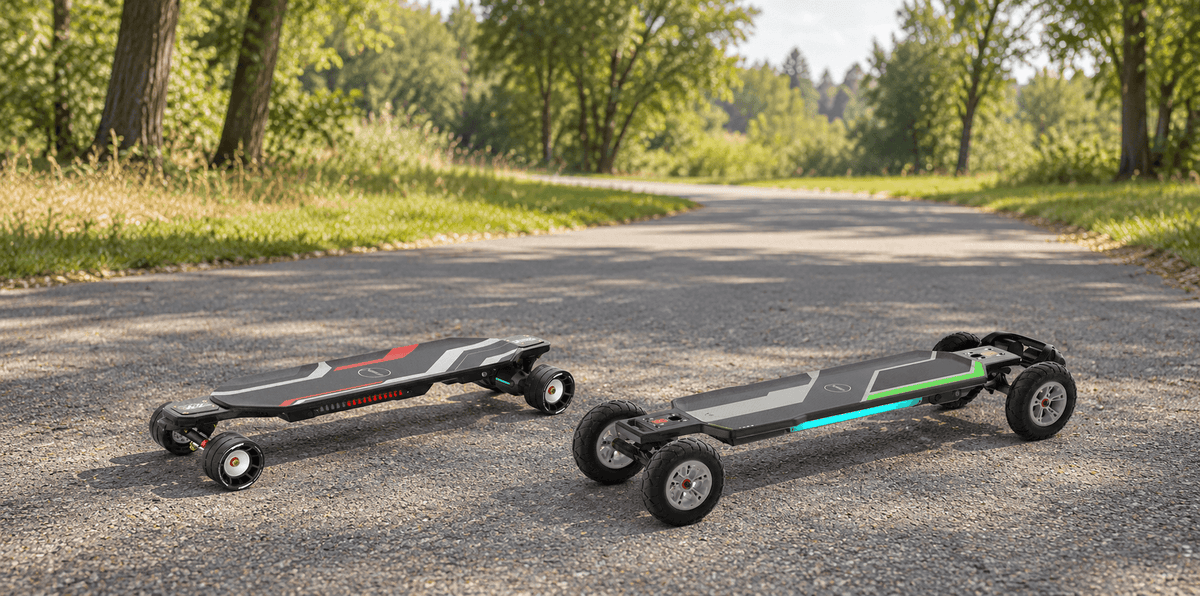
If your route is longer and mostly urban pavement, a longer commuter board with a claimed 34 to 37 mile range class makes more sense. You get more deck length, more stance confidence, and less pressure to charge constantly. For riders dealing with rough roads, patched bike lanes, and mixed surfaces, the better fit is an all-terrain format with wheel-dependent range expectations such as 37 miles on larger off-road wheels or 56 miles on more efficient street-oriented wheels.
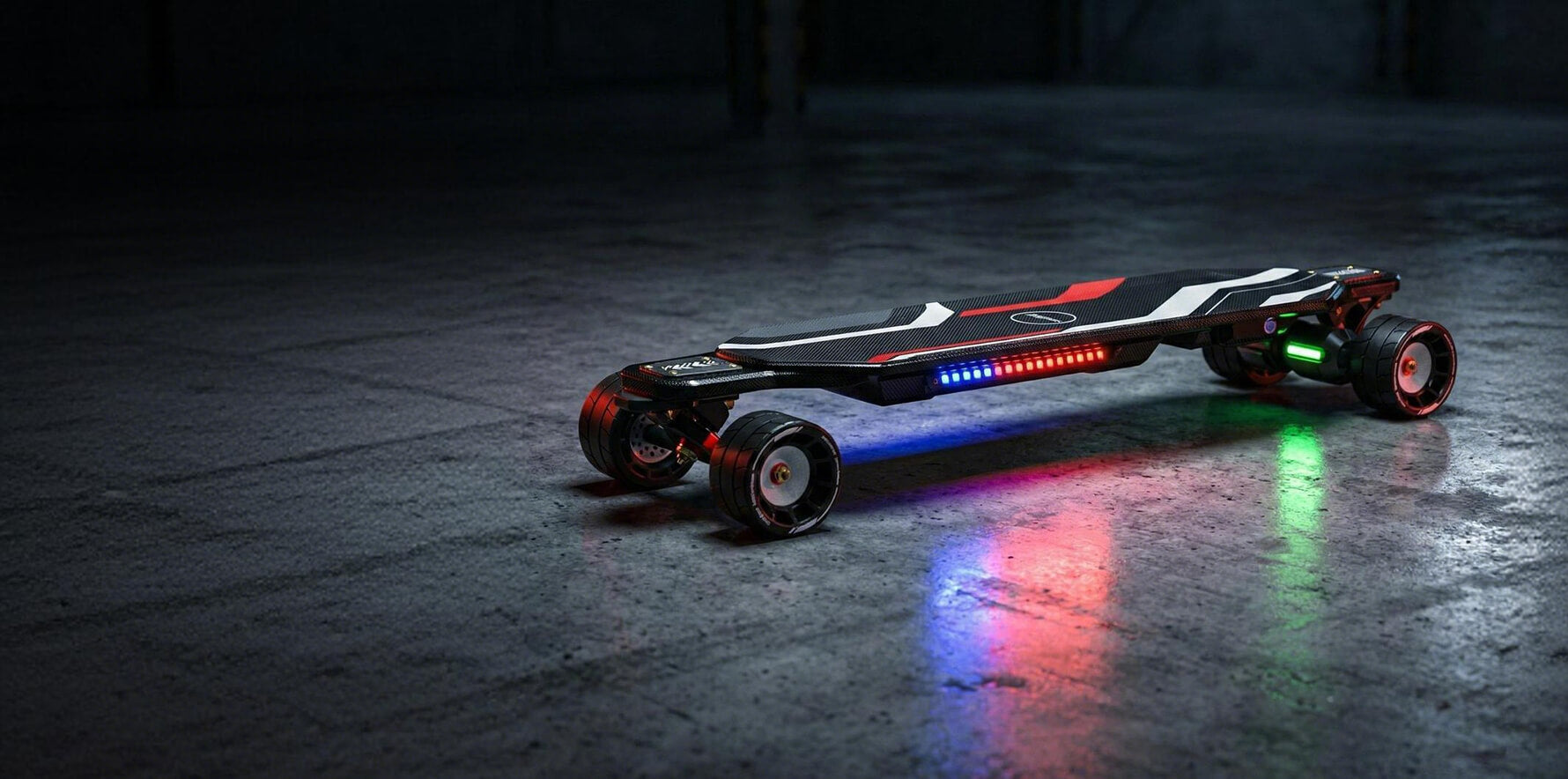
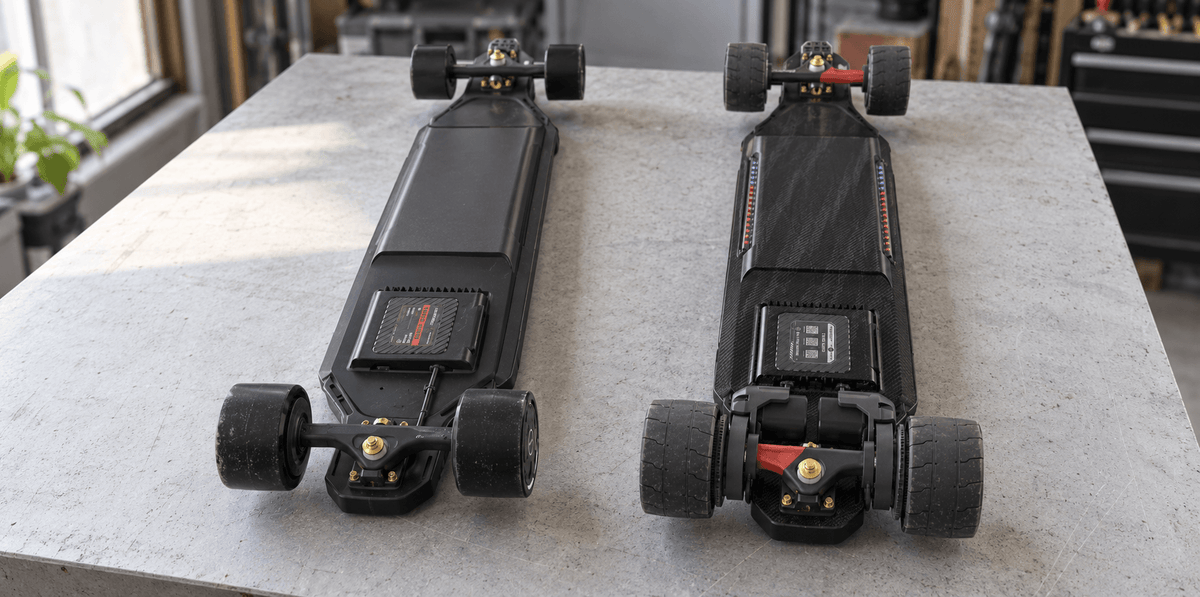
A lineup such as Maxfind’s CYBER series is useful here because it spans the three commuter formats people actually shop for: a 12.3 lb portable mini, a longer city-commute board in the 34 to 37 mile class, and an all-terrain option with 37/56 mile wheel-dependent range. The lesson is not to buy by category label. It is to buy by route, storage, and how much margin you want when the ride home is slower, wetter, or hillier than expected.
Commuters often ask whether splash resistance means rainproof. It does not. A third-party review reported an IPX5 rating for one commuter-oriented all-terrain model, and Electric Skateboard HQ noted that the battery enclosure is built into the deck to help achieve that water resistance. [2] That is a practical sign for light-rain realism, not a license to ride through standing water or treat wet traction like dry traction.
The bigger issue is grip. Wet roads lengthen braking distance, reduce wheel traction, and make smooth inputs more important. Slow down before painted arrows, manhole covers, steel plates, and glossy corner exits. Those surfaces can feel fine at walking speed and sketchy a second later.
Daily maintenance is what keeps a damp commute from becoming a reliability problem. Wipe the board down after wet rides. Check the grip surface, bushings, and wheel condition. Make sure the charging port is dry before plugging in. If bearings start sounding rough after repeated damp use, service them early instead of waiting for drag or noise to get worse. A commuter board can handle light-rain reality better when the rider treats moisture as a maintenance event, not just a weather condition.
Third-party feedback is most useful when it lines up across different kinds of sources. On Walmart, the Cyber Max X holds a 4.7 out of 5 rating from 113 ratings and 113 reviews. [3] Walmart’s AI review summary highlights high power performance, sturdy construction, fast charging speed, and a solid responsive ride. [3] Those are exactly the themes commuters tend to care about after the novelty wears off.
The individual comments are even more revealing. Jonathan T. wrote, “Absolutely amazing right out of the box! Love the ride feel, and the fact I feel zero road vibration is stunning. Nice gear ratio/throttle response, and braking.” Wesley G. [3] wrote, “Well worth the wait! The cyber max x is smooth as butter, has great range and top speed. [3] Fast charge time, great commuter board with a great thrill!” Other reviewers mentioned comfort around town, easy ride feel, and a useful safety guide in the box. [3]
There is also some anecdotal forum sentiment worth reading in the right spirit. One comment about a mini setup said it was really light and rode okay, while adding that build quality felt just okay. [3] Another snippet suggested strong torque and around 30 miles of range on a longer commuter setup. Forum comments are not formal testing, but they do reinforce a familiar pattern: portability is appreciated, while build impressions can vary by rider expectation and use case.
How much range should commuters really expect? Use claimed range as a ceiling, not a promise. If a board is rated around 34 to 37 miles, your real commute result will drop with hills, aggressive acceleration, heavier riders, and larger all-terrain wheels. A smart rule is to plan around noticeably less than the headline number and keep a return-trip buffer. [2][3]
Is a mini board practical for daily use? Yes, if your route is short and multimodal. A 12.3-pound carry weight is a strong benchmark when you need to bring the board onto transit, up stairs, or into work. The trade-off is that smaller boards usually feel less relaxed on rough pavement than longer decks.
Are larger wheels safer on rough pavement? Often, yes. A 107 mm wheel can reduce road vibration and improve roll-over comfort on pebbles and patched asphalt. A 175 mm all-terrain wheel is better when minor potholes, broken pavement, and loose debris are part of the normal route. [2]
Can an electric skateboard be used in light rain? Light rain is possible on a splash-resistant setup, but traction changes immediately. Treat wet roads as a lower-speed condition, avoid standing water, and dry the board before charging. Water resistance helps with exposure; it does not remove the need for caution.
How should braking be handled on steep descents? Brake early and progressively. Feather the brake instead of grabbing for a hard stop at the bottom. On steep downhills, be extra careful if the battery is at 100 percent, because regenerative braking works best when the pack has room to accept energy.
Reliable commuting comes down to a few repeatable decisions: choose braking you can trust in traffic, plan range with real-world margin, match wheel size to your pavement, and treat wet roads with respect. If you get those four things right, the ride feels less like a gamble and more like part of your day.
A commuter board should make city travel calmer, not more dramatic. The best choice is rarely the one with the loudest headline spec. It is the one that stays predictable when the road, weather, and traffic stop cooperating.

Compartir:
Electric Skateboard for Adult Riders: Choosing the Right Board for Daily Life
MAXFIND MINI P Review: Is This Compact Folding E-Bike Worth It?