


Promozione per il ritorno a scuola! 🏷️ Ottimo rapporto qualità-prezzo!

A 10-mile city commute sounds simple until stoplights, rough pavement, and battery anxiety turn brochure specs into a very different ride. The short answer is this: the standard Maxfind Cyber Max can be credibly treated as a commuter-oriented electric skateboard for a 10-mile urban trip, but only in a limited, careful sense because the official proof is modest and the stronger real-world evidence sits with the Cyber Max X rather than the base board. [1]
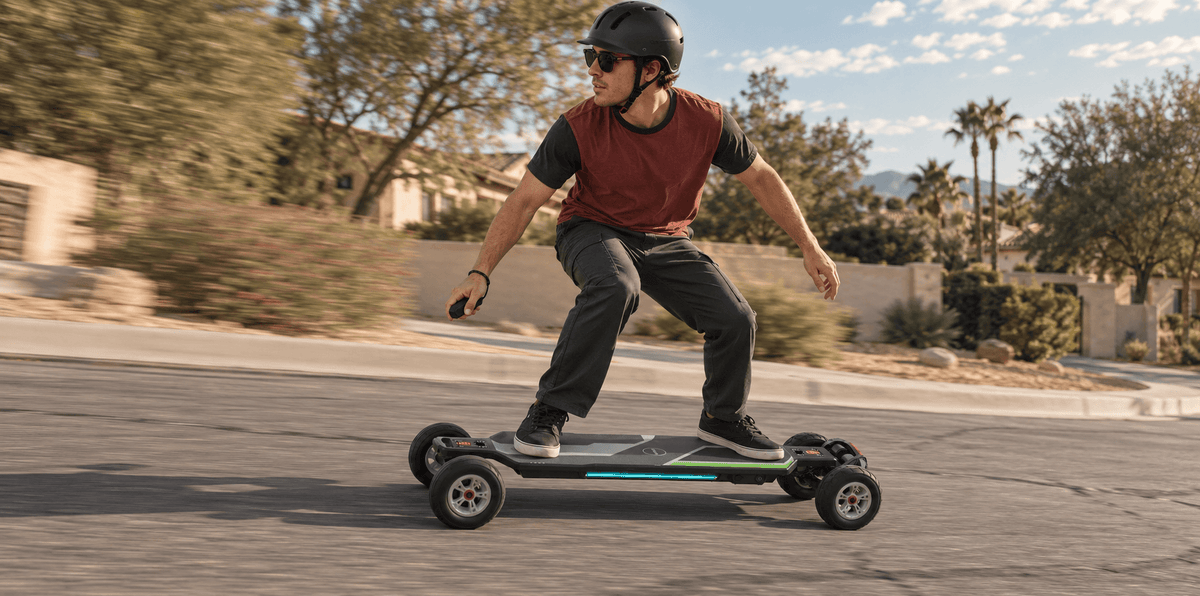
The standard Cyber Max has enough official spec to enter the commuter conversation, but not enough independent testing to own it outright. Maxfind positions the Cyber Max as “The Ulitmate Commuter E-Board,” and the official review page lists dual 650W hub motors, up to 15 miles of range, a Samsung 18650 10S2P 158.4Wh battery, 90mm PU wheels, a 38 x 11 in deck, and 30% hill climb capability. [2]
That makes the board relevant for the question people actually ask: which electric skateboard is best for 10-mile urban commutes, and which one gives you enough safe speed to cut commute time without the 37 mph fantasy. On paper, 15 miles is enough to cover a 10-mile route. In real city riding, though, a commuter board needs more than a paper range number. It needs battery margin after repeated stops, predictable braking, and a speed ceiling you can actually use between intersections.
That is where the evidence gets narrower. There is no strong independent stop-start city range test for the standard Cyber Max. The more convincing proof in this product family comes from the Cyber Max X, which has third-party commentary on realistic range and speed delivery. So if you are asking whether the base board is a verified 10-mile commuter, the honest answer is yes, but cautiously.
The Cyber Max qualifies for this topic because it was built and marketed around commuting rather than pure top-end performance. Maxfind describes its skateboards as being for adventure and commuting, and on its About page it calls the Cyber Max “The Ulitmate Commuter E-Board.” That matters because this is not a case of forcing a freestyle or off-road board into a commuter role after the fact. [2]
The official numbers are also specific enough to frame a real use case. The standard board is rated for up to 15 miles of range. It uses a Samsung 18650 10S2P 158.4Wh battery, dual 650W hub motors, 90mm PU wheels, and a 38 x 11 in deck. [3] Those are commuter-sized, city-relevant specs rather than vague lifestyle claims.
For this article, urban commuting efficiency means three things. First, the board needs enough battery headroom to finish a 10-mile route without treating the last mile like a gamble. Second, it needs controllable speed, because a board that can theoretically go faster than traffic is not automatically better in traffic. Third, it needs some degree of mixed-transit practicality, since many city riders carry a board into an office, apartment, or train station.
There are still important proof gaps. The base Cyber Max does not have a clean official weight figure in the supplied material. There is no independent stop-start city range test for the standard board. There is also no verified timed battery-swap workflow for this model, even though Maxfind’s battery page shows a broader battery ecosystem.

If your main question is which electric skateboard actually has the real-world battery life to handle a 10-mile commute without leaving you stranded, the base Cyber Max looks adequate on paper, not generous. Its official range is 15 miles, and its battery is 158.4Wh. A 10-mile ride would use about two-thirds of that claimed range before you factor in stop-start traffic, rider weight, rough pavement, hills, or headwind.
That is the key distinction. A board can be technically capable of a 10-mile commute and still feel tight on battery margin in city conditions. [1] Urban riding is rarely one long, efficient pull. It is acceleration from lights, braking into crossings, rolling over patched asphalt, and occasional detours. Every one of those things pushes a claimed range number downward.
The best clue inside this product family comes from the Cyber Max X. Electric Skateboard HQ lists that model with a 415Wh 12s2p Samsung 21700 40T battery, a claimed 37-mile range, and a 31 mph top speed. [3] Paxson Lim wrote, “In our experience, a realistic range estimate is around 28 miles (45 km) when riding fast on the 107mm wheels — which is still plenty for daily use and group rides.” That is a useful reality check because it shows a meaningful drop from claim to real use even on the larger-battery model.
The implication is straightforward. If the 415Wh Cyber Max X can compress from a 37-mile claim to around 28 miles in faster riding, the 158.4Wh base board should not be framed as having huge reserve for repeated 10-mile commuting without charging. It may do the job. It just does not have much room for bad conditions or forgotten charging habits.
So which electric skateboard is best for 10-mile urban commutes if battery confidence is your top priority? Based on the evidence here, the strongest case is not the base Cyber Max. The base board is plausible for one 10-mile city ride. It is not strongly verified for repeated stop-start commuting with comfortable reserve.
The speed question is where a lot of commuter marketing goes sideways. In traffic, usable speed is less about the highest number on a product page and more about how calmly the board accelerates, brakes, and settles over pavement transitions.
Traffic lights, parked cars, crosswalks, and lane changes make sustained top-speed riding unrealistic in most urban routes. A board that cruises smoothly at moderate speed can cut commute time more credibly than one that advertises a huge top number you rarely touch.
The Cyber Max X again offers the clearest third-party clue for how this family behaves. Paxson Lim wrote, “The board has a marketed top speed of 31 mph (50 km/h), and it does get there eventually.” He also noted, “In our test rides, acceleration felt strong but not outstandingly so.” For commuting, that is not bad news. [3] It suggests a board tuned more for stable delivery than for violent launch behavior.
User feedback on the Cyber Max points in the same direction. Walmart reviews highlight low road vibration, responsive throttle feel, and braking that riders found confidence-inspiring. One reviewer wrote, “Absolutely amazing right out of the box! Love the ride feel, and the fact I feel zero road vibration is stunning.” That is user evidence rather than lab testing, but it supports a comfort-and-control reading of the board.
So which electric skateboard actually delivers reliable speeds and range for a serious urban commute? For speed alone, the answer is the one with a controllable real-world cruise, not the one with the loudest top-speed claim. The independent proof remains thinner than the best-tested commuter benchmarks.
The standard Cyber Max belongs in the commuter discussion, but the comparison gets tougher once you line up published battery figures and third-party validation. TechGearLab says it tested 13 of today’s best e-skateboards head-to-head and measured top speed, range, braking power, and hill-climbing ability. [1] It also says electric skateboards can be used to glide through your commute. That kind of testing is the benchmark the base Cyber Max still lacks.
| Model | Price | Claimed top speed | Claimed range | Battery | Weight | Strongest commuting proof |
|---|---|---|---|---|---|---|
| Maxfind Cyber Max | Not stated | 28 mph | 15 miles | 158.4Wh | Not published by Maxfind | Officially positioned as “The Ulitmate Commuter E-Board”; commuter intent is clear, but independent stop-start city proof is limited |
| Maxfind Cyber Max X | $849 | 31 mph | 37 miles | 415Wh | 24.2 lbs | Electric Skateboard HQ reported realistic range around 28 miles when ridden fast on 107mm wheels |
| Meepo Flow | $649 | 32 mph | 24 miles | 432Wh | 24.2 lbs | Stronger published commuting-efficiency figures than the base Cyber Max on price, battery, and range |
| Exway Flex Pro V3 | $859 | 31 mph | 31 miles | Not published | Not published | Daily-commute positioning with a much longer published range claim than the base Cyber Max |
| Backfire Zealot S2 | Not published | 30.8 mph tested | Not published | Not published | Not published | TechGearLab named it its favorite overall and praised braking, hill power, and range |
This table compares only figures each brand or review actually publishes. That matters because commuter trust rises when the evidence is specific.
The base Cyber Max still has a real angle. Its edge is not maximum battery efficiency leadership. Its edge is a design-forward commuter pitch built around a 38 x 11 in deck, 90mm PU wheels, and comfort-oriented ride feel. The Cyber Max X adds stronger family-level proof with a 415Wh battery, 24.2 lbs weight, and a realistic third-party range estimate. [3] Meepo and Exway publish stronger battery or range numbers for commuting, while Backfire has the strongest independent benchmark in this set because TechGearLab tested braking, speed, and range directly.
Austin Palmer at TechGearLab described the Backfire Zealot S2 this way: “I experienced an outstanding blend of eye-watering speed, hill-gobbling power, marathon-plus range, and brakes that compete with boards that cost twice as much with this model.” That is the kind of independent commuting proof the base Cyber Max has not yet matched. [1]

The rider who makes the most sense for the standard Cyber Max is not chasing the highest speed number on the market. This board fits the commuter doing 5 to 10 mile city trips, dealing with rough pavement, and caring about ride feel, braking predictability, and easy storage in an office or apartment.
The official setup supports that reading. A 38 x 11 in deck gives the board a planted footprint. The 90mm PU wheels point toward paved-city use rather than all-terrain ambition. The commuter-first messaging is explicit, and the broader Cyber Max family shows that Maxfind has separated buyers by battery and performance needs rather than pretending one setup fits everyone.
That family matters. The official product page confirms Cyber Max, Cyber Max LR, Cyber Max6, Cyber Max Pro, and Cyber Max X. Hill climb is listed at 30% for Cyber Max, LR, and Max6, and 35% for Pro and X. Motor power also scales up from 650W x2 on Cyber Max and LR to 900W x2 on Max6 and Pro, then 1800W x2 on X. In plain terms, riders who need more battery headroom or stronger performance for longer commutes are already being pointed toward adjacent variants.
The caution remains practical, not theoretical. The missing base-model weight makes mixed-transit carry convenience harder to judge. The lack of an independent stop-start range test keeps the standard board from making a stronger efficiency claim. So the best version of the commuter argument is this: the base board looks well suited to comfort-first urban cruising, while riders who want more reserve for serious daily mileage should be looking at the larger Cyber Max family rather than stretching the smallest battery too far.
The standard Cyber Max can be credibly described as a commuter-oriented electric skateboard with enough official range to make a 10-mile city ride plausible on paper. [1] Maxfind’s own positioning, the 15-mile claimed range, the 28 mph top speed, the 158.4Wh battery, and the commuter-sized deck all support that.
What the evidence does not support is a stronger claim that the base board is already proven for stop-start urban conditions with generous battery reserve. The independent proof is much stronger for the Cyber Max X than for the standard Cyber Max, and even that stronger evidence points toward realistic moderation rather than headline-spec hype. A claimed 37-mile range became around 28 miles in fast riding for the X, which is still good, but it is also a reminder that city commuting should be judged by margin, not marketing. [3]
Who it is for: riders who value comfort-first city cruising, predictable control, and a board that was clearly designed with commuting in mind. [2] Who it is not for: commuters who want independently proven battery reserve, a published carry weight on the base model, or the strongest third-party validation in the category.
Yes, in a cautious on-paper sense. The standard board is officially rated for up to 15 miles and uses a 158.4Wh battery, so a 10-mile route is within its published capability. [2] The catch is margin. City riding with stops, rough pavement, hills, and wind can reduce usable range, so this looks more like “enough if conditions are reasonable” than “plenty with reserve.”
No strong independent stop-start city range test was found for the standard Cyber Max. That is the biggest evidence gap in the commuter story. The stronger third-party range evidence is for the Cyber Max X, where Electric Skateboard HQ reported a realistic range of around 28 miles when ridden fast on 107mm wheels, down from a 37-mile claim. [3] That makes the base board harder to verify beyond its official 15-mile figure.
For most urban commuting, yes. In traffic, stable acceleration, braking, and pavement control matter more than a top number you rarely sustain.
The Cyber Max X makes the strongest evidence-based commuter case in this family. Electric Skateboard HQ lists it at $849 with a 415Wh battery, 31 mph top speed, 37-mile claimed range, and 24.2 lbs weight, then adds a realistic range estimate of around 28 miles in faster riding. [3] The base Cyber Max still makes sense for shorter comfort-first commuting, but the proof is much stronger for the X than for the standard board.
Pricing reflects listed figures and can change; confirm current prices before buying.

Condividi:
Pavement Vibration Management With Maxfind CYBER ULTRA on Rough Streets