

Schulanfangsangebot! 🏷️ Tolles Preis-Leistungs-Verhältnis!

Quick Answer: For a rough-pavement commute, start with the wheel-and-deck configuration rather than the drivetrain label. Maxfind’s Cyber Max configurations with larger street wheels are worth exploring for mostly smooth routes interrupted by rough blocks; Cyber Ultra’s pneumatic configurations become more compelling when poor pavement is continuous and carrying is infrequent. [1] Hollow urethane wheels and the Cyber models’ composite decks offer relevant cushioning features, with reviewers reporting comfortable rides on specific Cyber Max X and Cyber Ultra belt setups. [2][3][4]
Choosing an electric skateboard for cracked asphalt and rough brick means looking beyond whether it can cross a bump. The more useful question is how the complete setup feels through repeated interruptions—and how that choice fits the rest of your commute.
Hub, belt, and gear drive are not enough to identify the most comfortable setup. On the Cyber Ultra, for example, Maxfind pairs the Hub Motor configuration with 165mm pneumatic wheels and the Belt Motor configuration with 175mm pneumatic wheels. [5] Comparing those boards changes the wheels as well as the drivetrain, so a comfort difference cannot automatically be credited to the motor type.
The ride observations discussed below do not provide a matched hub-versus-belt-versus-gear vibration test. A gear-drive comfort verdict remains unresolved, as does a drivetrain winner for cracked pavement and rough brick. The useful starting point is the documented wheel construction and the experience reported for each complete configuration.
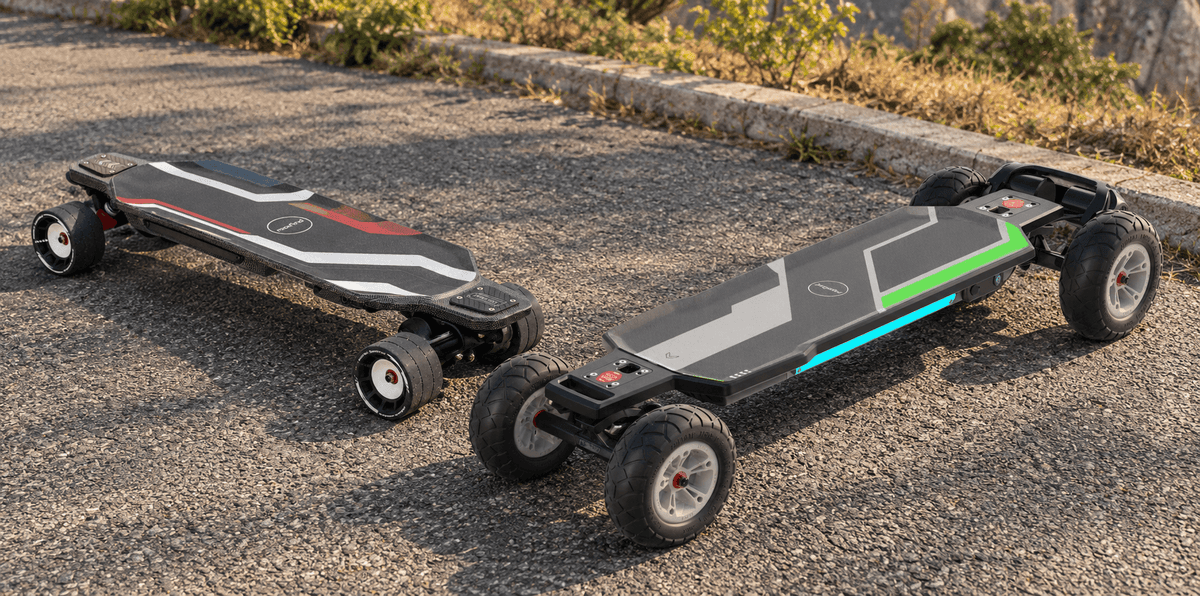
Within the Cyber Max series, the standard Cyber Max and LR specify 90mm PU wheels, while PRO and X specify 107mm Space Wheels. [2] The Cyber Mini series makes a similar distinction: standard Cyber Mini and AIR use 90mm PU wheels, while PRO and X use 107mm Space Wheels. [6] Select the variant deliberately; the series name alone does not tell you which wheels you will be riding.
Maxfind describes the 107mm Space Wheels on both series as using 74A urethane, a reinforced nylon core, and 10 hollow pockets that allow the polyurethane to flex. [2][6] That construction gives the soft material room to deform under load. For a commuter, the relevant feature is this combination of wheel size and flexing urethane—not diameter alone.
Paxson Lim of Electric Skateboard HQ found that the Cyber Max X’s 107mm, 74A urethane Spacewheels did a decent job absorbing road vibration on rougher pavement and felt more comfortable than standard PU wheels during his rides. [3] His observation belongs to the tested X belt-drive setup; it is a qualitative riding impression rather than a measured vibration-reduction percentage.
An owner’s account illustrates why crossing bumps and staying comfortable are different outcomes. In a Maxfind-hosted review marked Verified, Karel S. in the Czech Republic reported that his Cyber Mini with 90mm wheels could traverse some bumps, but comfort decreased and he preferred a very smooth surface. [6] He reported weighing 90kg and having attempted speeds up to 25km/h; that was his maximum attempted speed, not a fixed comfort-test condition. [6] This is experience with his particular board, not a verdict on every Cyber Mini configuration or a specification for US models.
For readers already drawn to the Cyber Mini series, the PRO and X wheel construction therefore deserves attention when pavement comfort is a priority. The owner’s 90mm experience should not be transferred to those 107mm versions.
Cyber Ultra provides a different configuration path. Its Belt Motor version specifies 175mm pneumatic wheels, its Hub Motor version specifies 165mm pneumatic wheels, and its Belt Motor (2 in 1) option specifies 175mm pneumatic wheels plus 107mm Space Wheels. [5] Those are distinct choices; the 2-in-1 specification does not establish identical ride behavior with either wheel set.
Ziyad Khairi of Electric Skateboard HQ tested the Cyber Ultra belt version with 175mm pneumatic wheels and reported that they absorbed road vibration well, including over cracks and gravel. [4] That observation supports considering this particular setup for rough commuting surfaces, without establishing how the 165mm hub version compares.
Khairi also identified a useful trade-off: the 175mm wheels and slightly dropped deck produce a higher ride height, helping clearance over speed bumps but delivering less of a low, planted carving feel. [4] If your electric longboard commute includes raised transitions, that clearance may matter more than a deeply settled carving sensation.
In a separate Maxfind-hosted review marked Verified, Cyber Ultra owner Chris P. reported that 175mm air tires softened small rocks and rough pavement seams on a route with a short packed-gravel stretch. [5] His motor configuration was unspecified, so his account adds an owner perspective on those tires without confirming a belt-versus-hub result.
Pneumatic cushioning also depends on pressure. Maxfind advises maintaining tires within the manufacturer’s specified range for the exact wheel-and-tire configuration: excessive pressure reduces cushioning, while excessively low pressure increases rolling resistance and exposes the tire or rim to impact damage. [1] Use the matching tire instructions to establish that range before riding; do not copy a pressure from another model or lower it experimentally just to soften the ride.
These experiences make larger hollow urethane wheels and pneumatic setups relevant options for a bumpy commute. They do not establish a best configuration for every brick surface or guarantee reduced knee or ankle fatigue on rides of 10 miles or longer.

The deck is the other important part of the setup beneath your feet. Cyber Max and Cyber Ultra specify integrated decks made from PPS composite and glass fiber. [2][5] Cyber Mini also specifies PPS composite and glass fiber as its deck material, with a carbon-fiber surface coating. [6] That coating should not be read as an all-carbon structural deck.
Maxfind’s material rationale is that its PPS composite flex helps absorb road chatter. [7] For the commuter, the practical question is whether that give complements the wheels without making the board feel excessively bouncy.
Lim’s Cyber Max X ride provides a model-specific example. He described its U-shaped concave as helping keep his feet settled and its deck as having enough give to absorb some shocks without feeling overly bouncy or unstable. [3] His ride used the 107mm Spacewheels, which he also credited with contributing substantially to comfort. [3] This supports considering the wheel-and-deck combination rather than assigning the entire result to flex alone.
Khairi similarly described the Cyber Ultra belt setup’s semi-flex composite deck as pairing naturally with its tested 175mm pneumatic wheels. [4] Together, these reports give a practical reason to consider composite flex as part of pavement vibration management.
Rider weight still matters when interpreting that feel. Cyber Mini, Cyber Max, and Cyber Ultra each publish a load limit of 330 Lbs / 150 Kg. [2][6][5] Those are operating limits, not target weights for ideal flex or guaranteed comfort.
The cited ride accounts do not isolate the deck’s vibration contribution or establish how much each deck flexes at your weight. Ask Maxfind for exact-model fit guidance using your rider weight, chosen wheel configuration, and the character of your route. A material name alone cannot establish a carbon-versus-bamboo-versus-composite comfort ranking, and load-test figures should not be treated as rider-specific cushioning results.

A useful shortlist starts with your commute, then narrows to the Cyber configuration that addresses it.
Not automatically. Terrain labels need to be interpreted alongside the particular setup and the kind of terrain involved.
Paxson Lim of Electric Skateboard HQ cautioned that the Cyber Max X with 107mm Spacewheels lacked the torque and clearance for actual trail riding, despite its ability to handle some small debris and loose surfaces. [3]
Ziyad Khairi judged the tested Cyber Ultra belt version with 175mm all-terrain wheels capable of light off-roading, but not suited to serious mountain trails. [4] These are reviewers’ judgments about those configurations, not terrain certifications. For a pavement commuter, an “all terrain” or “off road” description is a reason to examine the setup closely—not permission to extend every comfortable street ride onto trails.
Teilen:
Best Boards for Campus, Hills & Heavy Riders