

Schulanfangsangebot! 🏷️ Tolles Preis-Leistungs-Verhältnis!
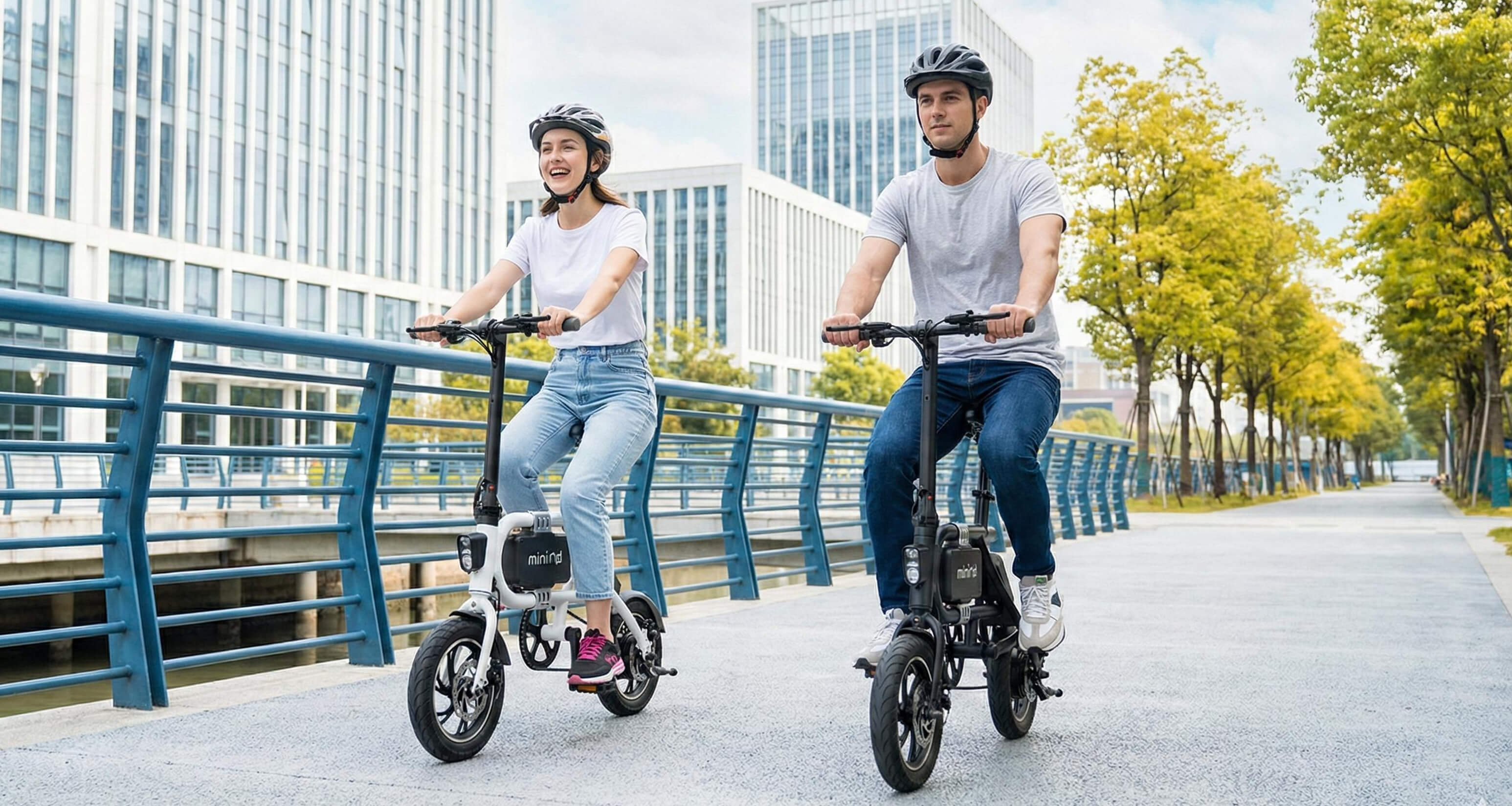
The MAXFIND MINI P is a compact folding e-bike built for short commutes, apartment storage, offices, and RV travel. With a 350W motor, pedal assist, and 12-inch tires, it favors everyday convenience over high performance. This review examines its range, portability, comfort, and ideal use cases.
The MAXFIND MINI P is a storage-focused electric bike for everyday urban mobility. Its folding frame and seated pedal-assist design make it suitable for indoor storage and occasional lifting, but less practical for commutes that involve frequent carrying.
The MINI P combines the compact dimensions of a micromobility vehicle with the seat, pedals, and riding position of a small electric bicycle. Its design prioritizes convenient storage and moderate urban travel rather than high speed, aggressive climbing, or off-road performance.

Compared with an electric scooter, the MINI P provides a seat and pedal assistance, which may improve comfort and help extend range during neighborhood trips. Riders who prefer a standing position, higher performance, and a conventional scooter format can compare it with the currently available MAXFIND GLIDER G5 Series. Compared with a 16-inch or 20-inch folding e-bike, the MINI P requires less storage space but provides less obstacle clearance. It is a better match for compact seated travel, while a larger folding e-bike generally feels more conventional over longer routes and uneven surfaces.
The published specifications position the MINI P as a moderate-speed commuter for everyday paved routes. Performance can change with rider weight, terrain, temperature, tire pressure, riding mode, cargo, and battery condition.
|
Specification |
MAXFIND MINI P |
|
Motor |
350W brushless hub motor |
|
Motor torque |
19Nm |
|
Top speed |
Up to 16 mph / 25 km/h |
|
Pure electric range |
Up to 18 miles / 30 km |
|
Pedal-assist range |
Up to 37 miles / 60 km |
|
Battery |
EVE 18650, 7.8Ah, 280Wh |
|
Charging time |
Approximately 3.9 hours |
|
Pedal assistance |
Three modes |
|
Wheels |
12-inch inflatable tires |
|
Brakes |
Dual disc brakes |
|
Bike weight |
55 lb / 25 kg |
|
Maximum load |
330 lb / 150 kg |
|
Water resistance |
IPX5 |
|
Display |
2-inch high-brightness LED |
|
App |
Tuya |
|
Unfolded dimensions |
43.3 × 6.8 × 41.3 inches |
|
Folded dimensions |
43.3 × 6.8 × 22.4 inches |
|
Lighting |
90-lux front light and rear light |
Folding is the MINI P’s defining feature, but folded size and carrying ease should be evaluated separately. The bike becomes easier to store without becoming a lightweight object to carry.
Maxfind describes a one-second unlocking process and a three-second fold. This can make the transition between riding and storage more convenient when the mechanism is used correctly. Before riding, the frame should be fully opened, the folding lock should be completely engaged, and the joint should be checked for unexpected movement. The locking area should also be included in regular inspections because repeated folding, transportation, and road vibration can gradually affect its adjustment.
The published height decreases from 41.3 inches when unfolded to 22.4 inches when folded, while the listed length remains 43.3 inches. The bike therefore becomes lower but does not collapse into a suitcase-sized package. Its shape may fit beside an office desk, against an apartment wall, inside an RV compartment, or in a suitable car trunk. Buyers should measure both the intended storage area and the trunk opening before ordering, and the bike should be secured during vehicle travel.
At 55 lb, the MINI P is compact but not lightweight. Many adults may be able to lift it briefly into a vehicle or move it over a curb, but carrying it through a station or up several flights of stairs could quickly become uncomfortable. It is better suited to ground-floor homes, buildings with elevators, accessible offices, and car-based travel. Older adults and riders with limited grip, shoulder, back, or upper-body strength should test their ability to manage a similar weight before buying.
The motor and speed are designed around controlled city travel rather than aggressive performance. Riders should compare these figures with the distance, traffic, and hills on their normal route.
A 350W hub motor should provide useful assistance for starts, neighborhood riding, maintained streets, and moderate inclines, particularly when the rider contributes through the pedals. Performance may decrease with additional cargo, low battery charge, strong headwinds, or repeated hills. The published 330 lb maximum load describes the listed carrying capacity and does not mean that acceleration, range, and climbing ability will remain unchanged as the total load increases.
A top speed of up to 16 mph is sufficient for many campuses, parks, neighborhoods, bike paths, and office commutes. The moderate limit may feel more approachable to a beginner than the higher speeds offered by performance-focused e-bikes. It may feel restrictive to riders covering longer open-road distances or traveling with faster cyclists. Local e-bike classifications, campus policies, path regulations, and posted limits should always take priority over the bike’s maximum capability.
Maxfind publishes a 20% hill-climbing figure, but another section of the product page also uses a 20-degree description. A percentage gradient and an angle are different measurements, so buyers should use the 20% specification unless Maxfind provides additional test details. Practical climbing ability also depends on slope length, total load, remaining battery charge, tire pressure, approach speed, temperature, and pedal input. The MINI P is more appropriate for moderate urban inclines than long, steep climbs powered only by the motor.

The MINI P combines a 280Wh battery with pure electric and pedal-assisted operation. Understanding how the riding modes change energy use is essential when planning a regular route.
Maxfind lists up to 18 miles in pure electric mode and up to 37 miles with pedal assistance. The product page describes the 37-mile figure as a pedal-assist result tested with a 90 kg rider, so it should not be presented as a throttle-only range. Results can still change with route conditions, speed, assist level, and rider effort. Daily commuters should leave enough reserve for detours, wind, changing temperatures, and gradual battery aging.
Range can decrease because of added weight, hills, cold temperatures, headwinds, low tire pressure, frequent acceleration, higher assistance settings, continuous throttle use, and battery condition. Stop-and-go traffic may also require more energy than maintaining a steady pace on a flat path. Riders can improve efficiency by keeping the tires properly inflated, accelerating smoothly, contributing through the pedals, and selecting an assistance level that matches the route.
The scroll throttle allows the motor to propel the bike without continuous pedaling, while the three pedal-assist modes provide published assistance levels of 25%, 50%, and 75%. Lower assistance is useful for flatter routes and conserving battery power, while higher assistance can reduce effort during starts, headwinds, and moderate inclines. The product information also states that the assistance percentage can be adjusted through the Tuya app.
The 280Wh battery has a published charging time of approximately 3.9 hours with the included 42V 2A charger. Owners should charge the bike in a dry, ventilated location, use only the specified compatible charger, inspect the battery and charging port for visible damage, and avoid excessive heat. If the bike will not be used for an extended period, the battery should be stored according to the manufacturer’s current guidance rather than left completely depleted.
The pedals provide a backup when the remaining charge becomes low, but moving a 55 lb electric bike without assistance will require more effort than riding a lightweight conventional bicycle. Hills and cargo will make the difference more noticeable. Pedal-only operation is therefore better treated as a way to finish a short return trip than as a plan for regularly riding long distances with an empty battery.
The included charger is described as a UL charger, but the product page does not clearly identify a whole-bike UL 2849 certification. Buyers who require certified electrical-system protection should confirm the applicable standard, certification organization, and exact model coverage before ordering. Certification of a charger or another Maxfind product should not automatically be treated as certification of the complete MINI P electrical system.
Wheel size, tire construction, rider position, and braking equipment have a direct effect on daily comfort and control. The MINI P uses a compact small-wheel setup intended primarily for maintained urban surfaces.
The 12-inch wheels help reduce the bike’s overall dimensions and can make low-speed steering feel responsive. The extra-wide inflatable tires should absorb minor surface vibration better than solid tires, but they cannot fully compensate for deep potholes, high curbs, drainage channels, loose gravel, or abrupt road transitions. Riders should slow down before broken sections and approach obstacles as directly as conditions safely allow.
The upright handlebar and ventilated seat support a relaxed seated position for everyday trips. Proper fit still depends on seat height, handlebar reach, pedal position, leg extension, and individual body proportions. The published maximum load does not confirm that every rider within that limit will have enough legroom or receive the same riding comfort. Very tall or short riders should confirm the available seat-adjustment range before purchasing.
The compact design can help the MINI P move through narrow spaces, but small wheels may make steering inputs feel quicker than on a full-size bicycle. New riders should practice starting, gradual turning, controlled braking, and low-speed balance on a flat, dry surface before entering traffic or crowded paths. Smooth throttle input is especially important around pedestrians because sudden acceleration reduces the time available to correct a mistake.
The MINI P uses a dual-disc braking system. Effective stopping still depends on adjustment, pad condition, rotor alignment, road conditions, and rider technique. Before the first full ride, owners should test both brakes at walking speed and confirm that the controls respond consistently. Stopping distance will increase with speed, total load, downhill grades, and wet pavement, so riders should leave additional space whenever conditions become less predictable.
The bike includes a 90-lux front light, rear light, brake-light function, and electric horn. These features improve visibility and communication during urban riding, but riders should make sure the lights remain unobstructed and bright enough for their route. Additional reflective clothing or lighting may still be useful around traffic, dark paths, and poorly lit intersections.
An IPX5 rating indicates resistance to water exposure under defined test conditions, but it does not make the MINI P fully waterproof or suitable for submersion. Wet pavement can also reduce tire grip, hide road damage, and increase braking distance. Riders should avoid deep water, protect the charging port, reduce speed when conditions change, and dry the bike after unexpected exposure.
The MINI P includes several convenience features that support daily use. They add value after the bike’s range, fit, and storage characteristics have already been matched to the rider.
The two-inch high-brightness LED display is designed to present riding information at a glance, while the Tuya app allows riders to adjust the pedal-assist percentage. The integrated USB output can help power a phone or another small device during a trip, although this energy comes from the bike’s main battery. These features improve convenience, but they should remain secondary to practical considerations such as route length, rider fit, and storage access.
The MINI P works best when its folding profile solves a genuine storage problem and the bike can normally be rolled to its destination. Its suitability changes according to the rider’s building access, route, and transportation habits.
The bike is a strong match for an elevator-equipped apartment, ground-floor home, accessible office, or car and RV owner who needs compact transportation at the destination. It is less convenient in a walk-up apartment or a commute involving long station corridors. Campus users should confirm local rules covering registration, helmets, charging, indoor storage, speed, and permitted routes. For RV and camping use, the MINI P is better suited to paved campground roads and local supply trips than loose trails.
Light cargo may be practical if a compatible basket, rack, or bag system is available, but buyers should confirm approved accessory options before purchasing. Heavy bags should not hang loosely from the handlebar because they can interfere with steering or reach the front wheel. Added cargo will also affect range, acceleration, braking, and climbing. The MINI P is more naturally suited to a backpack or small work bag than a large grocery load.

Long-term value depends on whether routine service and replacement components remain accessible. Buyers should consider maintenance requirements and after-sales support alongside the initial product specifications.
Routine care should include checking tire pressure, tire condition, both brakes, visible cables, frame fasteners, lights, the charging port, and the folding lock. The folding mechanism deserves particular attention because it is both a convenience feature and a structural connection. Cleaning should avoid directing high-pressure water toward bearings, electrical connections, the display, or the charging port.
Buyers should confirm the availability of common wear items such as 12-inch tires, compatible inner tubes, and brake pads, along with model-specific components such as the battery and charger. Standard mechanical parts may be easier to replace locally, while electrical components are more likely to depend on Maxfind or an authorized seller. Replacement-battery availability is particularly important to the bike’s long-term usability.
A local bicycle shop may agree to service tires and mechanical brakes while declining work on an unfamiliar battery, controller, motor, or folding frame. Buyers who depend on professional maintenance should contact a nearby repair shop before purchasing. They should also confirm coverage for the frame, folding mechanism, motor, battery, controller, charger, labor, and shipping, along with any differences between direct and third-party purchases. Return conditions and shipping costs should be reviewed before the bike is assembled or used.
The MINI P offers a practical set of features for compact daily transportation, but its value depends on whether the rider’s storage situation, route, and physical ability match the design.
|
Pros |
Cons |
|
Compact folding profile |
Heavy for frequent carrying |
|
Seated throttle and pedal-assist riding |
Small wheels require more care around potholes |
|
Moderate speed for urban trips |
Limited performance on long or steep hills |
|
Wide pneumatic tires |
Maximum range depends on riding conditions |
|
Dual disc brakes |
Less suitable for long-distance commuting |
|
Integrated display, lights, and horn |
Cargo compatibility requires confirmation |
|
Tuya app and USB output |
Local electrical repair options may be limited |
|
Multiple color choices |
Model-specific parts may depend on Maxfind |
|
Practical short-distance design |
Whole-bike certification requires verification |
The MAXFIND MINI P folding electric bike is best suited to short-distance commuters, apartment residents with elevator access, office or campus riders with approved storage, and car or RV travelers who want seated transportation at their destination. It makes the most sense when routes are mainly paved, the expected range leaves a comfortable reserve, and the bike can usually be rolled instead of carried. Riders who face stairs every day, extended steep hills, heavily damaged roads, substantial cargo requirements, or limited access to compatible repair services should consider another e-bike.
The MAXFIND MINI P is a useful middle ground between an electric scooter and a larger folding e-bike. It is worth considering when compact storage, seated assistance, and moderate urban performance matter more than easy carrying, rough-road capability, or long-distance range.
Maxfind lists up to 18 miles in pure electric mode and up to 37 miles with pedal assistance. The 37-mile figure is described as a pedal-assist result tested with a 90 kg rider, while actual results can still vary with terrain, weather, speed, load, and assistance level.
Its folding design reduces storage height and can make it easier to place in an apartment, office, car, or RV. Its weight makes extended carrying and repeated stair use difficult, so it is more practical to roll and store than carry over long distances.
The 350W motor is better suited to moderate urban inclines than long, steep climbs. Its inflatable tires can absorb minor surface vibration but are not designed for deep potholes, loose gravel, high curbs, or heavily damaged roads.
The published maximum load is 330 lb, but load capacity does not guarantee comfortable fit or unchanged performance. Buyers should confirm the current seat-adjustment range, while heavier riders should allow for possible reductions in acceleration, range, and climbing speed.
More reading: Electric Skateboard vs Electric Bike for Short Urban Trips
Teilen:
How to Assess Commute Safety and Reliability on a Maxfind Electric Skateboard
How to Reduce Pavement Vibration on Rough City Streets