

¡Oferta de vuelta a clases! 🏷️ ¡Una excelente relación calidad-precio!
--
Días--
Horario--
Minutos--
SegundosLas ruedas de los monopatines eléctricos influyen en mucho más que la comodidad de marcha. Pasar de 90 mm a 105 mm o 120 mm puede cambiar la capacidad para superar obstáculos, la aceleración, la sensación de frenado, la altura de conducción y la autonomía. Esta guía compara los tres tamaños y explica la compatibilidad para que puedas elegir ruedas que se adapten a tu tabla, tus carreteras y tus prioridades de conducción.
No existe un único tamaño de rueda ideal para todos los monopatines eléctricos. Las ruedas más pequeñas generalmente favorecen una conducción urbana más reactiva, mientras que las ruedas más grandes priorizan la capacidad para superar obstáculos y la comodidad.
|
Tamaño de la rueda |
Ideal para |
Ventaja clave |
Principal desventaja |
|
90 mm |
Carreteras lisas |
Conducción rápida y receptiva |
Más vibraciones de la carretera |
|
105 mm |
Pavimento mixto |
Equilibrio entre comodidad y control |
Ligeramente menos receptivas |
|
120 mm |
Caminos accidentados |
Superación más suave de los obstáculos |
Mayor distancia al suelo y límites de compatibilidad |
MAXFIND ofrece varias ruedas para monopatín eléctrico en estos rangos de tamaño, incluidas las ruedas de PU estándar, las ruedas amortiguadoras y las opciones Cloudwheel para diferentes sistemas de transmisión.

El diámetro de la rueda cambia la distancia recorrida por rotación y la capacidad de la rueda para pasar sobre las irregularidades de la superficie. El resultado final también depende del motor, la transmisión, el material de la rueda, el peso del usuario y las condiciones de la carretera.
Una rueda más grande generalmente pasa sobre juntas del pavimento, grietas poco profundas y pequeños residuos de forma más gradual, porque esos obstáculos son menores en relación con su diámetro. Por lo tanto, una rueda de 120 mm puede sentirse menos brusca que una de 90 mm sobre asfalto deteriorado, mientras que las ruedas de 105 mm ofrecen una opción intermedia para quienes buscan más comodidad sin usar la configuración más grande.
Con el motor y la transmisión sin cambios, las ruedas más pequeñas generalmente proporcionan una respuesta de aceleración y frenado más inmediata, mientras que las ruedas más grandes aumentan la relación de transmisión efectiva y pueden hacer que el par o el frenado a baja velocidad se sientan menos agresivos. La magnitud de este cambio depende de la potencia del motor, la relación de transmisión, las pendientes, el peso del usuario y los ajustes del controlador, por lo que no debe presentarse como idéntica para todas las tablas.
A la misma velocidad de rotación de la rueda, una rueda más grande recorre una mayor distancia y puede aumentar la velocidad máxima teórica, pero el motor aún debe tener suficiente potencia para alcanzar esa velocidad bajo carga. La autonomía puede aumentar o disminuir según los hábitos de aceleración, el peso de las ruedas, la superficie de la carretera, las cuestas, la velocidad de conducción y la eficiencia de la transmisión, por lo que el diámetro de la rueda por sí solo no permite predecir un cambio fijo en la autonomía.
Las ruedas más grandes elevan la tabla y las carcasas electrónicas más lejos del suelo y facilitan superar las irregularidades de la superficie, pero la mayor altura de conducción puede sentirse menos directa en los giros cerrados. Las ruedas más pequeñas mantienen la tabla más baja y normalmente ofrecen una sensación de contacto más estrecha con la calle, mientras que las ruedas más grandes favorecen la capacidad de superar obstáculos y la comodidad en lugar de la máxima agilidad.
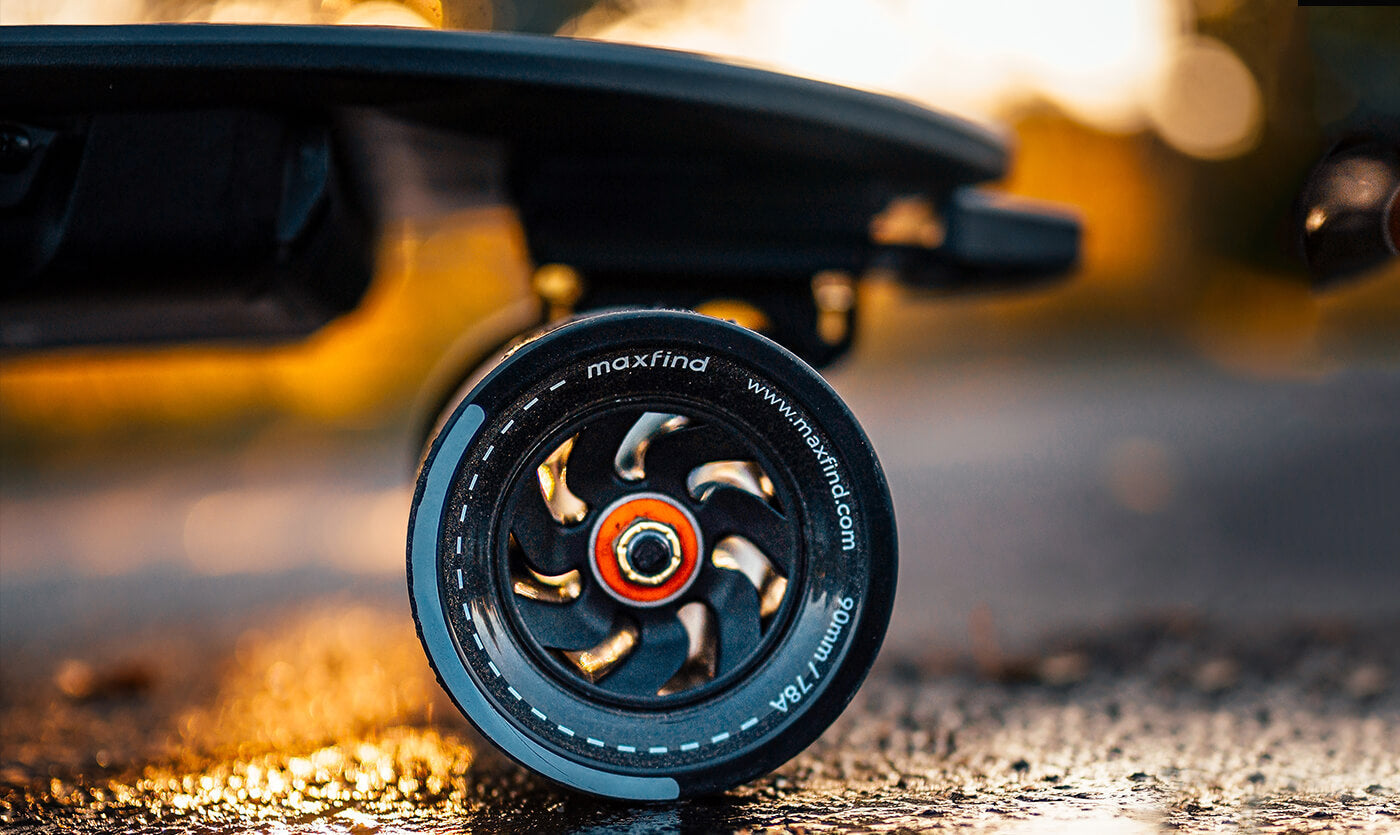
El diámetro es solo un aspecto del rendimiento de una rueda. MAXFIND indica que sus ruedas de PU de 90 mm tienen una dureza de 78A y 60 mm de ancho, que sus ruedas amortiguadoras de 105 mm tienen una dureza de 78A y están fabricadas con PU de alta elasticidad, y que sus Donut Cloudwheels tienen una dureza de 78A, una banda de rodadura escalonada y una estructura de amortiguación DFC; por eso, unas ruedas con una dureza similar aún pueden sentirse diferentes debido a su forma, anchura, rebote y diseño interno.
Un diámetro preferido no es automáticamente un diámetro compatible. Comprueba el sistema de transmisión, el núcleo de la rueda, la polea, el espacio libre y los modelos de tablas compatibles antes de pedir ruedas de repuesto para monopatines eléctricos.
Los motores de buje están integrados en las ruedas motrices, por lo que los repuestos compatibles deben adaptarse a la carcasa del motor y no limitarse a coincidir con el diámetro original. Actualmente, MAXFIND ofrece variantes Donut Cloudwheel de 105 mm y 120 mm específicas para motores de buje para los modelos indicados, pero aun así debes confirmar la compatibilidad con la tabla, el motor y la variante exactos del producto, en lugar de basarte únicamente en el tamaño.
Las tablas con transmisión por correa suelen ofrecer más opciones de ruedas, pero el núcleo de la rueda debe aceptar la polea correcta, y el número de dientes de la polea, la relación de transmisión, la longitud de la correa y la posición del motor deben funcionar en conjunto. Una rueda más grande cambia la relación de transmisión efectiva, mientras que las combinaciones incorrectas de polea o correa pueden provocar una mala alineación o tensión de la correa; por eso, verifica todo el sistema de transmisión y no solo el diámetro de la rueda.
Las ruedas más grandes necesitan suficiente espacio alrededor de la tabla, los ejes, los soportes del motor, las cubiertas de la correa y las carcasas durante los giros completos y la flexión de la tabla. Comprueba ambos lados con los ejes completamente girados antes de circular, porque una rueda que no toca la tabla cuando está detenida aún puede rozar al tomar curvas pronunciadas o bajo el peso del usuario.
Los mandos a distancia compatibles de MAXFIND incluyen el diámetro de la rueda y la relación de transmisión entre sus parámetros de configuración, lo que permite que los cálculos de velocidad y distancia se ajusten mejor a la configuración instalada. No todas las tablas ni todos los mandos ofrecen el mismo proceso de ajuste, así que sigue las instrucciones del controlador exacto en lugar de asumir que la calibración está disponible universalmente.
Empieza por las superficies por las que circulas con más frecuencia y, después, considera la comodidad, la respuesta, la portabilidad y la compatibilidad. Un número más grande no hace que una rueda sea automáticamente mejor para todos los recorridos.
Elige ruedas de patinete eléctrico de 90 mm cuando la mayor parte de tus trayectos transcurra sobre asfalto liso, calles bien mantenidas o carriles bici y prefieras una aceleración directa y una respuesta ágil al tomar curvas. Las actuales ruedas de 90 mm de MAXFIND ruedas de PU de 90 mm utilizan poliuretano 78A y tienen un ancho de 60 mm, por lo que son una opción orientada a la ciudad en lugar de ruedas diseñadas para sustituir configuraciones todoterreno más grandes.

Elige ruedas de 105 mm cuando tu recorrido combine pavimento liso con juntas, grietas y tramos irregulares ocasionales. MAXFIND ofrece tanto ruedas de PU amortiguadoras de 105 mm y varias configuraciones de Cloudwheel, lo que convierte este tamaño en un punto intermedio práctico, aunque el producto adecuado depende de si la tabla utiliza transmisión por buje o por correa.

Elige ruedas de 120 mm cuando el asfalto irregular y la capacidad de superar obstáculos sean más importantes que conservar la respuesta urbana más directa. MAXFIND ofrece Cloudwheel de 120 mm opciones, pero los tipos de transmisión disponibles difieren entre las líneas de productos, así que comprueba la variante seleccionada, los modelos compatibles, el espacio libre para las ruedas y los requisitos de la transmisión antes de considerar las de 120 mm como una actualización directa.

Vale la pena considerar ruedas más grandes cuando resuelven un problema específico de la configuración actual. Actualizar solo por estética puede introducir problemas de compatibilidad o compromisos de rendimiento sin mejorar realmente la ruta del usuario.
Considera pasar de ruedas de 90 mm a 105 mm cuando las vibraciones repetidas, las juntas del pavimento o las grietas poco profundas hagan incómodos los trayectos habituales, pero aún quieras una configuración orientada a la circulación urbana. Mantener las de 90 mm tiene más sentido cuando las carreteras son lisas y la aceleración ágil, la menor altura de conducción y el manejo directo son prioridades mayores.
Considera pasar de ruedas de 105 mm a 120 mm cuando tu ruta habitual siga siendo incómoda y mejorar la capacidad de superar irregularidades sea más importante que conservar la sensación actual de aceleración y frenado. Si las ruedas de 105 mm ya se adaptan bien a la ruta, el tamaño adicional y los requisitos de compatibilidad de las ruedas de 120 mm pueden ofrecer un beneficio práctico limitado.
Elige ruedas de monopatín eléctrico de 90 mm para una respuesta suave en carreteras lisas, ruedas de 105 mm para una configuración diaria equilibrada y ruedas de 120 mm cuando la capacidad de superar irregularidades y la comodidad en superficies accidentadas sean las prioridades principales. Antes de actualizarlas, confirma el tipo de transmisión, la variante de la rueda, la compatibilidad de la polea o del buje, el espacio libre disponible y los ajustes compatibles del mando, en lugar de seleccionar las ruedas basándote únicamente en el diámetro.
No siempre. Los elevadores pueden ayudar cuando las ruedas grandes se acercan a la tabla durante los giros pronunciados, pero la necesidad depende de la forma de la tabla, los trucks, el desplazamiento de las ruedas, los bushings y el espacio libre disponible.
Los herrajes del eje deben eliminar el juego lateral excesivo sin bloquear los rodamientos ni el conjunto de la rueda. Las ruedas no motrices deben girar suavemente, mientras que las ruedas con motor en el buje pueden presentar una resistencia normal del motor; por ello, sigue las instrucciones de instalación específicas de la rueda y del sistema de transmisión.
Las ruedas más anchas pueden ofrecer una mayor superficie de contacto y más agarre, pero también pueden añadir peso y resistencia a la rodadura. El ancho debe considerarse por separado del diámetro y adaptarse a los trucks de la tabla, el espacio libre y la superficie prevista para circular.
Más información:La mejor longboard eléctrica para una conducción suave: guía definitiva de comodidad

Compartir:
¿Qué distancia de frenado necesita un monopatín eléctrico para desplazarse al trabajo?
Lista de comprobación de la fiabilidad de un monopatín eléctrico para desplazamientos diarios