

Le prix le plus bas de l’année 🏷️
Garantie du prix « Black Friday » 🔒
The purchase price is only the beginning of electric scooter ownership. Charging is usually inexpensive, while tires, brakes, battery condition, riding frequency, and repair access have a greater effect on long-term costs. This guide explains what to budget for and how to avoid preventable expenses.
Electric scooter ownership includes the initial purchase, electricity, consumable parts, repairs, safety equipment, and potentially a replacement battery. The exact total depends more on how and where you ride than on a universal annual estimate.
| Cost category | How often it occurs | Main cost drivers |
|---|---|---|
| Purchase price | Once | Motor power, battery size, construction and features |
| Charging | After rides | Battery capacity, electricity rate and charger efficiency |
| Tires and tubes | As worn or damaged | Tire type, pressure, road debris and mileage |
| Brake maintenance | Periodically | Brake design, hills, rider weight and riding style |
| Battery replacement | After significant degradation or failure | Battery design, temperature, charging habits and storage |
| Repairs | As needed | Impacts, water exposure, loose hardware and component availability |
| Safety equipment | Initially and when damaged | Helmet type, visibility equipment and local requirements |
The purchase price should be compared with the equipment and support included rather than viewed alone. A lower-priced scooter may cost more to maintain if compatible tires, brake parts, chargers, or technical assistance are difficult to obtain. Riders comparing current designs can browse MAXFIND’s electric scooter collection, but should confirm the price and configuration displayed for their region before ordering.

Charging is normally one of the smallest parts of the electric scooter maintenance cost. A useful estimate starts with the battery’s watt-hour rating rather than the scooter’s claimed range.
Convert battery capacity from watt-hours to kilowatt-hours, account for energy lost during charging, and multiply the result by your electricity rate:
Estimated charging cost = battery capacity in kWh ÷ charging efficiency × electricity price per kWh
For example, a 648Wh battery stores 0.648kWh. Assuming approximately 85% overall charging efficiency for a planning estimate, a full charge would draw about 0.762kWh from the outlet. At 18.16 cents per kWh—the U.S. residential average reported by the Energy Information Administration for August 2026—that charge would cost roughly 14 cents. A 376Wh battery would cost approximately 8 cents under the same assumptions. Actual results vary with the charger, battery condition, ambient temperature, local utility rate, and whether the battery begins completely empty.
A commuter using one complete 648Wh battery equivalent five times per week would spend approximately $3 per month or $36 per year at the example electricity rate. Most riders recharge from a partially discharged state, so it is more accurate to count full-charge equivalents than the number of times the charger is connected. Owners with time-of-use utility plans may pay less by charging during off-peak periods, although charging should still take place in a dry, ventilated location where the scooter can be monitored.
Wear-related costs are less predictable than electricity because pavement quality, tire pressure, hills, weather, rider load, and braking habits all affect component life. Regular inspection cannot eliminate wear, but it can prevent a small adjustment from becoming a more expensive repair.
Pneumatic tires generally offer more cushioning and traction than small solid tires, but they introduce pressure checks, puncture risk, and possible tube or tire replacement. Low pressure increases rolling resistance, can reduce range, and may make pinch damage more likely. Excessive pressure can create a harsher ride and reduce the useful contact patch. Riders should follow the pressure specified for their exact tire and inspect the tread, sidewalls, valves, and embedded debris regularly.
Replacement cost depends on tire size, construction, whether a tube is required, and local labor. Wheel removal can also be more involved when a motor cable, brake disc, or tightly fitted tire is present. Before buying, confirm that the manufacturer or a qualified repair shop can supply compatible parts for the exact model rather than assuming every 10-inch tire is interchangeable.
Electric scooters may combine electronic braking with mechanical disc, drum, or foot-operated braking. Electronic braking does not remove the need to inspect the mechanical system. Disc pads gradually wear, mechanical brake cables may stretch where fitted, and rotors can become misaligned or contaminated. Frequent descents, abrupt stopping, heavier loads, and wet or dirty routes generally increase maintenance needs.
A rubbing brake can waste energy and accelerate pad wear, while weak or inconsistent braking is a safety problem rather than an expense to postpone. Riders should test brake response at low speed, check for unusual noise or lever travel, and arrange adjustment when performance changes. Replacement intervals should follow the owner’s manual and actual component condition instead of an arbitrary mileage figure.
Vibration can affect stem hardware, folding mechanisms, wheel fasteners, fenders, and accessories. A short inspection should confirm that the stem locks securely, the handlebars have no unexpected movement, the wheels rotate normally, and visible hardware remains properly secured. Do not apply lubricant or thread-locking products unless the manual or manufacturer specifies where and how they should be used.
Bearings and folding components do not need automatic replacement every year, but looseness, grinding, binding, corrosion, or a change in handling requires attention. Continuing to ride after an impact or after the steering develops play can turn a serviceable part into a larger repair.
The battery is usually one of the most expensive electrical components, but there is no dependable universal rule saying that every scooter battery lasts a fixed number of years or charge cycles. Cell quality, pack construction, temperature, discharge depth, storage charge, rider demand, and charging practices all influence degradation.
Normal aging generally appears as a gradual reduction in usable range. Sudden power loss, failure to charge, swelling, leakage, unusual odor, smoke, or abnormal heat should not be treated as ordinary capacity loss. Stop using and charging the scooter, move away from an immediate hazard when it is safe to do so, and contact the manufacturer, a qualified battery professional, or emergency services as appropriate. Do not open or rebuild a high-energy battery pack without suitable training and facilities.
Battery life can be supported by using the intended charger, avoiding unnecessary exposure to extreme heat or freezing conditions, allowing the scooter to cool after demanding rides, and following the manual’s storage instructions. If the scooter will be stored for an extended period, check the recommended storage charge and inspection schedule instead of leaving it fully depleted.
Motors and electronic controllers are not routine consumables, so their cost belongs in a repair reserve rather than a fixed annual budget. Failures may be related to impact damage, connector problems, water intrusion, overheating, wiring faults, or defects. Diagnosing the cause matters because replacing an expensive assembly without identifying the underlying problem may not solve it.
Warranty coverage can reduce the cost of qualifying defects, but it should not be assumed to cover crashes, water damage, modifications, neglected maintenance, or ordinary wear. Buyers should read the current policy and confirm whether service involves local repair, shipment of replacement parts, or owner-assisted installation.

Instead of relying on a single average, build a personal budget around route conditions and use frequency. Charging can be calculated from the battery capacity and local electricity rate; wear and repair expenses should be treated as adjustable reserves.
| Rider profile | Charging expense | Wear-item reserve | Repair reserve |
|---|---|---|---|
| Occasional recreational rider | Very low | Small | Small, but still necessary |
| Regular paved-road commuter | Low | Moderate | Moderate |
| Daily rider on rough streets | Low to moderate | Higher | Higher |
| Rider facing hills or heavy loads | Moderate | Higher for brakes and tires | Higher |
| Rider using a scooter in poor weather | Variable | Higher | Potentially much higher |
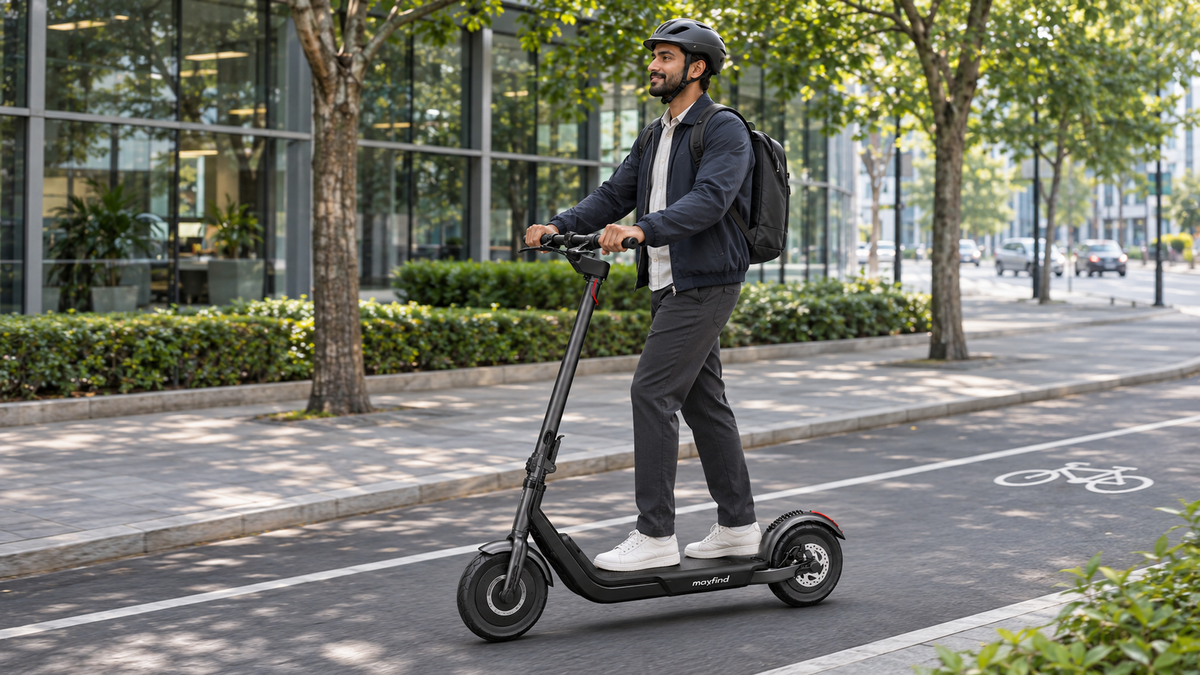
The MAXFIND GLIDER G5 Series, for example, uses 10-inch pneumatic tires and combines electronic, mechanical disc, and fender braking according to its current specification table. That configuration favors comfort and provides multiple braking methods, but it also means owners need to budget attention for tire pressure, punctures, disc alignment, and brake wear. MAXFIND lists different batteries across the G5 variants, so charging estimates must use the watt-hour rating of the exact version purchased.
A sensible reserve does not require predicting the exact date of every repair. Set aside a small amount regularly, inspect the scooter before problems become severe, and confirm part availability before the scooter becomes essential daily transportation. Insurance, registration, locks, and mandatory safety equipment may add further costs depending on the rider’s location and circumstances.
Preventive care is most effective when it is simple enough to perform consistently:
Preventive maintenance does not make a scooter failure-proof, but it reduces avoidable damage and makes changes easier to notice before they interrupt a commute.

Charging an electric scooter is usually inexpensive; tires, brakes, battery condition, and unexpected repairs create the larger long-term uncertainty. Choose a scooter with suitable parts and support, calculate electricity from its actual battery capacity, and maintain a repair reserve that reflects your route and riding frequency.
Multiply the electricity drawn from the outlet by your utility rate. A 648Wh battery may draw roughly 0.762kWh when an 85% charging-efficiency estimate is used, costing about 14 cents at 18.16 cents per kWh. The actual amount varies by scooter, charger, battery state, and location.
There is no universal interval. Tire life depends on construction, pressure, rider load, road surface, braking, mileage, and damage. Replace a tire when it reaches the manufacturer’s wear limit or shows unsafe tread loss, casing damage, repeated pressure loss, or another condition identified by a qualified technician.
Routine checks and electricity are generally manageable, but punctures, brake work, batteries, and electrical repairs can raise ownership costs. A serviceable design with available parts may cost less over time than a cheaper scooter with limited repair support.
No. A battery is not normally replaced on a fixed annual schedule. Replacement becomes relevant when capacity no longer meets the route, the pack fails, or a qualified assessment identifies a safety problem. Battery condition and compatible replacement pricing vary considerably by model.
More reading: MAXFIND GLIDER G5 Review: Range, Comfort, and Commuting
Partager:
Short vs. Long Electric Skateboards: Which Should Beginners Choose?