

Promotion de rentrée scolaire ! 🏷️ Un excellent rapport qualité-prix !
--
Jours--
Heures--
Minutes--
SecondesThe MAXFIND MAX ONE is a compact electric skateboard designed around manageable power, short trips, and easy carrying. Its low-speed modes and 10-pound build suit new riders, but the small wheels, limited hill rating, and published 11-mile range define where this board makes the most sense.
This review evaluates the published specifications and their practical meaning rather than presenting them as independent road-test results. The MAXFIND MAX ONE is currently listed as an in-stock compact board aimed at beginners, younger riders, and short-distance users.
| Specification | Published figure | Practical meaning |
|---|---|---|
| Top speed | 15 mph / 25 km/h | Moderate maximum speed, though beginners should start much slower |
| Rated range | Up to 11 miles / 18 km | Best treated as a short-trip figure with extra battery reserve |
| Motor | 350W hub motor | Suited to maintained pavement and modest inclines |
| Hill climbing | 10% | Not intended for steep or sustained hills |
| Battery | Samsung 18650, 99Wh | Compact capacity that helps limit board weight |
| Charging time | About 1.9 hours | Practical for recharging between short riding sessions |
| Deck size | 27 × 8 inches | Compact to carry, but with less stance room than a longboard |
| Wheels | 75mm | Agile on smooth pavement but less forgiving on cracks and debris |
| Weight | 10 lb / 4.6 kg | Easier to carry upstairs or onto public transportation |
| Maximum load | 220 lb / 100 kg | A structural rating, not a promise of unchanged range or hill performance |
| Water-resistance rating | IPX5 | Not a reason to ride in heavy rain or through standing water |
The MAX ONE combines a Hall-effect thumb-wheel remote with a single hub motor and a Hobbywing V5.0 FOC electronic speed controller. This relatively simple setup is intended to make starting, accelerating, and braking easier to learn.
MAXFIND lists three remote modes: Beginner at up to 4 mph, Fast at up to 7 mph, and MAX at up to 11 mph. These lower ceilings give a new rider room to practise throttle movement without immediately accessing the board’s full published speed.
There is, however, an inconsistency on the official product page: the formal specification table lists a 15 mph top speed, while the remote-mode section lists a maximum of 11 mph. Buyers should confirm the current controller programming with MAXFIND before purchasing if the exact maximum speed matters. Either way, the lowest mode is the appropriate starting point for learning how gently the thumb wheel responds.
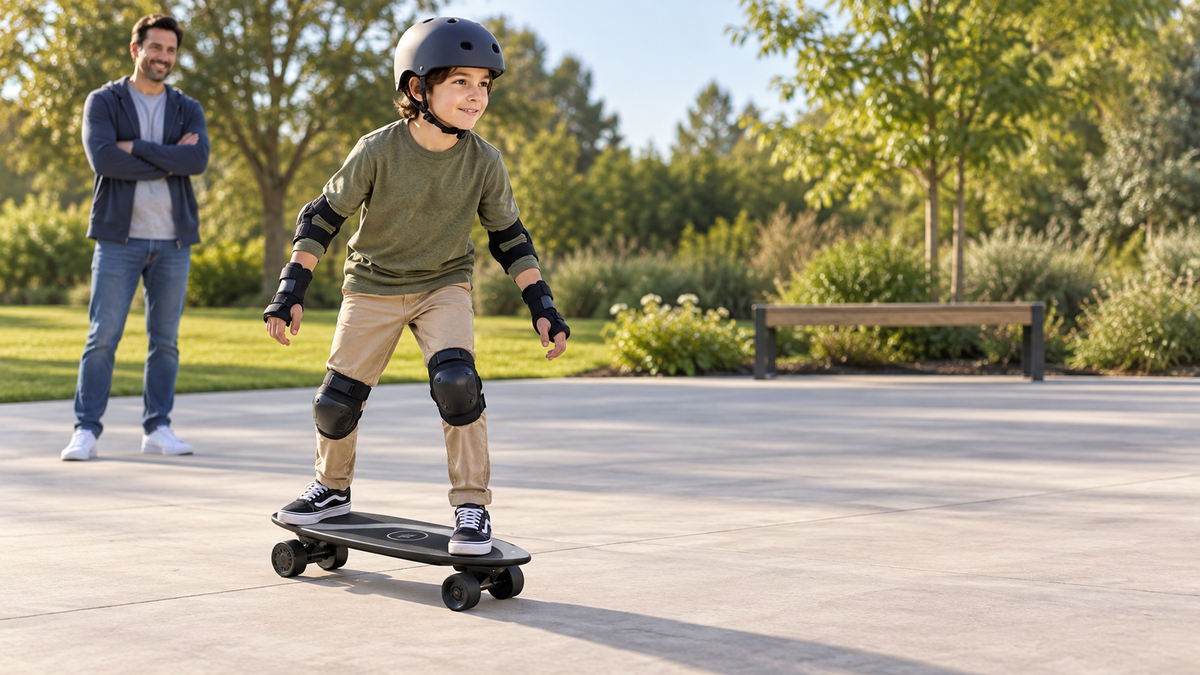
A beginner should practise on a dry, flat, traffic-free surface while wearing a helmet and suitable protective equipment. Starting, coasting, gradual acceleration, wide turns, controlled braking, and stepping off safely should become familiar before riding near vehicles, pedestrians, hills, or intersections.
The board uses a 350W hub motor and electronic regenerative braking controlled through the remote. A single-motor system generally delivers less aggressive acceleration than a high-powered dual-motor board, which can make the response easier for a new rider to anticipate.
Electronic braking still requires practice. Braking force can feel different depending on speed, rider weight, surface grip, slope, and battery condition. Riders should bend their knees, shift their weight gradually, and learn to add braking pressure rather than abruptly moving the thumb wheel. Because electronic braking depends on the powered system, the rider should leave more stopping distance than would seem necessary and avoid relying on the board for emergency stops.

The MAX ONE’s strongest practical advantage is not maximum performance but how little space and effort it requires between rides. Its size suits routines that involve stairs, car trunks, lockers, desks, or short public-transit connections.
At 27 inches long and a published 10 pounds, the MAX ONE is considerably easier to carry than a full-size electric longboard. A rider can pick it up for a staircase, bring it into a classroom, or store it vertically in a small apartment without dealing with a long, heavy deck.
Compactness involves a trade-off. The 8-inch-wide deck provides useful standing space for a mini board, but the shorter platform gives riders less freedom to adjust their stance. Taller adults or riders with larger feet may feel confined even when their weight is below the published 220-pound limit. Maximum load capacity describes a limit, not ideal ergonomic fit or guaranteed performance at that weight.
The kicktail can assist with positioning and tight low-speed manoeuvres, but powered riding should not be treated like conventional trick skating. The motor, battery, and electronics add weight and affect the board’s balance.
MAXFIND publishes a maximum range of 11 miles, supported by a 99Wh Samsung battery. That figure should be treated as an “up to” rating rather than a distance every rider will achieve. Rider weight, acceleration frequency, temperature, pavement, hills, wind, tyre resistance, speed, and battery age can all reduce real-world range.
For everyday planning, the board makes more sense for short neighbourhood rides, recreational loops, campus paths where permitted, or first-and-last-mile connections than for an 11-mile one-way journey. A useful route should leave enough battery reserve for detours, headwinds, repeated starts, and the return trip. Riders should also check local rules because electric skateboard access can differ across streets, paths, campuses, parks, and public-transport systems.
The published charging time is approximately 1.9 hours with the supplied 1.5A charger. That is convenient for topping up between sessions, although the board should be charged in a dry, ventilated location with the correct charger rather than left charging unattended.
The MAX ONE is built primarily for maintained pavement. Its wheel size, deck length, motor output, and hill rating favour controlled short rides over rough-road comfort or demanding commuting.

The 75mm wheels help keep the board compact, light, and responsive. On smooth asphalt or clean concrete, this setup should feel agile and easy to direct at moderate speeds.
Small wheels are less capable of rolling over cracks, raised joints, stones, twigs, drain covers, and broken pavement than larger street wheels or pneumatic tyres. These obstacles can produce sharper impacts or stop a wheel unexpectedly. Riders should scan farther ahead, reduce speed before imperfect surfaces, and avoid riding through debris or water that may conceal a hazard.
The integrated composite-and-glass-fibre deck is described by MAXFIND as durable, while the anti-slip surface is intended to support secure foot placement. Even so, a compact deck cannot provide the same stance length or vibration management as a longer, more flexible platform. Riders whose routes contain rough asphalt may need a larger board with bigger wheels.
The published 350W motor and 10% hill-climbing rating position the MAX ONE for flat ground and gentle slopes. A 10% grade describes a rise of 10 units over 100 horizontal units; it should not be interpreted as 10 degrees.
Real hill performance depends on rider weight, battery charge, approach speed, surface condition, wind, and the length of the incline. Performance may weaken as the battery level drops, and repeated climbing increases motor and battery demand. Riders with sustained or steep hills should not choose this board based only on its portability.
The single hub motor also means the board is not intended to deliver the strong acceleration, hill reserve, or higher-speed stability of a larger dual-motor model. That limitation can be helpful during initial learning, but it becomes restrictive when a route includes repeated slopes or when an experienced rider wants more performance.
A short board changes direction more readily than a longboard and takes up less room in storage. This can be useful in open, low-speed areas where the rider needs simple manoeuvrability.
The same short wheelbase can respond more quickly to shifts in body position. Beginners should keep their stance relaxed, knees slightly bent, and movements deliberate. A longboard may feel calmer at speed, while the MAX ONE prioritizes carrying convenience and compact handling.
Riders comparing portable formats can browse the current mini electric skateboard collection, but deck length, weight, battery capacity, and wheel size should be checked individually rather than assuming every compact board rides the same way.
Daily usability also depends on weather care, charging habits, maintenance, and whether the board’s compact design matches the rider rather than merely meeting the load rating.
MAXFIND lists an IPX5 water-resistance rating, but the company still advises avoiding heavy rain because water exposure can damage the board and resistance may decrease over time. IPX5 does not make the board waterproof, and it does not remove the loss of traction associated with wet pavement.
Before riding, check that the wheels rotate normally, the trucks and visible fasteners are secure, the deck and grip surface are undamaged, the remote is charged and paired, and the battery has enough reserve for the planned route. After a dusty ride, use a dry or lightly damp cloth rather than spraying the board. Any unusual sound, heat, vibration, braking behaviour, or damaged battery enclosure should be addressed before the next ride.
The MAX ONE makes the most sense for a beginner who wants a compact first electric skateboard for controlled practice and short rides on smooth pavement. Its low-speed modes, 10-pound weight, short charging time, and modest single-motor output support that role.
It may also suit a parent shopping for a supervised younger rider, but the product label does not replace local age rules, protective-equipment requirements, adult supervision, or an honest assessment of the child’s balance and judgement. Electric skateboards are powered vehicles capable of causing serious injury.
A different board may be more appropriate for heavier adult riders seeking comfortable foot placement, commuters travelling close to the full published range, routes with steep hills, or streets with cracked and uneven pavement. Those needs usually call for a longer deck, larger wheels, greater battery reserve, or more motor capacity—even though those upgrades make the board heavier.

The MAXFIND MAX ONE is best viewed as a lightweight beginner board for smooth surfaces and short everyday rides. Its portability and low-speed modes are the main advantages; small wheels, limited hill capability, and modest range are the main constraints. Choose it when easy carrying matters more than power, rough-road comfort, or long-distance capacity.
Its low-speed modes, compact size, and modest single-motor power make it suitable for controlled beginner practice. New riders still need protective equipment and a dry, traffic-free learning area.
MAXFIND lists a range of up to 11 miles. Actual distance may be lower because of rider weight, hills, temperature, wind, speed, repeated acceleration, road condition, and battery age.
The published maximum load is 220 pounds, but adults should also consider the 27-inch deck and compact stance. Larger riders may prefer a longer platform even when they remain below the weight limit.
MAXFIND lists an IPX5 rating but advises against heavy-rain use. Wet pavement reduces grip, and water exposure can still damage components, especially as seals and materials age.
More reading: Beginner Guide to Mini Electric Skateboards

Partager:
Does an Electric Skateboard Need Suspension for Uneven City Routes?