

Promotion de rentrée scolaire ! 🏷️ Un excellent rapport qualité-prix !

Quick Answer: Maxfind Cyber Max PRO and X pair belt drive with 107mm Space Wheels, making them worth exploring for rides that mix pavement with occasional light dirt or grass crossings; a Cyber Max X review supports short-grass and loose-gravel use. [1][2] When grass and light off-road sections are recurring parts of your weekend route, Cyber Ultra’s belt-drive configuration with 175mm pneumatic tires is the more relevant setup to explore, supported by a review of that exact configuration. [3] Match the range claim to the wheels, rider load and route conditions rather than treating the family’s headline mileage as your expected distance.
Maxfind lists Cyber Max X with a 415Wh Samsung 21700 battery in a 12S2P, 9.6Ah configuration. [1] Its published range is 37 miles / 60 km. [1] Those figures give you a model-specific starting point, but they do not provide a mileage prediction for a particular rider weight and hill grade. The listed specifications do not attach rider weight, speed, surface, temperature or a range-test endpoint to that distance. [1]
Cyber Ultra offers a more detailed reference. Maxfind advertises 37 miles / 60 km with 175mm tires under these conditions: a 143–154 lb rider, cruising at 12.5 mph on flat terrain, temperature above 77°F, no wind, and tire pressure of 40–42 PSI. [4] That pressure belongs to the published range reference; it is not a universal off-road pressure recommendation.
The wheel configuration also changes which Cyber Ultra range figure applies. Maxfind lists the belt-drive 175mm AT setup at 37 miles / 60 km and the hub-drive 165mm AT setup separately at 37 miles / 60 km. [4] The 56-mile / 90 km claim belongs to the belt-drive configuration with 107mm Space Wheels. [4] The 175mm test conditions should not be transferred to either of the other configurations, whose separate complete range protocols are unspecified in those specifications. [4]
Both Cyber Max and Cyber Ultra list a maximum load of 330 lb / 150 kg. [1][4] A load limit answers a different question from a range-test weight: being within that limit does not mean a heavier rider will reproduce the Ultra’s flat-route reference.
For your weekend ride, compare your riding weight—including what you carry—with the reference rider, then identify the exact wheels, total route distance, surface mix and climbs. A heavier rider covering dirt and grass with repeated ascents is asking the board to complete a materially different route. Exact mileage for that combination remains unresolved; neither a proportional weight correction nor a fixed percentage deduction for hills would be justified by these figures.
The useful next step is to ask Maxfind for range guidance or a documented result matching your intended Cyber configuration, total load and route profile. That makes the inquiry much more useful than asking whether the board can “do 37 miles.”

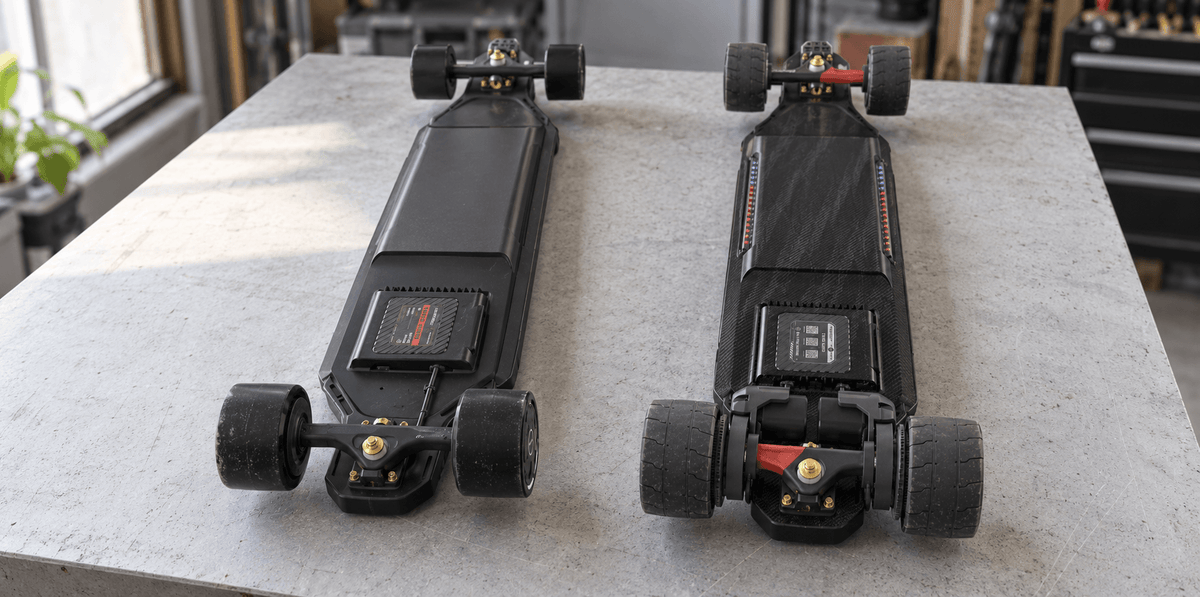
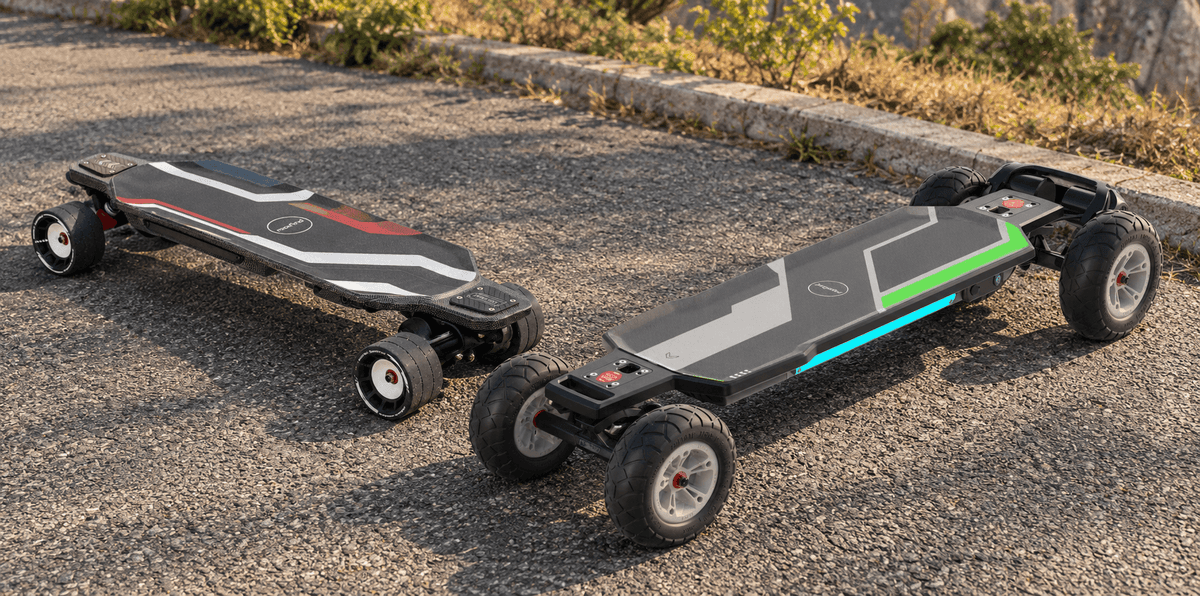
Within the Cyber Max line, the configuration name matters. Standard and LR versions use 90mm PU wheels with hub motors; PRO and X use 107mm Space Wheels with belt motors. [1] For a rider looking beyond street-wheel behavior, PRO and X are the configurations to examine.
Maxfind describes the 107mm Space Wheels as 74A urethane around a reinforced nylon core, with a concave tread pattern and ten hollow pockets that let the polyurethane flex. [1] The flexing construction addresses compliance over rough surfaces, while the tread is intended to support grip. It remains a urethane-wheel design, so its construction should not be read as pneumatic-tire equivalence or a measured guarantee of grass traction.
Paxson Lim’s Electric Skateboard HQ review gives that design a practical context. On the tested Cyber Max X with 107mm Space Wheels, Lim reported reduced road vibration and the ability to traverse small debris, short grass and loose gravel without much trouble. [2] He also reported rolling over sticks, pebbles and minor potholes without difficulty. [2] His terrain assessment had a clear limit: he judged the board’s torque and clearance insufficient for actual trail riding. [2]
An owner account adds a separate perspective on the PRO. Ko F., a 135 lb rider in Denver writing in Maxfind’s customer reviews, described occasional dirt and grass use and said the stiffer trucks required some stance adjustment at that rider weight. [1] That is useful experience for a pavement-led route with occasional surface changes, rather than validation for heavyweight riders or sustained off-road climbing.
The practical distinction is between crossing a light unpaved section and choosing a board for a demanding trail. Cyber Max PRO and X offer a supported reason to explore the first use case. Root-filled paths, deep loose ground or taller grass require more than evidence of passing over small road debris.
Lim’s observations do not specify obstacle dimensions, loaded ground clearance, surface moisture or grass height beyond “short.” [2] Those details matter if your usual route catches street wheels or scrapes the underside of a board. The accounts cannot establish that Cyber Max will avoid bogging down or falls on your particular dirt-and-grass route. Describe those troublesome sections when discussing PRO or X with Maxfind, rather than relying on the phrase “off road” alone.
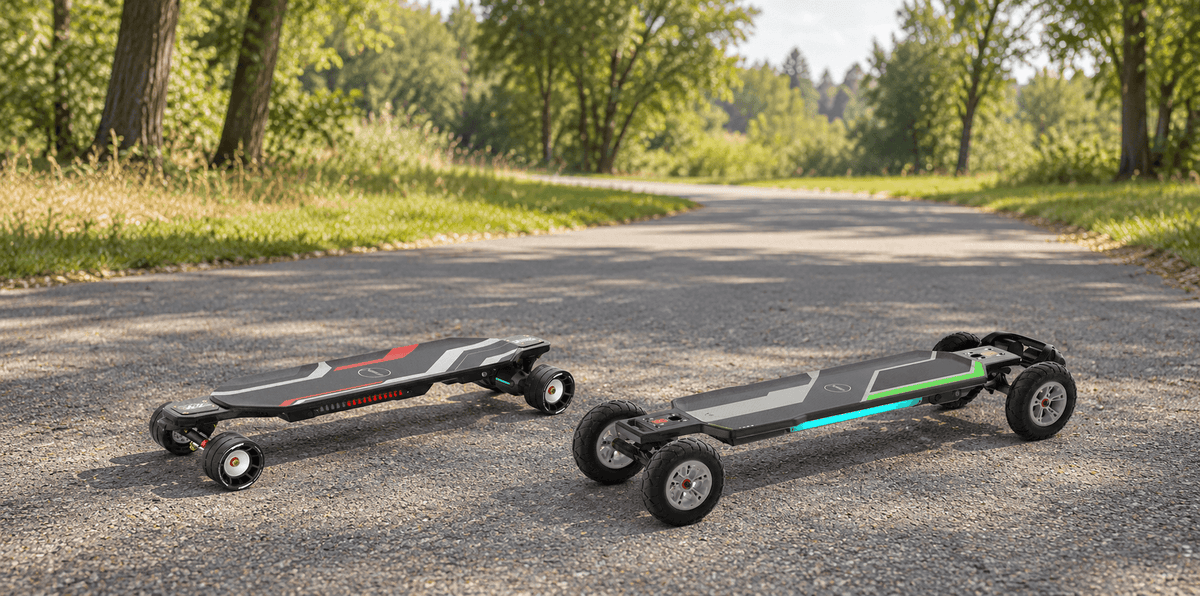
Cyber Ultra’s belt-drive 175mm pneumatic setup is the next configuration to explore when light off-roading becomes a regular part of the ride. Ziyad Khairi’s Electric Skateboard HQ review tested that setup and found its tires effective over cracks, gravel and grass, with good vibration absorption for light off-road riding. [3]
The review also explains a useful clearance trade-off. Khairi found the higher ride height less likely to scrape the enclosure on speed bumps, but said the higher center of gravity reduced how deeply the rider could lean into carves. [3] For a mixed-surface weekend route, that is a reason to prioritize obstacle accommodation over a low-slung carving feel. It is a qualitative ride-height observation, not a measured limit for clearing roots.
Maxfind offers Cyber Ultra in three relevant wheel-and-drive arrangements: belt drive with 175mm pneumatic tires, hub drive with 165mm pneumatic tires, and a belt-drive 2-in-1 package containing both 175mm pneumatic tires and 107mm Space Wheels. [4] Khairi’s terrain findings belong to the tested 175mm belt setup; they do not establish the same ride behavior for the 165mm hub version or the 107mm wheel configuration.
Cyber Ultra also has a motor guard that Maxfind describes as shielding the drivetrain from rocks, gravel and debris. [4] That feature is relevant where loose material can reach the drivetrain, although the description supplies no impact rating.
A separate Maxfind-hosted owner review from Chris P. reports good results on a short packed-gravel stretch with 175mm air tires, including softer impacts from small rocks and pavement seams. [4] The account does not specify rider weight or operating pressure. [4] Together with Khairi’s review, it supports exploring the pneumatic configuration for recurring light terrain—not treating it as a serious mountain-trail board, a use Khairi expressly distinguished from its strengths. [3]
Cyber Mini serves a different branch of the same route decision. Its standard and AIR configurations pair 90mm PU wheels with hub drive; PRO and X pair 107mm Space Wheels with belt drive. [5] The AIR name should therefore not be mistaken for a pneumatic-tire configuration.
Karel S., a 90 kg owner whose review describes delivery to the Czech Republic, reported that a Cyber Mini with 90mm wheels could traverse some bumps but needed a really smooth surface for comfortable riding. [5] The owner also described strong acceleration, but the exact variant was unspecified and the account provides no off-road climbing result. [5] It helps explain the smooth-surface use case; it does not establish US-model specifications or terrain performance for Mini PRO and X.
For a route dominated by smooth pavement, Cyber Mini remains worth considering within its own configuration choices. For recurring grass and packed-gravel sections, Cyber Ultra with 175mm pneumatic tires has the more directly relevant riding observations. Carry that exact configuration into your range and hill assessment, because changing wheels changes the question you are asking.

If a previous board stopped halfway up a grassy incline, two separate questions matter: could the wheels maintain grip, and could the drivetrain sustain enough output to continue climbing? An advertised grade percentage cannot diagnose which caused the stall. More motor output does not resolve lost traction, and tire grip alone does not establish sustained climbing capacity.
Cyber Max X lists dual 1800W motors, dual 6Nm torque and a 35% hill-climbing claim. [1] In his tested X configuration, Paxson Lim reported 15:40 gearing and described acceleration as strong but not outstanding, interpreting the gearing as oriented more toward efficiency and top speed than explosive torque. [2] That review helps explain the ride character, but it was not a sustained grassy-climb test.
Cyber Ultra’s belt-drive specification lists dual 2000W motors and dual 12Nm torque, alongside an advertised 35% climbing capability. [4] Those figures make the belt drivetrain worth examining for the hill task. The published Cyber Max X and Cyber Ultra specifications do not identify whether their power ratings are continuous or peak, or define the climbing-test conditions, so the numbers cannot establish how long either will sustain a particular grassy ascent. [1][4]
Keep your rider-and-carried load within the relevant 330 lb / 150 kg maximum, but do not treat that maximum as the load used to establish the advertised grade. [1][4] This distinction is particularly important for a heavier rider considering a steep climb.
There is a useful, limited hill account for Cyber Ultra. Roberto G., a self-described bigger rider writing in Maxfind’s customer reviews, said the belt-drive version repeatedly completed a steep daily-route hill while carrying a heavy work backpack, slowing by a couple of mph near the top. [4] The account leaves rider weight, wheels, measured grade, climb length and surface unspecified. [4] It is encouraging owner experience, but it cannot answer whether the board will complete your grassy incline.
Cyber Max’s controller protection also deserves a precise reading. Maxfind specifies a V6.0 FOC HOBBYWING ESC and lists “OVP/UVP/OTP/Stall Guard” protection. [1] Those labels do not document activation thresholds, sustained-climb operating limits, recovery procedures or braking behavior after a stall. [1] Do not interpret “Stall Guard” as a promise that the board cannot stall or as an instruction to restart on an incline.
For a steep grassy hill—especially a 25%+ grade—the unresolved issue is completion under comparable conditions, including thermal behavior. A useful model-specific inquiry should identify your total load, exact wheel-and-drive configuration, grass condition, measured grade, climb length, starting speed and battery state. Ask for matching operating guidance or a documented comparable climb that records completion and any slowing or thermal limitation, rather than improvising a stall-and-restart test.
This gives you a focused next step: explore Cyber Max PRO/X for occasional light-surface riding, or Cyber Ultra’s 175mm belt configuration for recurring light off-roading, then resolve the demanding hill against that exact setup.
No. Percent grade is vertical rise divided by horizontal run, multiplied by 100. A 35% grade means 35 units of rise for every 100 units of horizontal run.
The angle is arctan(0.35), approximately 19.3 degrees. Cyber Max X and Cyber Ultra advertise a 35% climbing capability, so that is the appropriate mathematical interpretation of the stated unit. [1][4] Converting the unit does not validate that either configuration will complete that slope at your load and on your surface.
No—the rating alone does not establish route suitability. Maxfind lists Cyber Ultra as IPX5 but recommends avoiding heavy rain, warns that water exposure can damage the board, and states that prolonged use may reduce its water resistance. [4]
Water resistance also does not answer whether the tires will maintain traction on wet grass or what range to expect there. Those outcomes remain unresolved for a specified rider load and grade, so a dry-condition terrain assessment should not be treated as assurance for a rainy grass route.
Partager:
Which Maxfind Board Fits Your Commute?