

Black-Friday-Angebote. Niedrigster Preis des Jahres 🏷️
Choosing an electric skateboard deck is not only about its shape or appearance. A carbon fiber skateboard deck, bamboo deck, maple deck, and MAXFIND Xcomposite™ deck can differ in flexibility, vibration control, moisture resistance, maintenance, and long-term durability. Understanding these differences helps riders choose a deck that fits their roads, riding style, and comfort expectations.
An electric skateboard deck supports more than the rider. It must also carry the battery, controller, enclosure, and mounting hardware while handling repeated vibration, acceleration, braking, and changing road conditions.
Deck flex affects both comfort and control. A more flexible deck can help absorb small road vibrations, but excessive movement may feel less predictable at higher speeds. A stiffer deck can provide more direct feedback, although the rider may feel more vibration on rough pavement. Final ride quality does not depend on the deck alone: board length, deck thickness, trucks, bushings, wheels, tire type, speed, and rider weight all contribute to how an electric skateboard feels.
An electric skateboard deck must accommodate electronic components without allowing excessive movement around the battery and controller. Enclosure mounting points, cable routing, seams, screw holes, and material stability therefore matter more than they usually do on an unpowered skateboard. Moisture resistance is also important, but a water-resistant deck does not make the complete board waterproof because bearings, motors, electrical connectors, battery housings, and charging ports may still be vulnerable to water.
These materials are common reference points when comparing skateboard deck materials, but no category has one universal construction. Thickness, reinforcement, material layup, adhesives, deck shape, and enclosure design can substantially change performance.
A carbon fiber skateboard deck generally prioritizes stiffness, structural precision, and a favorable strength-to-weight ratio, making it suitable for electric skateboard designs that require controlled movement around mounted electronics. However, not every carbon fiber skateboard feels the same: ride characteristics depend on fiber orientation, layer count, resin system, core structure, deck thickness, and whether the battery enclosure is integrated into the deck. Some constructions are intentionally rigid, while others use hybrid materials or shaped sections to introduce controlled flex. A stiff carbon deck can provide precise feedback and stability, but it may transmit more road vibration than a flexible bamboo construction. Hard impacts can also cause internal laminate damage that is less obvious than a visible crack in a wooden deck, while repairs usually require composite-material expertise rather than conventional woodworking.
A bamboo skateboard deck is commonly selected for elasticity and a lively, flexible ride. This movement can help reduce fatigue on uneven urban pavement by allowing the deck to absorb part of the vibration before it reaches the rider. Its actual performance depends on the number and orientation of the bamboo layers, adhesive system, pressing process, deck shape, and whether reinforcing materials such as fiberglass are added, so bamboo should not be treated as having one fixed level of flexibility or durability. Moisture may affect bamboo laminates when damaged coatings, exposed edges, or drilled holes allow water to reach the internal layers, while delamination risk and long-term fatigue depend heavily on manufacturing quality and environmental protection.
A maple skateboard deck provides the familiar feel associated with traditional skateboarding. Laminated maple constructions usually offer predictable feedback, a solid platform, and manufacturing methods that are widely understood across the skateboard industry. Compared with bamboo, maple is generally associated with a firmer response, although layer count, deck thickness, concave, wheelbase, and adhesive selection still influence the result. Moisture content can affect the dimensional stability and mechanical behavior of wood, so effective sealing and suitable storage conditions remain important. Surface damage may be easier to identify than internal damage in a composite deck, but serious cracks, delamination, or damage around electronic mounting points can still require deck replacement.

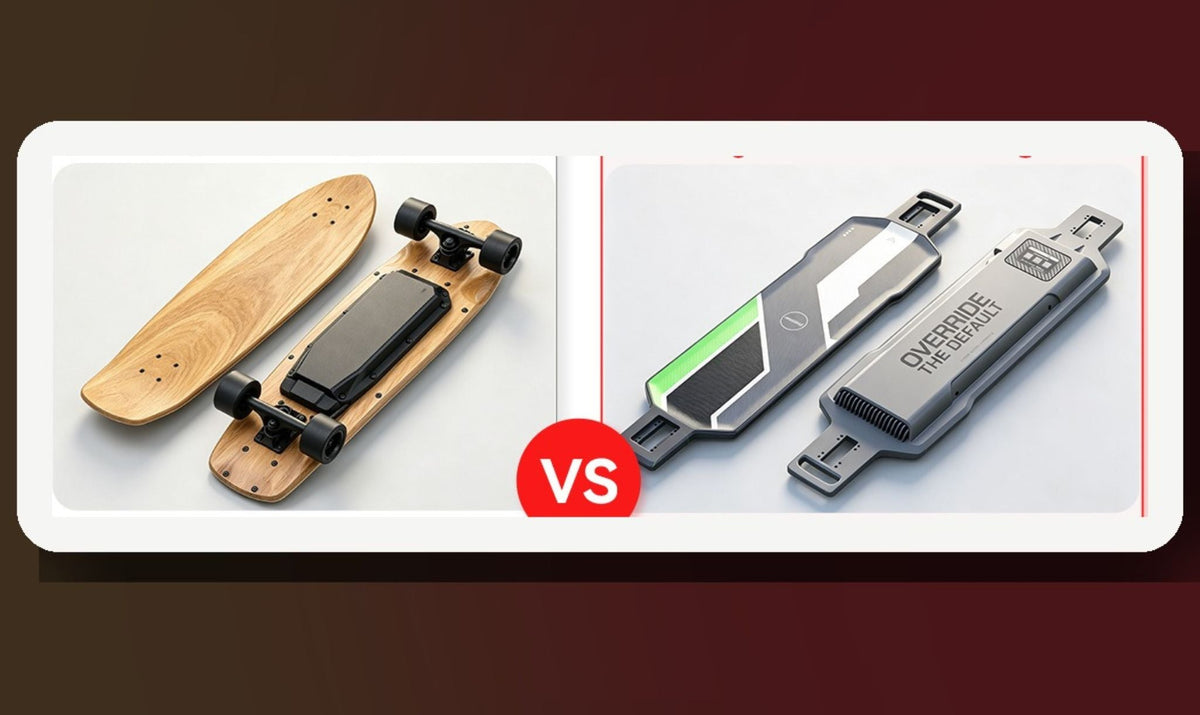
The MAXFIND Xcomposite deck is designed specifically for powered boards rather than adapted from a conventional skateboard structure. Its main distinction is the integration of the deck and electronic compartments into one molded component.
According to MAXFIND’s technical materials and current product specifications, Xcomposite™ uses a PPS-and-glass-fiber composite formed through a one-piece injection-molding process. The deck integrates areas for the battery, controller, and carrying handle instead of relying entirely on separate enclosures attached beneath a traditional wooden deck. This approach reduces unnecessary seams, screw holes, and potential water-entry points while supporting dimensional consistency around the electronic components.
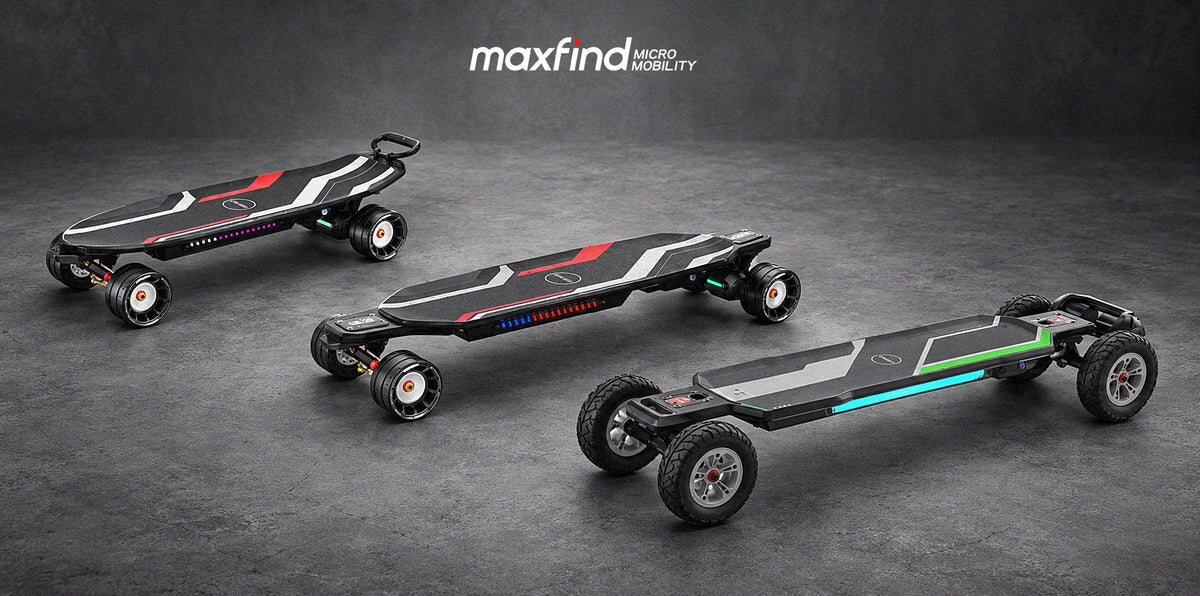
PPS, or polyphenylene sulfide, belongs to an engineering polymer family commonly selected for low moisture uptake, dimensional stability, and chemical resistance. The performance of a finished deck still depends on its glass-fiber reinforcement, additives, geometry, molding quality, and integration with the rest of the board. The Xcomposite design appears on current models such as the MAXFIND CYBER MINI and MAXFIND CYBER ULTRA, although the two boards use different dimensions, wheel systems, and riding configurations.
MAXFIND states that Xcomposite™ has undergone static-load, dynamic, flex, impact, and temperature testing. Because the published materials do not provide one unified protocol for comparing finished Xcomposite™, bamboo, maple, and carbon fiber decks, these results should be treated as manufacturer evidence rather than a direct material ranking. The Xcomposite design aims to provide controlled flex while supporting the battery and controller within an integrated structure, but its actual ride feel still depends on deck geometry, board dimensions, rider weight, wheels, and trucks. MAXFIND also describes the material as recyclable, although actual recycling availability depends on local collection systems and whether the deck can be appropriately separated from its electronic and metal components.
No deck material is best in every category. The first table compares typical ride characteristics, while the second focuses on environmental exposure, damage, and maintenance.
|
Material |
Typical Flex |
Vibration Control |
Typical Feel |
Best Suited To |
|
Bamboo |
Usually high |
Generally good |
Lively and flexible |
Comfort-focused cruising |
|
Maple |
Usually moderate |
Moderate |
Firm and familiar |
Traditional skateboard feel |
|
Carbon fiber |
Often low |
Depends on construction |
Direct and precise |
Stiff, performance-focused designs |
|
Xcomposite™ |
Controlled by molded geometry |
Designed for balanced support |
Supportive with measured flex |
Integrated electric skateboard designs |
These descriptions are general tendencies rather than fixed ratings. Deck length, thickness, wheelbase, material layout, rider weight, wheels, and trucks can significantly change the actual ride.
|
Material |
Moisture Considerations |
Damage and Maintenance |
|
Bamboo |
Sealed edges and mounting holes help limit moisture entry |
Adhesive condition and signs of delamination should be checked |
|
Maple |
Effective sealing and dry storage remain important |
Cracks and layer separation may be visually noticeable |
|
Carbon fiber |
Does not swell like wood, but resin, edges, holes, seals, and metal hardware still matter |
Internal laminate damage can be difficult to identify and repair |
|
Xcomposite™ |
PPS-and-glass-fiber construction reduces unnecessary seams |
Published materials do not specify a local deck-repair procedure; contact MAXFIND to assess structural damage |
The table describes typical material tendencies rather than guaranteed performance. Manufacturing quality, component integration, use conditions, and maintenance can be as important as the material itself.
There is no single best skateboard deck material for every rider. The right choice depends on the balance between comfort, stiffness, environmental resistance, maintenance, and the complete board design.
Bamboo may suit riders who prefer noticeable deck movement and additional vibration filtering, while maple can be a better match for riders who want a more traditional skateboard response with predictable feedback. Neither material should be selected by name alone because layer construction, sealing, deck shape, electronics mounting, and adhesive quality are equally important.

A carbon fiber skateboard deck may appeal to riders who prioritize stiffness, accurate handling, and efficient structural design. It can be particularly useful where deck movement around integrated electronics must be limited, but riders should also consider whether the complete board provides enough vibration control through its wheels, tires, trucks, or suspension system. A stiff deck paired with hard wheels can feel very different from the same deck paired with larger, softer wheels.
The MAXFIND Xcomposite deck is most relevant to riders who value an integrated electric skateboard structure, fewer enclosure seams, controlled flex, and a PPS-and-glass-fiber construction with low moisture uptake. Riders can compare current electric skateboards to see how deck construction works alongside different wheel types, board dimensions, and performance configurations. These characteristics do not make Xcomposite™ universally better than bamboo, maple, or carbon fiber; its advantages are most meaningful when the integrated structure aligns with the rider’s intended use.

Bamboo emphasizes flexibility and a natural ride, maple provides familiar skateboard feedback, and carbon fiber generally favors stiffness and structural precision. MAXFIND Xcomposite™ takes a different approach by integrating the deck and electronic compartments into a PPS-and-glass-fiber molded structure. The best choice depends on the complete board, so riders should consider road conditions, speed, wheel setup, comfort, maintenance, and environmental exposure before deciding.
No. Carbon fiber decks generally prioritize stiffness, but their ride feel depends on the fiber layup, resin system, thickness, internal structure, shape, and enclosure design. Hybrid materials can also introduce additional flex.
Bamboo usually provides more noticeable flex and vibration filtering, while maple tends to deliver a firmer, more traditional skateboard feel. The better option depends on rider preference, board construction, and intended speed.
No. According to MAXFIND’s current specifications, Xcomposite™ uses a PPS composite reinforced with glass fiber and is formed through a one-piece injection-molding process. A carbon-fiber surface coating used on a particular model should not be confused with the deck’s structural material.
No. Deck resistance is only one part of water protection. Motors, bearings, battery housings, charging ports, connectors, and controllers may still be damaged by moisture. Riders should follow the manufacturer’s water-exposure guidance for the complete board.
More reading: Electric Skateboard Deck Technology: How Xcomposite™ Works
Teilen:
Black Friday Electric Skateboard Buying Guide 2026: Choose Your MAXFIND
How Much Electric Skateboard Range Do You Need for Commuting?