

Black-Friday-Angebote. Niedrigster Preis des Jahres 🏷️
Bei der Goofy-Stance steht dein rechter Fuß vorn. Bei einem Elektro-Skateboard kommen jedoch motorisiertes Beschleunigen und Bremsen hinzu, was dein Gleichgewicht schnell verlagern kann. In diesem Ratgeber erfährst du, wie du deine Füße positionierst, die Fernbedienung verwendest, Kurven fährst und anhältst sowie die Kontrolle verbesserst, ohne dich in eine Regular-Stance zu zwingen.
Bei einer Goofy-Stance fährst du mit dem rechten Fuß vorn und dem linken Fuß hinten auf dem Board. Sie ist das Gegenteil der Regular-Stance, bei der der linke Fuß vorne steht. Keine der beiden Positionen ist von Natur aus besser oder sicherer. Richtig ist die Stance, mit der du bequem das Gleichgewicht halten, Kurven fahren und reagieren kannst. Wenn du noch nicht sicher bist, welcher Fuß vorne stehen sollte, hilft dir Maxfinds Ratgeber zur Bestimmung der Goofy- oder Regular-Stance beim Skateboarden, deine natürliche Stance zu finden, bevor du das Beschleunigen mit Motor übst.

Bevor du an deiner Fußstellung oder der Fernbedienung arbeitest, bereite deine Schutzausrüstung, den Fahrbereich und das Board vor. Mit einer kontrollierten Vorbereitung hast du mehr Zeit und Platz, um Fehler auszugleichen.
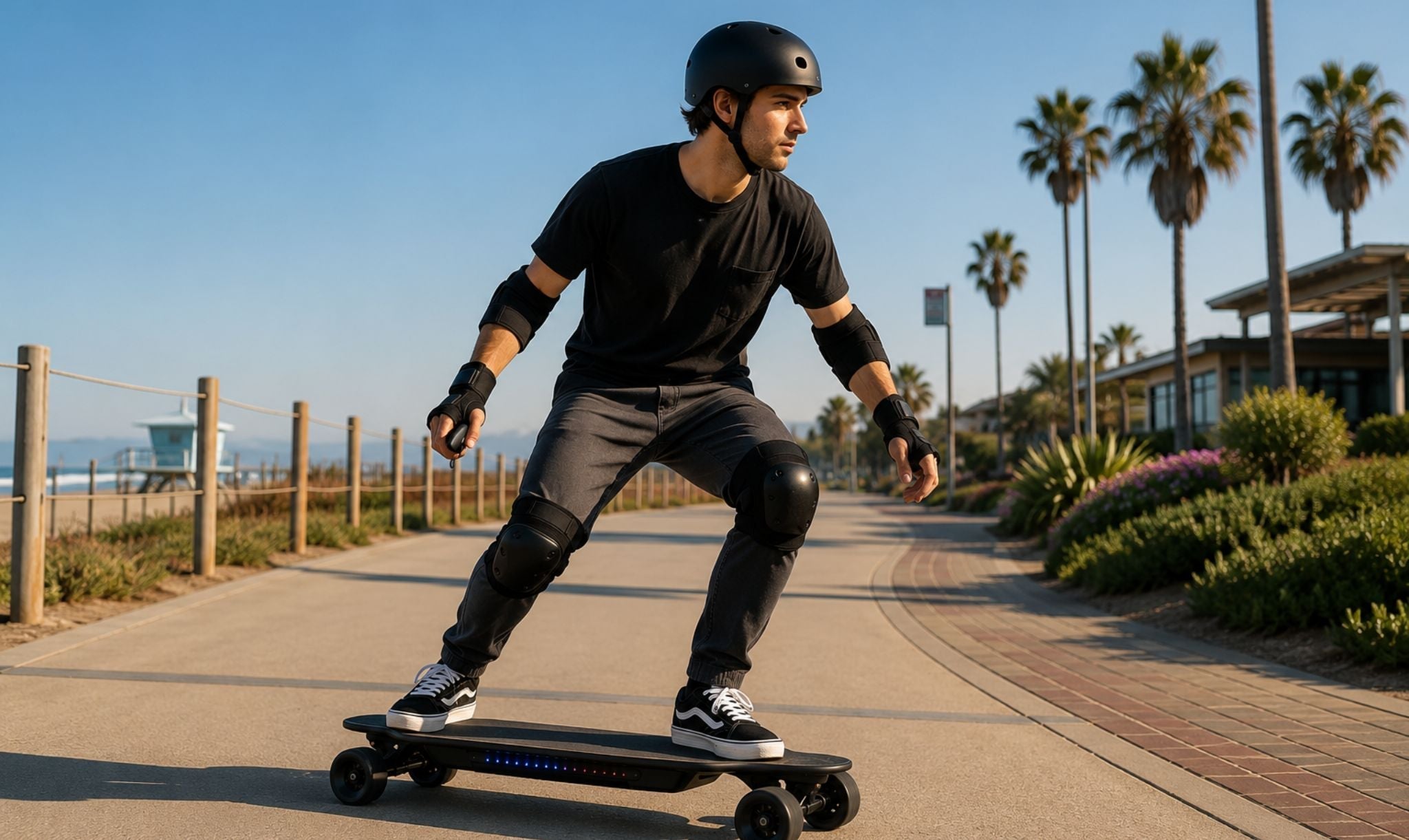
Setze einen gut sitzenden Skateboard-Helm auf, bevor du auf das Board steigst. Handgelenk-, Knie- und Ellbogenschoner bieten zusätzlichen Schutz, während du lernst, wie das Board auf Beschleunigen und Bremsen reagiert. Geschlossene Schuhe mit flachen, griffigen Sohlen helfen dir, den Kontakt zum Deck zu halten.
Beginne auf einem glatten, trockenen Belag mit viel freier Fläche. Meide Hügel, losen Schotter, nasse Oberflächen, parkende Fahrzeuge, Fußgänger und fließenden Verkehr. Ein ruhiger Parkplatz, ein leerer befestigter Sportplatz oder ein anderer zulässiger Übungsbereich bietet genug Platz für langsames Anfahren, kontrolliertes Anhalten und weite Kurven.
Vergewissere dich, dass Board und Fernbedienung ausreichend geladen und korrekt gekoppelt sind. Überprüfe Deck, Achsen, Rollen und sichtbare Hardware auf Schäden oder lockere Teile. Prüfe ohne Fahrer auf dem Board kurz, ob sich die Fernbedienung verbindet und die Motoren reagieren. Teste anschließend bei Schrittgeschwindigkeit auf einer ebenen, freien Fläche, wie das Board tatsächlich bremst.
Für eine stabile Goofy-Stance brauchst du einen ausreichend breiten Stand, entspannte Gelenke und Fußpositionen, die zur Form deines Decks passen. Die genauen Winkel können je nach Fahrer und Board variieren.
Setze deinen rechten Fuß näher an den vorderen Achsenbereich und nicht ganz an die Spitze der Nose. Winkle ihn leicht quer zum Deck an, statt ihn gerade nach vorn zeigen zu lassen. Passe anschließend die Position an die Form des Boards an und lass genug Platz, um beim Beschleunigen dein Gewicht zu verlagern.
Setze deinen linken Fuß nahe an den Bereich der hinteren Achse, normalerweise darüber oder etwas davor. Halte deine Füße etwa schulterbreit auseinander und passe den Abstand dann an die Länge des Decks und deinen natürlichen Stand an. Stelle den hinteren Fuß nicht zu nah an den vorderen, da ein enger Stand weniger Hebelwirkung bietet, wenn das Board beschleunigt, langsamer wird oder eine Kurve fährt.
Halte beide Knie leicht gebeugt und zentriere deine Hüften zwischen den Füßen. Dein Oberkörper sollte entspannt statt steif bleiben, denn gebeugte Knie helfen deinen Beinen, Geschwindigkeitsänderungen und Unebenheiten im Straßenbelag abzufedern, während durchgestreckte Gelenke jede Bewegung direkt auf deinen Oberkörper übertragen.
Sobald du dich im Stillstand stabil fühlst, kannst du mit dem Üben der motorisierten Fortbewegung beginnen. Dein erstes Ziel ist es, zu verstehen, wie das Board auf kleine Eingaben reagiert, nicht eine hohe Geschwindigkeit zu erreichen.
Stabilisiere das Board auf einer ebenen Fläche und setze zuerst deinen rechten Fuß nahe der vorderen Achse auf. Sobald sich dieser Fuß sicher anfühlt, stelle deinen linken Fuß auf den hinteren Teil des Decks und finde deinen Stand, bevor du den Gashebel betätigst. Versuche nicht, beide Füße neu zu positionieren, nachdem das Board bereits beschleunigt.
Verwende bei deinen ersten Fahrten den niedrigsten verfügbaren Fahrmodus, denn eine sanftere Beschleunigung gibt dir mehr Zeit, das Einsetzen der Motoren zu spüren und deine Haltung anzupassen. Ein auf Anfänger ausgerichtetes Board wie das elektrische Skateboard MAXFIND MAX5S eignet sich für diese Phase, da es über vier Geschwindigkeitsmodi auf der Fernbedienung verfügt. Über die mobile App können Fahrer außerdem Geschwindigkeit, Drehmoment und Bremsverhalten anpassen, während sich ihre Kontrolle verbessert.

Beim Fahren im Goofy-Stand musst du die Fernbedienung nicht in einer bestimmten Hand halten. Verwende die Hand, mit der du die Geschwindigkeit am präzisesten und bequemsten steuern kannst, halte die Fernbedienung locker, sichere sie mit der Handgelenkschlaufe, sofern vorhanden, und vermeide es, deinen Arm beim Beschleunigen oder in Kurven abrupt zu schwingen.
Richte deinen Blick nach vorn auf den Weg, anstatt auf deine Füße, das Deck oder die Fernbedienung zu starren. Mit deinem peripheren Sehen kannst du das Board im Blick behalten, während du deine Aufmerksamkeit auf Veränderungen der Oberfläche, Hindernisse, Fußgänger und die gewünschte Fahrtrichtung richtest. Wenn du zu lange nach unten schaust, können deine Schultern absinken, deine Haltung steif werden und das Board von deiner Linie abkommen.
Dein Gleichgewicht verändert sich, sobald die Motoren Leistung abgeben oder reduzieren. Wenn du deinen Körper vorbereitest, bevor du die Fernbedienung bewegst, kannst du das Gleichgewicht besser halten, als wenn du erst versuchst, dich wiederzufangen, nachdem sich das Board unter dir verschoben hat.
Verlagere vor dem Beschleunigen deinen Körperschwerpunkt leicht in Richtung deines rechten vorderen Fußes. Nimm die Anpassung über Knöchel, Knie und Hüften vor, statt dich stark in der Taille zu beugen. Du solltest weiterhin Druck über deinen linken hinteren Fuß spüren, denn das Ziel ist eine leichte Gewichtsverlagerung nach vorn und nicht, dein gesamtes Gewicht über der vorderen Achse zu platzieren.
Bewege den Gashebel allmählich und warte, bis das Board reagiert, bevor du mehr Leistung hinzufügst. Gib nicht sofort Vollgas, auch nicht im niedrigsten Fahrmodus. Mit kleinen Eingaben lernst du, wie schnell die Motoren ansprechen und wie viel Druck nach vorn du bei verschiedenen Beschleunigungsstufen benötigst.
Bereite dich auf das Bremsen vor, indem du deine Hüften leicht in Richtung deines linken hinteren Fußes verlagerst und beide Knie gebeugt hältst, während beide Füße fest auf dem Deck stehen. Lehne dich nicht stark zurück. Verlagere dein Gewicht nur so weit nach hinten, dass du die Vorwärtsbewegung ausgleichst, die dein Körper beim Abbremsen des Boards erfährt.
Beginne mit leichtem Bremsdruck und steigere ihn nach und nach. Plötzliches Bremsen kann deinen Oberkörper nach vorn schleudern, besonders wenn du zu aufrecht stehst. Übe, aus Schrittgeschwindigkeit abzubremsen, bevor du schnellere Stopps versuchst, und plane auf Gefällen, unebenem Belag oder unbekanntem Untergrund einen längeren Bremsweg ein.
Das Drehen entsteht durch kontrollierten Druck über die Füße und eine koordinierte Bewegung von Knöcheln, Knien, Hüften und Schultern. Übe Zehen- und Fersenkantendrehungen zunächst getrennt, bevor du sie zu fließenden Kurven verbindest.
Drücke bei einer Zehenkantendrehung allmählich über die Fußballen und lass deine Knie sich leicht zur Zehenkante des Decks bewegen. Halte deine Fersen in Kontakt mit dem Board, statt sie ganz anzuheben, und beginne mit einem weiten Bogen, damit du spüren kannst, wie viel Druck nötig ist, ohne dich zu stark zu neigen.
Verlagere bei einer Fersenkantendrehung den Druck in Richtung deiner Fersen und halte dabei die Knie locker. Wirf Kopf und Schultern nicht nach hinten. Die Bewegung sollte durch eine kontrollierte Gewichtsverlagerung im Unterkörper entstehen, während dein Oberkörper über dem Deck im Gleichgewicht bleibt.
Blicke in die Richtung, in die das Board fahren soll, und lass deine Schultern und Hüften sich leicht mit der Kurve drehen, statt dich dagegenzustemmen. Wenn sich Augen, Oberkörper und Unterkörper in dieselbe Richtung bewegen, folgt das Board einem sanfteren und besser vorhersehbaren Bogen.
Wenn du deine Schultern drehst, ohne den Druck über deine Füße zu verändern, entsteht kein stabiles Carven, und dein Oberkörper kann von deiner Standfläche weggezogen werden. Leite die Kurve über das Deck ein und lass dann Hüften und Schultern folgen, statt das Board allein durch eine Drehung des Oberkörpers herumzuzwingen.
Versuche nicht, Beschleunigen, Bremsen und Carven in einer einzigen Einheit bei voller Geschwindigkeit zu lernen. Übe jede Fähigkeit einzeln und kombiniere sie erst, wenn deine Bewegungen gleichmäßig sind.
Fahre bei niedriger Geschwindigkeit eine kurze Strecke geradeaus, bremse kontrolliert bis zum Stillstand, richte deinen Stand neu aus und wiederhole die Übung. Konzentriere dich darauf, dein Gewicht vor jeder Eingabe an der Fernbedienung vorzubereiten. Mehrere kurze Wiederholungen sind meist hilfreicher als eine lange Fahrt, bei der deine Haltung allmählich an Stabilität verliert.
Sobald du anfahren und anhalten kannst, ohne deinen Körper ruckartig zu bewegen, füge weite Kurven auf der Zehen- und Fersenseite hinzu. Lass dir reichlich Platz und vermeide zunächst enge Kreise. Übe beide Richtungen, auch wenn dir eine leichter fällt, denn ausgewogenes Kurvenfahren ist wichtig, wenn du die Richtung wechseln oder einem Hindernis ausweichen musst.
Übe als Nächstes, vor einer Kurve langsamer zu werden. Bremse auf gerader Strecke, löse oder verringere den Bremsdruck und leite dann die Kurve ein. Vermeide starkes Bremsen mitten in einer engen Kurve, bis du genug Erfahrung hast, um Brems- und Kurvenkräfte gleichzeitig zu kontrollieren.
Wechsle erst dann in einen schnelleren Modus, wenn du wiederholt anfahren, bremsen und abbiegen kannst, ohne deinen Stand zu verlieren. Ändere immer nur einen Faktor auf einmal. Wenn du gleichzeitig schneller fährst, engere Kurven ziehst und auf unebenerem Gelände unterwegs bist, lässt sich nur schwer feststellen, welche Änderung das Kontrollproblem verursacht hat.

Anfangsfehler entstehen meist durch einen zu breiten oder zu schmalen Stand, eine steife Haltung, eine schlecht abgestimmte Gewichtsverlagerung oder zu abrupte Fernbedienungseingaben. Finde heraus, in welchem Moment du genau die Kontrolle verlierst, statt anzunehmen, dass der Goofy-Stand selbst das Problem ist.
Prüfe, ob deine Füße zu dicht beieinander stehen oder deine Knie durchgedrückt sind. Stelle beide Füße auf, bevor du beschleunigst, und gib zunächst weniger Gas. Wenn sich das Board bei niedriger Geschwindigkeit immer noch mechanisch instabil anfühlt, beende die Fahrt und überprüfe Achsen, Rollen und Befestigungsteile gemäß den Anweisungen des Herstellers.
Das passiert meist, wenn du Gas gibst, während dein Körper aufrecht steht oder zum hinteren Fuß geneigt ist. Verlagere deine Hüften leicht zum rechten vorderen Fuß, bevor die Motoren einsetzen, und gib dann etwas weniger Gas. Versuche nicht, das auszugleichen, indem du nur den Oberkörper nach vorne beugst. Halte die Bewegung mit Hüften und Beinen zentriert.
Bereite dich früher vor, indem du deine Hüften zum linken hinteren Fuß verlagerst, bevor du bremst. Halte die Knie gebeugt und steigere den Bremsdruck allmählich. Wenn dein Oberkörper weiterhin nach vorne kippt, verringere die Fahrgeschwindigkeit und übe mit sanfteren Bremseingaben.
Die meisten Anfänger haben eine Seite, zu der sie sich beim Kurvenfahren stärker hingezogen fühlen. Übe die schwächere Seite mit weiten, langsamen Bögen, statt enge Carves zu erzwingen. Achte darauf, beide Füße gleichmäßig auf das Deck zu stellen und in die Kurve zu schauen, anstatt auf das Board hinunterzustarren.
Um ein elektrisches Skateboard in der Goofy-Stellung zu fahren, brauchst du weder ein spezielles Board noch andere grundlegende Fähigkeiten. Der Hauptunterschied besteht darin, dass dein rechter Fuß vorne steht, während dein linker Fuß das hintere Ende des Decks stützt. Ein stabiler Stand, vorbereitete Gewichtsverlagerungen, sanfte Eingaben an der Fernbedienung und Wiederholungen bei niedriger Geschwindigkeit sind wichtiger als die Frage, ob du Goofy oder Regular fährst. Wähle daher die Stellung, in der du dich am natürlichsten ausbalancierst, und erhöhe die Geschwindigkeit erst, wenn du dein Board zuverlässig kontrollierst.
Nein. Goofy ist eine der beiden üblichen Skateboard-Stellungen und sowohl bei Freizeit- als auch bei Profifahrern verbreitet. Es ist eine normale Fahrposition, kein Fehler und kein Zeichen geringeren Könnens.
Der genaue Ursprung des Begriffs ist umstritten. Mit der Zeit wurde „Goofy“ zum gängigen Slang in Boardsportarten für das Fahren mit dem rechten Fuß vorne. Das Wort bedeutet nicht, dass die Stellung unbeholfen oder falsch ist.
Ja. Viele Profifahrer fahren in den Disziplinen Street, Park und Vert Goofy. Die bevorzugte Stellung sagt nichts über das Können oder das Potenzial eines Fahrers aus.
Auf einem herkömmlichen Skateboard steht ein Goofy-Fahrer normalerweise mit dem rechten Fuß vorne und stößt sich mit dem linken Fuß ab. Ein elektrisches Skateboard beschleunigt mithilfe des Motors, auch wenn je nach Board und Fahrbedingungen ein leichter manueller Abstoß sinnvoll sein kann.
Weiterlesen: Woran erkennt man, ob man Goofy oder Regular fährt?

Teilen:
Bestes Elektro-Skateboard für schwere Fahrer: Worauf Sie vor dem Kauf achten sollten
Testbericht zum MAXFIND CYBER MAX: Fahrkomfort, Carving und Kontrolle im Alltag