

Niedrigster Preis des Jahres 🏷️
„Black Friday“-Preisgarantie 🔒

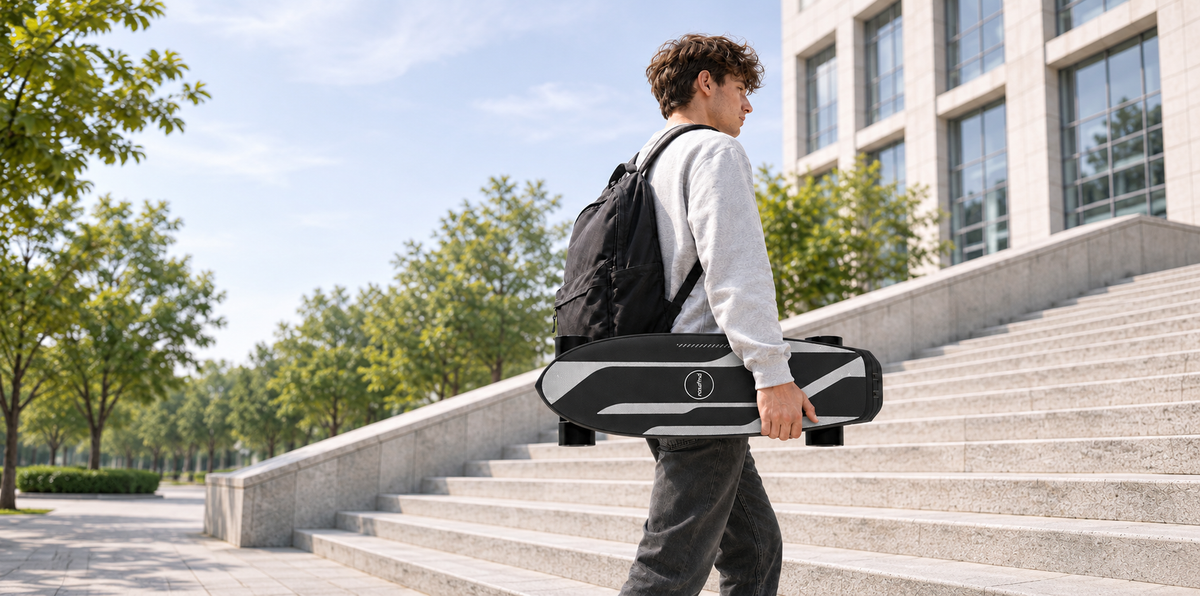
An electric skateboard can work well for a train commute when the riding sections suit the board, your transit operator accepts it, and you can manage every section on foot. Judge portability by carrying distance, time, and frequency, together with weight, overall dimensions, grip, and storage space.
At MAXFIND, we recommend planning the entire door-to-door trip before choosing a board. A short ride to the station can still involve apartment stairs, a long platform connection, a crowded walk near work, and a stop at the store on the way home. Here, we compare the CYBER MINI AIR, standard CYBER MINI, and base CYBER MAX for those transitions.
Walk your route in both directions and record every place where the board leaves the ground. Include station corridors, stairs, entrances, ticket gates, and any stretch you cannot ride. Record the longest continuous carry as well as the daily total.
Here is an illustrative one-way route. These distances and times are examples for planning, not comfort limits or measured results.
| Section on foot | Carrying distance | Carrying time | Separate carries |
|---|---|---|---|
| Apartment stairs and entrance | 100 ft | 1 minute | 1 |
| Station entrance to platform | 900 ft | 4 minutes | 1 |
| Destination station to office | 600 ft | 3 minutes | 1 |
| One-way total | 1,600 ft | 8 minutes | 3 |
If the return trip is the same, that becomes 3,200 ft (about 0.6 mile) and 16 minutes of carrying across six separate carries per day, before errands. The longest uninterrupted carry is four minutes over 900 ft. Reproduce that part of your route during a trial, with your work bag packed.
Also count how often you would attach and remove a carrier. A backpack may suit a long uninterrupted walk, while several brief stops can make repeated loading the bigger inconvenience. Note whether a longer elevator route reduces lifting, and keep an alternative in mind for days when an elevator is unavailable.
Weight tells you the load. Overall size tells you how much room you need to move and store it. Your grip determines how you control that load, and the available storage decides whether it fits into the day.
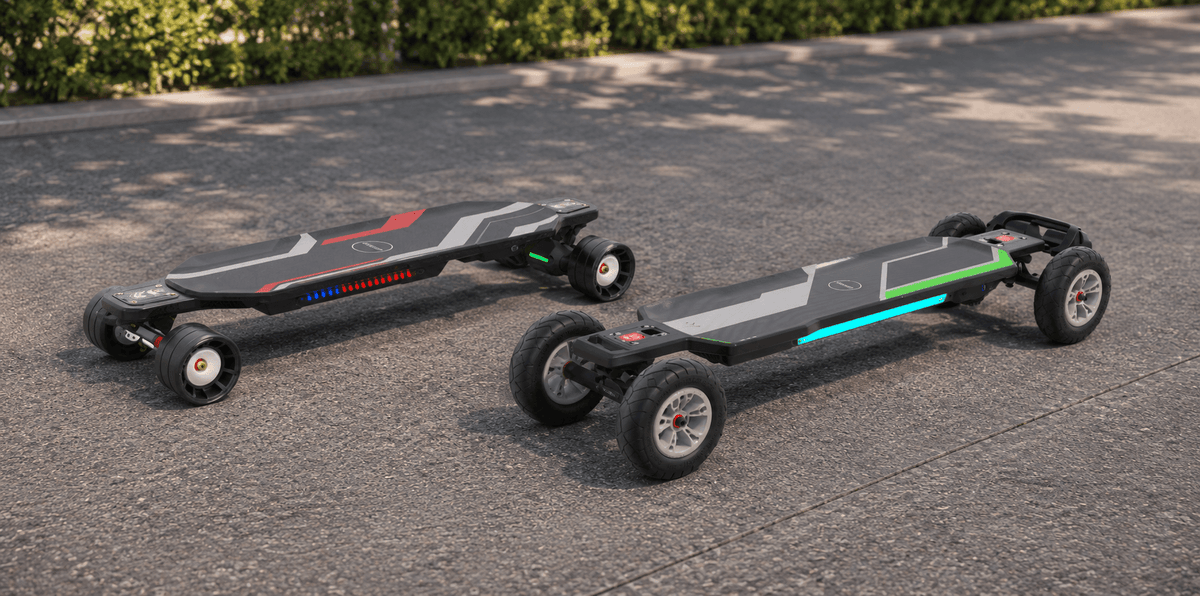
The comparison below uses the 99Wh CYBER MINI AIR and the standard 158.4Wh hub-drive CYBER MINI and CYBER MAX.
| Configuration | Listed board weight | Overall size, L × W × H | What it means for your commute |
|---|---|---|---|
| CYBER MINI AIR, 99Wh | 12.4 lb / 5.6 kg | Approx. 32.9 × 10.6 × 6.3 in; 83.5 × 27 × 16 cm | The lightest of these three configurations to lift repeatedly |
| CYBER MINI, 158.4Wh | 16 lb / 7.3 kg | Approx. 32.9 × 10.6 × 6.3 in; 83.5 × 27 × 16 cm | The same dimensions as AIR, with additional carrying weight and published range |
| CYBER MAX, 158.4Wh, 90mm hub configuration | 19.8 lb / 9 kg | Approx. 38.2 × 10.6 × 5.1 in; 97 × 27 × 13 cm | A longer platform for riders who prefer an electric longboard and have shorter carrying sections |
These are listed specifications, not independent carry tests. Inch dimensions are rounded conversions from the centimeter dimensions. Check the selected configuration on our CYBER MINI product page or CYBER MAX product page.
The standard MINI adds 1.7 kg to the AIR while keeping the same overall dimensions. Your storage needs remain similar, but every lift involves more weight.
Both Mini configurations are 13.5 cm, or about 5.3 inches, shorter than the MAX. Their listed height is greater, so check all three dimensions when measuring a locker opening, a space beside a desk, or an approved train storage area. Include any fitted accessories and the carrier.
For riding distance, the AIR lists up to 9 miles, while the standard MINI and base MAX both list up to 15 miles. These are maximum claimed ranges; plan a reserve for your actual route and conditions. In this comparison, the MAX offers a longer platform with the same published maximum range as the standard MINI.
Try lifting the board in the orientation you will use through doors and on stairs. Check hand clearance, balance, and whether the tail stays clear of the ground.
Our MINI and MAX product pages describe a removable carry handle. Confirm compatibility, the accessory list, and mounting instructions for your selected board. With a handle installed, you still lift the complete board; test its position with your normal work bag.
Measure storage using the complete board dimensions, including trucks and wheels. Check the opening and usable depth of a locker, the space beside your desk, and whether your chair can move normally with the board stored there. Allow room to take the board out again. Confirm the available space beneath a particular train seat before planning to use it.

Choose a carrying method for your longest walking section and your number of transitions. A carrier changes how you support the board; it also adds its own weight and takes time to put on and remove.
| Carrying method | When to consider it | What to check before relying on it |
|---|---|---|
| Hand-carry at a suitable grip point or carry handle | Brief lifts, entrances, and frequent short stops | A secure grip, ground clearance, balance, and whether your other hand remains available |
| Purpose-built carrying strap | Longer walking sections where hand-carrying is inconvenient | Published load rating, attachment instructions, strap position, board swing, and interference with your work bag |
| Purpose-built skateboard backpack | Longer continuous walks or a need to keep hands available | Board size and weight compatibility, secure retention, loaded comfort, laptop space, and loading time |
Confirm that the carrier is intended for an electric board with your setup's weight and dimensions, including truck width, wheels, battery enclosure, and accessories. Follow the carrier maker's attachment instructions and check for slipping or sideways movement before walking. Keep loose straps clear of the wheels before riding again.
If you need to carry a laptop, try the bag with the laptop, charger, water, and other daily items inside. Check that the board stays secure, does not press into the laptop compartment, and does not prevent you from reaching your fare card or phone. Account for the helmet too. Check how far the board extends above and below the bag when you turn, bend, or climb a step. The backpack's stated volume does not establish its board-carrying capacity.
Before committing to a train-based commute, check your operator’s current rules for electric skateboards, batteries, baggage size, and stowage. Ask about your exact service and travel time as well as your board. If powered boards are not clearly addressed, confirm acceptance directly with the operator.
Rules about riding in a station are a separate issue. For example, Caltrain prohibits using skateboards on platforms and ramps. That rule does not, by itself, confirm acceptance of a particular powered board as baggage.
Where your board is accepted, switch it off and secure the remote before handling it. Work out how you will pass through gates, board, and keep the board under control in an approved storage position. Keep doors and aisles clear. Do not plan around an overhead lift or an under-seat fit you have not checked.
Count flights and landings, then check whether you can keep a hand available for the railing. Pay attention to the tail near the steps and the board’s width when turning at a landing. For a shoulder or backpack carrier, check whether the board shifts as you climb.
Use your normal work bag during the trial. A board you can manage on its own may be less convenient when you are also carrying lunch or opening a heavy entrance door.
Ask the store whether the board can come inside and whether it must be covered. Count the shopping time as part of your carrying plan if there is nowhere approved to set it down. Consider how you will handle a basket, reach your wallet, and keep wheels or grip tape away from other shoppers.
For a brief stop, quickly picking up the board may be more practical than attaching and removing a backpack. For a longer visit, that same hand-carry can become the longest carry of the day. Try the routine that matches your errands rather than choosing a carrier only for the station walk.

Before buying, try the candidate board with your loaded work bag and intended carrier where possible. Reproduce the longest continuous walk, a staircase and landing, a doorway, and the storage position you intend to use. If you cannot trial the exact setup, treat carrier fit and carrying comfort as unresolved parts of the decision.
Use your route notes to narrow the comparison:
These recommendations follow the listed specifications and route requirements. Carrying comfort and carrier compatibility still need a trial with your setup.
Choose the board and carrier together, after accounting for the train, every walking section, and the place you will leave it at your destination. You can compare our CYBER MINI options and CYBER MAX, or use our portable electric skateboard guide alongside your route notes.
Teilen:
Kaufst du dein erstes elektrisches Skateboard? Worauf du jenseits der Höchstgeschwindigkeit achten solltest
Electric Skateboard Wheels for Rough Roads: Street Wheels or Pneumatic Tires?