

Schulanfangsangebot! 🏷️ Tolles Preis-Leistungs-Verhältnis!
--
Tage--
Öffnungszeiten--
Minuten--
Sek.Dieser Unterschied ist wichtig, da die offiziellen Angaben nicht vollständig einheitlich sind. Die einzelnen, weiter unten besprochenen Produktseiten nennen IPX5, während Maxfind auf seiner Garantieseite derzeit IP65 als allgemeine Angabe für Maxfind-Skateboards verwendet. Beide Schutzarten weisen bei der Flüssigkeitsbeständigkeit die Ziffer 5 auf, doch IP65 enthält zusätzlich eine separate Angabe zum Staubschutz. Noch wichtiger ist, dass auf der Garantieseite steht, die Boards seien nicht vollständig wasserdicht, die internen Komponenten seien nicht wasserdicht und das Fahren bei Regen sei riskant. Für einen sorgfältigen Kaufratgeber ist es daher sinnvoll, die auf der jeweiligen Produktseite veröffentlichte IPX5-Einstufung zu verwenden und die vorsichtigere Warnung vor Regen zu befolgen.
Maxfind ist eine Direktvertriebsmarke für urbane Mikromobilität mit Mini-Boards, Longboards und elektrischen All-Terrain-Skateboards zu Preisen von 199 bis über 1.000 US-Dollar. Modellübergreifend finden sich wiederkehrende Merkmale wie eine auf Hobbywing basierende Steuerung, schnell wechselbare Akkus bei der FF-Familie und dem CYBER-Umrüstsatz, pendlerfreundliche Formate und eine cyberindustrielle Designsprache. Beim Besitz und Einsatz bei feuchtem Wetter stehen Design und Leistung jedoch hinter Gehäusekonstruktion, Schutz des Ladeanschlusses, der Pflege der Batterieschnittstelle und einer realistischen Einschätzung zurück, wann man besser nicht fährt.
|
Fahrertyp |
Wahrscheinlicher Streckenzustand |
Empfohlene Maxfind-Konfiguration |
Wichtige zu prüfende Variable |
Realistisches Ziel |
|
Pendler, der Zug und letzte Meile kombiniert |
Überwiegend trockene Straßen mit gelegentlicher Restfeuchtigkeit |
MAX2 PRO Single, Dual oder X, je nach Reichweitenbedarf und Verfügbarkeit |
Exakte Batterie- und Motorversion |
Kurze Fahrten in der Stadt, bei denen Tragbarkeit wichtiger ist als Komfort auf holprigen Straßen |
|
Stadtfahrer mit längerem Arbeitsweg auf der Straße |
Trockener bis feuchter Straßenbelag mit möglichem leichten Spritzwasser |
FF PRO, zwei 1000-W-Nabenmotoren und 96-mm-Räder |
Schließung der Batterieabdeckung und Dauer der Wassereinwirkung |
Längere Fahrten auf der Straße mit Reichweitenreserve, jedoch keine geplanten Fahrten bei Regen |
|
Fahrer auf holprigem Straßenbelag |
Beschädigter Asphalt und fleckige, gemischte Oberflächen |
CYBER ULTRA Belt mit 175-mm-Luftreifen oder Hub mit 165-mm-AT-Rädern |
Exakte Rad- und Motorkonfiguration |
Besseres Überrollen von Hindernissen auf holprigen Straßen, ohne zusätzlichen Nassgrip vorauszusetzen |
|
Anfänger, der ein stabiles Street-Longboard sucht |
Überwiegend trockene Straßen, die nach Regen noch feucht sein können |
MAX5S, zwei 650-W-Nabenmotoren und 90-mm-PU-Räder |
Beschaffenheit der Oberfläche und Streckenlänge |
Kontrollierte Anfängerfahrten auf nahezu trockenen Straßen |
|
Fahrer auf rauerem Straßenbelag mit kürzerer Strecke |
Risse, raue Stellen und gelegentliche Restfeuchtigkeit |
FF AT, zwei Nabenmotoren mit jeweils 1500 W und 165-mm-Vakuumgummiräder |
Bodenhaftung und Überprüfung nach der Fahrt |
Komfort auf rauem Untergrund bei vorsichtiger Geschwindigkeit und ohne stehendes Wasser |
Prüfen Sie drei Dinge, bevor Sie entscheiden, ob ein Board für eine möglicherweise noch feuchte Strecke geeignet ist: die veröffentlichte Angabe des Modells zur Wasserbeständigkeit, das zum Straßenbelag passende Radformat und reale Reichweitendaten aus Tests derselben oder eindeutig bezeichneten Konfiguration. Fehlt eines dieser Elemente, sollten Sie die Lücke nicht durch Vermutungen füllen.
Sie müssen außerdem die tatsächliche Strecke berücksichtigen, nicht die ideale. Eine kurze Fahrt, nachdem der Straßenbelag größtenteils getrocknet ist, ist etwas anderes als vierzig Minuten bei anhaltendem Nieselregen, Spritzwasser von der Straße, Pfützenrändern und markierten Kreuzungen. Die Zuverlässigkeit bei feuchtem Wetter ist immer eine Kombination aus Gehäusedesign, Streckenbeschaffenheit, Verhalten des Fahrers, Einwirkungsdauer und Pflege nach der Fahrt.
Beginnen Sie damit, IPX5 praxisgerecht zu verstehen. Im IEC-Schutzartensystem bedeutet der Buchstabe „X“, dass die Schutzart keinen geprüften Schutzgrad gegen feste Partikel angibt, während sich die letzte Ziffer „5“ unter festgelegten Prüfbedingungen auf den Schutz gegen Wasserstrahlen bezieht.[1] Das bedeutet nicht, dass das gesamte Skateboard wasserdicht ist, schützt nicht vor dem Eintauchen und garantiert nicht, dass jeder Ladeanschluss, jede Akkuschnittstelle, jedes Lager, jede Motoröffnung oder jede Naht nach Verschleiß weiterhin geschützt bleibt.

Auf den aktuellen Produktseiten von MAX2 PRO, MAX5S, FF PRO, FF AT und CYBER ULTRA wird jeweils IPX5 angegeben.[3][4][5][6][7] Diese Angaben sind nützliche produktspezifische Informationen, doch jede dieser Seiten warnt außerdem davor, dass Wassereinwirkung das Skateboard beschädigen kann, und empfiehlt, starken Regen zu vermeiden. Auf der Garantieseite geht Maxfind noch weiter und erklärt, dass das Fahren bei Regen riskant ist und die internen Komponenten nicht wasserdicht sind.[2]
Die praktische Grenze liegt daher konservativer als bei der Aussage „IPX5 bedeutet, dass man bedenkenlos bei Nieselregen fahren kann“. Wenn Sie von einem kurzen, leichten Schauer überrascht werden, verkürzen oder beenden Sie die Fahrt, sobald dies möglich ist, meiden Sie Pfützen und überprüfen und trocknen Sie das Board anschließend. Wenn die Strecke anhaltenden Regen, überflutete Fahrbahnränder, Wasser bis zur Unterseite oder wiederholte Pfützendurchfahrten umfasst, nutzen Sie ein anderes Verkehrsmittel.
Dies ist besonders wichtig bei Boards mit herausnehmbaren Akkus. Auf der aktuellen FF-PRO-Produktseite werden ein integriertes Deck und die Schutzart IPX5 angegeben, doch auch die Bewertung des FF PRO durch Electric Skateboard HQ warnte, dass durch das von oben zugängliche Akkufach Wasser von oben eindringen könnte.[9] Der Komfort eines schnell wechselbaren Akkus macht es nicht überflüssig, Deckel, Verschluss, Dichtungsbereich und Akkuschnittstelle zu überprüfen.
Achtung: Eine IP-Schutzart beschreibt eine definierte Testbedingung, keine dauerhafte Unempfindlichkeit. Dichtungen altern, Anschlüsse können teilweise offen bleiben, Befestigungselemente können sich lockern, und Beschädigungen können den Schutz verändern, der beim Neuzustand des Produkts vorhanden war. Verwende die Schutzart niemals als Grund, durch stehendes Wasser zu fahren.
Du weißt, dass du IPX5 richtig interpretierst, wenn sich dein Fahrplan weiterhin mit dem Wetter ändert. Verbleibende Feuchtigkeit kann eine langsamere und kürzere Fahrt erforderlich machen. Bei aktivem Regen oder stehendem Wasser solltest du auf ein anderes Verkehrsmittel ausweichen.
Wähle das Board passend zur Strecke aus, indem du dich fragst, wie weit du fährst, wie der Asphalt beschaffen ist, wie lange die Elektronik Spritzwasser ausgesetzt sein könnte und welche genaue SKU du in Betracht ziehst.

Das MAX2 PRO ist ein gutes Beispiel dafür, warum die SKU wichtig ist. Die Version mit einem Motor ist für 32 km/h und 24 km ausgelegt. Die Version mit zwei Motoren ist für 39 km/h und 24 km ausgelegt. Das MAX2 PRO X ist für 39 km/h und 34 km ausgelegt und verwendet einen größeren 230-Wh-Akku anstelle des 158,4-Wh-Akkus der Versionen mit einem und zwei Motoren. In den detaillierten technischen Daten werden für die Produktreihe eine Steigfähigkeit von 25 % und IPX5 angegeben.[3] Der beworbene Einstiegspreis sollte nicht automatisch mit der Spezifikation der X-Version mit größerer Reichweite verknüpft werden.
Das MAX5S ist die stabilere Longboard-Option für Einsteiger. Das aktuelle Modell wird mit zwei 650-W-Nabenmotoren, einem Hobbywing-V6.0-FOC-ESC, einem 158,4-Wh-Akku, 90-mm-PU-Rädern, einer Höchstgeschwindigkeit von 39 km/h, einer Reichweite von 24 km, einer angegebenen Steigfähigkeit von 25 % und IPX5 aufgeführt.[4] Seine größere Plattform kann sich ruhiger anfühlen als ein Mini-Board, aber die kompakten PU-Räder erfordern weiterhin eine sorgfältige Routenwahl, wenn der Asphalt rissig, körnig oder nass ist.
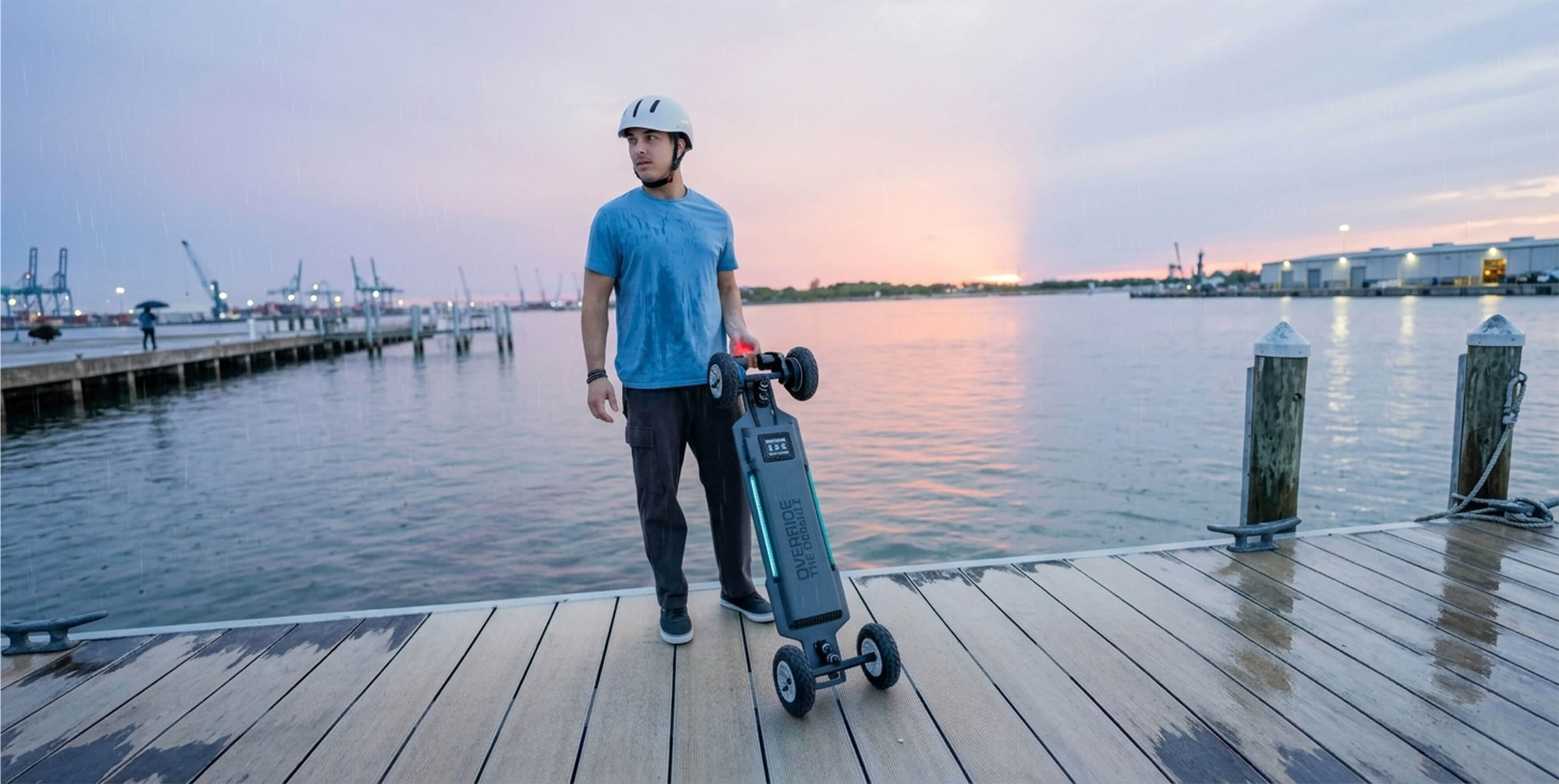
Mit dem FF PRO ändert sich der Einsatzzweck. Das aktuelle Modell beginnt bei 699 US-Dollar und wird mit zwei 1.000-W-Nabenmotoren, einem 376-Wh-Samsung-Akku, 96-mm-Rädern, einer Höchstgeschwindigkeit von 45 km/h, einer angegebenen Reichweite von 45 km, einer Steigfähigkeit von 30 % und IPX5 aufgeführt.[5] Am besten lässt es sich als Streetboard mit großer Reichweite und gelegentlicher Spritzwasserbeständigkeit sowie einem praktischen, von oben zugänglichen Akku beschreiben – nicht als Spezialist für nasses Wetter.
Der FF AT wird derzeit mit zwei 1.500-W-Nabenmotoren, einem 376-Wh-Samsung-Akku, 165-mm-Vakuum-Gummirädern, einer Höchstgeschwindigkeit von 45 km/h, einer Reichweite von 27 km, einer angegebenen Steigfähigkeit von 35 % und IPX5 aufgeführt.[6] Die größeren Räder können die Auswirkungen von Rissen und beschädigtem Asphalt verringern, aber der Raddurchmesser allein beweist keine bessere Bremsleistung oder Kurvenhaftung auf nassem Asphalt. Gummimischung, Profil, Geschwindigkeit, Fahrereingaben und Verschmutzungen spielen weiterhin eine Rolle.
Das CYBER ULTRA muss ebenfalls nach Konfiguration beschrieben werden. Die Version mit Riemenmotor verwendet 175-mm-Luftreifen, erreicht laut Angabe 37 mph und bietet eine angegebene Reichweite von 37 Meilen. Die Version mit Hubmotor verwendet 165-mm-AT-Reifen, erreicht 31 mph und bietet ebenfalls 37 Meilen Reichweite. Das 2-in-1-Paket mit Riemenmotor enthält zusätzlich 107-mm-Space-Wheels; die Angabe von 56 Meilen gilt bei Verwendung dieses Straßenreifen-Setups. Alle Versionen verwenden einen 648-Wh-Akku mit LG-Zellen und sind mit IPX5 angegeben.[7] Zur Veranschaulichung auf unebenen Straßen eignet sich die 175-mm-Riemenkonfiguration am besten, doch ihre höhere Geschwindigkeit ist bei feuchtem Wetter kein Vorteil.
Die aktuellen Produktseiten veröffentlichen Maße, Gewicht, Belastbarkeit, Radgröße und Materialien; diese Angaben sollten daher nicht als „nicht veröffentlicht“ bezeichnet werden. Nicht belegt ist weiterhin ein kontrollierter Vergleich des Nassgrips oder Nassbremsverhaltens von Modell zu Modell. Dieser Artikel verwendet das Reifenformat daher zur Erläuterung von Hindernisüberrollung und Komfort, nicht als Behauptung einer gemessenen Überlegenheit bei nassem Wetter.
Auch das Deck und das Griptape spielen eine Rolle. Composite- oder flexorientierte Decks können harte Stöße abmildern, und Maxfinds gummiartige Grifffläche schont die Kleidung mehr als herkömmliches Sandpapier. Keine dieser Eigenschaften macht ein nasses Deck sicher. Halte die Standfläche sauber und trocken und gehe nicht davon aus, dass feuchte Schuhe denselben Halt bieten wie trockene.
Praxisberichte helfen dabei, Reichweite und Fahrcharakter zu bestimmen, beweisen aber nicht automatisch die Zuverlässigkeit bei nassem Wetter. Verwende sie nur für die Fragen, die tatsächlich getestet wurden.
Die Maxfind-Max5-Pro-Rezension von Electric Skateboard HQ aus dem Jahr 2023 behandelte eine frühere Generation, nicht das aktuelle MAX5S. Das getestete Board hatte zwei 650-W-Hubmotoren, einen Hobbywing-3.0-ESC, einen 158,4-Wh-Akku und eine IPX5-Einstufung. Bei zügiger Fahrt mit einem 220 Pfund schweren Fahrer erreichte es im Reichweitentest des Rezensenten 9,3 Meilen.[8] Dieses Ergebnis ist als historischer Kontext dafür nützlich, wie sich Fahrergewicht und Tempo auf eine ähnliche Akkukapazität auswirken, sollte aber nicht als Reichweitentest des aktuellen MAX5S mit V6.0 präsentiert werden.
Die FF-PRO-Rezension passt eindeutig besser zum Modell. Electric Skateboard HQ testete einen 376-Wh-Samsung-12S3P-Akku, einen Hobbywing-5.0-FOC-Controller und zwei 1000-W-Hubmotoren. Das Board wurde im Testzeitraum mit 27 Meilen beworben, erreichte mit einem 196 Pfund schweren Fahrer 17 Meilen und erzielte an einem windigen Tag 23,6 mph gegenüber den angegebenen 28 mph.[9] Auf der aktuellen offiziellen Seite sind inzwischen 28 Meilen angegeben, doch das unabhängige Ergebnis von 17 Meilen bleibt für Fahrer mit ähnlichem Gewicht und unter ähnlichen Bedingungen die konservativere Planungsgrundlage.
Die CYBER-ULTRA-Rezension von Electric Skateboard HQ testete die Version mit Riemenmotor und 175-mm-Geländereifen. Sie bestätigte den 648-Wh-Akku, LG-21700-Zellen, das integrierte Composite-Deck und die IPX5-Einstufung und beschrieb die Reichweite bei aggressiver Fahrweise mit AT-Reifen als eher 30 Meilen statt der angegebenen 37 Meilen.[10] Dieses Ergebnis sollte nicht auf die Hub-Konfiguration oder die Reichweitenangabe von 107-mm-Space-Wheels übertragen werden, ohne einen weiteren Test.
Kalte Bedingungen können die verfügbare Akkuleistung verringern, aber diese Quellensammlung enthält keinen kontrollierten Kältetest der aktuellen Maxfind-Modelle. Daher sollte kein genauer Prozentsatz für den Reichweitenverlust im Winter behauptet werden. Praktisch empfiehlt es sich, eine größere Reserve einzuplanen, eigene Streckendaten zu erfassen und an einem kalten Tag keine Rückfahrt am äußersten Rand einer Marketingangabe zu planen.
Ein historischer Test des FF Plus von ERideHero zeigt, wie stark allein die Geschwindigkeit die Reichweite verändern kann. Mit einem 170 Pfund schweren Testfahrer und einem 216-Wh-Akku erreichte der eingestellte FF Plus 8,9 Meilen bei einer Durchschnittsgeschwindigkeit von 13 mph, 7,8 Meilen bei 15,2 mph und 6,6 Meilen bei 18,7 mph. Im selben Test wurden eine Höchstgeschwindigkeit von 21,8 mph und eine Beschleunigung von 0 auf 15 mph in 3,53 Sekunden gemessen.[11] Dies ist kein Beleg für aktuelle Maxfind-Modelle oder das Fahren bei Regen. Es ist lediglich ein kontrolliertes Beispiel dafür, warum Geschwindigkeit und Fahrstil in die Reichweitenplanung einbezogen werden müssen.
Profi-Tipp: Wenn du keine eigenen Streckendaten hast, kann es vorsichtig sein, 60–75 % der veröffentlichten Maximalreichweite vorübergehend als Planungsfenster anzusetzen; das ist jedoch keine allgemeingültige Formel. Ersetze diese Schätzung so bald wie möglich durch deine eigenen protokollierten Ergebnisse.
Die folgende Tabelle verwendet modellspezifische Informationen, die von den Herstellern veröffentlicht wurden. Sie bewertet die Boards nicht danach, wie gut sie sich bei Regen fahren lassen, denn eine IP-Schutzart ist nicht dasselbe wie ein kontrollierter Test der Bremsleistung bei Nässe, des Grips bei Nässe oder der langfristigen Korrosion.
|
Marke/Modell |
Angegebene Schutzart |
Akku |
Räder |
Warnung oder Einschränkung des Herstellers |
Preiskontext |
|
Maxfind MAX2 PRO |
IPX5 |
158,4 Wh Single/Dual; 230 Wh X |
90 mm |
Die Produktseite warnt davor, dass Wasser das Board beschädigen kann, und empfiehlt, starken Regen zu vermeiden |
Ab 299 $ |
|
Maxfind MAX5S |
IPX5 |
158,4 Wh |
90-mm-PU |
Die Produktseite warnt davor, dass Wasser das Board beschädigen kann, und empfiehlt, starken Regen zu vermeiden |
379 $ zum Prüfzeitpunkt |
|
Maxfind FF PRO |
IPX5 |
376 Wh |
96 mm |
Die Produktseite warnt vor starkem Regen; eine Drittanbieterbewertung weist auf mögliches Eindringen von oben hin |
Ab 699 $ |
|
Maxfind FF AT |
IPX5 |
376 Wh |
165-mm-Vakuumgummi |
Die Produktseite warnt davor, dass Wasser das Board beschädigen kann, und empfiehlt, starken Regen zu vermeiden |
799 $ zum Prüfzeitpunkt |
|
Maxfind CYBER ULTRA |
IPX5 |
648 Wh |
165-mm-Nabenmotor; 175-mm-Riemen; 107 mm zusätzlich mit 2-in-1 |
Die Produktseite warnt vor starkem Regen; die Schutzart gilt nicht für das Eintauchen |
Ab 999 $ |
|
Backfire ERA 5 |
IP65 |
216 Wh |
96 mm |
Auf der offiziellen Seite wird IP65 angegeben; es gibt keine Aussage zur Eintauchtiefe |
449 $ zum Prüfzeitpunkt |
|
Exway Flex Paragon |
IP55 |
504 Wh |
Plattform für Straßenräder |
Auf der offiziellen Seite steht ausdrücklich, dass man bei Regen oder auf nassem Untergrund nicht fahren soll |
Preis variiert je nach Angebot |
|
MEEPO Go |
IPX5 |
324 Wh |
90-mm-PU |
Auf der offiziellen Seite steht, dass Schäden durch Wassereinwirkung von der Garantie ausgeschlossen sind |
569 $ zum Prüfzeitpunkt |
Dieser Vergleich liefert zwei nützliche Erkenntnisse. Erstens bezeichnet die letzte Ziffer die Schutzklasse gegen Flüssigkeiten: IPX5 und IP65 verwenden beide „5“ für den Wasserschutz, während das erste Zeichen bzw. die erste Ziffer angibt, ob eine Einstufung für feste Partikel angegeben ist. Zweitens ist der Nutzungshinweis des Herstellers ebenso wichtig wie der Code. Exway veröffentlicht IP55 und weist Fahrer dennoch an, das Board nicht bei Regen oder auf nassem Untergrund zu verwenden. MEEPO veröffentlicht IPX5, schließt Wasserschäden jedoch von der Garantie aus. Maxfind veröffentlicht auf den entsprechenden Produktseiten IPX5 und warnt zugleich davor, dass Wasser das Board beschädigen kann.
Die ehrliche Schlussfolgerung lautet nicht, dass ein bestimmter Schutzcode ein Board zum Regenfahrzeug macht. Vielmehr kann der angegebene Gehäuseschutz das Risiko durch gelegentliche Nässeeinwirkung verringern, während die Wahl der Strecke und die Pflege nach der Fahrt weiterhin darüber entscheiden, ob dieser Schutz verantwortungsvoll genutzt wird.
Etabliere für feuchtes Wetter eine Routine aus Überprüfung, bewussten Fahrentscheidungen und Pflege nach der Fahrt. Die tägliche Zuverlässigkeit hängt davon ab, was du vor und nach dem Pendeln tust.
Überprüfe vor der Fahrt die Abdeckung des Ladeanschlusses und stelle sicher, dass sie bündig sitzt und vollständig geschlossen ist. Vergewissere dich bei Boards mit herausnehmbaren Akkus, dass Verschluss und Gehäuse sicher befestigt sind. Prüfe die Wettervorhersage und den tatsächlichen Zustand des Straßenbelags. Wenn stehendes Wasser, anhaltender Regen oder überflutete Fahrbahnränder zu erwarten sind, lass das Board zu Hause.
Meide während der Fahrt Pfützen und reduziere die Geschwindigkeit auf Fahrbahnmarkierungen, Metallabdeckungen, nassem Laub und rutschigen Zebrastreifen. Gleichmäßiges Beschleunigen und Bremsen ist wichtiger als maximale Leistung. Plane einen längeren Bremsweg ein und vermeide abruptes Carven oder Beschleunigen.

Schalte das Board nach der Fahrt aus und wische Deck, Achsen, Räder und Unterseite ab. Stelle sicher, dass der Ladeanschluss und die Schnittstelle für den herausnehmbaren Akku vollständig trocken sind, bevor du ein Ladegerät anschließt oder den Akku wechselst. Lass das Board an einem gut belüfteten Ort an der Luft trocknen. Verwende keine starke Hitze am Akku, am Ladeanschluss, an den Dichtungen oder an der Elektronik.
Hier ist eine praktische Checkliste:
Vor der Fahrt
· Überprüfe die Abdeckung des Ladeanschlusses.
· Vergewissere dich, dass der Akkuverschluss oder das Batteriegehäuse sicher geschlossen ist.
· Überprüfe die Strecke auf Pfützen, überflutete Fahrbahnränder und aktuellen Regen.
· Plane bei kalten Bedingungen oder unklarer Strecke eine größere Akkureserve ein.
Während der Fahrt
· Meide stehendes Wasser.
· Fahre langsamer über Fahrbahnmarkierungen, Metallabdeckungen, Laub und Schmutz.
· Beschleunige, bremse und carve gleichmäßig.
· Plane einen längeren Bremsweg ein.
Nach der Fahrt
· Schalte das Board aus.
· Wische Deck, Achsen, Räder und Unterseite ab.
· Trockne den Ladeanschluss und die Batterieschnittstelle, bevor du das Board auflädst oder den Akku wechselst.
· Überprüfe die Nähte und Verschlüsse, wenn die Strecke Spritzwasser von der Straße beinhaltete.
· Verstaue das Board erst, wenn es trocken ist.
Wenn unebener Straßenbelag das Hauptproblem ist, können Konfigurationen mit größeren Rädern wie das FF AT oder CYBER ULTRA die Auswirkungen von Rissen und Übergängen im Untergrund verringern. Das macht sie jedoch nicht nachweislich zu den Modellen mit der besten Nasshaftung. Wenn leichte Transportierbarkeit am wichtigsten ist, lässt sich das MAX2 PRO einfacher in Innenräume tragen. Trotzdem musst du die richtige Single-, Dual- oder X-Version auswählen, statt jedes MAX2 PRO als Board mit 21 Meilen Reichweite zu betrachten.
Du wirst wissen, dass die Routine funktioniert, wenn das Board auch nach wiederholten Fahrten berechenbar bleibt: kein überraschendes Aufladen nach einer feuchten Fahrt, keine offenen Anschlussabdeckungen, kein Batteriewechsel bei Feuchtigkeit an den Kontakten und keine Streckenplanung rund um stehendes Wasser.
Das stärkste Argument unabhängiger Quellen für diese Boards ist nicht waghalsiges Fahren bei Extremwetter. Es sind die sanfte Kontrolle, die realistische Reichweite und einige nützliche Designentscheidungen.
Paxson Lim von Electric Skateboard HQ beschrieb die vier Geschwindigkeitsmodi des früheren Max5 Pro als „100 % sanft und äußerst intuitiv zu bedienen“.[8] Das stützt die Geschichte der Familie in Bezug auf sanfte Kontrolle, doch das aktuelle MAX5S verwendet nun einen anderen V6.0-FOC-Controller. Daher sollte das Zitat nicht als direkter Test des aktuellen ESC präsentiert werden.
Zum FF PRO schrieb dieselbe Publikation, dass der Hobbywing-5.0-ESC „butterweiche und intuitive Kontrolle sowohl beim Beschleunigen als auch beim Bremsen“ biete. Außerdem wurden im Test 17 Meilen mit einem 196 Pfund schweren Fahrer erreicht, verglichen mit der im Testzeitraum angegebenen Reichweite von 27 Meilen.[9] Diese Beobachtungen stützen die Einschätzung des Kontrollgefühls und eine realistische Reichweitenplanung; sie belegen jedoch keinen Bremsweg auf nasser Fahrbahn.
Die Tests des eingestellten FF Plus von ERideHero liefern ein kontrolliertes Beispiel dafür, wie sich das Tempo auf die Reichweite auswirkt, während die Bewertung des CYBER ULTRA durch Electric Skateboard HQ das hochwertige Design des Flaggschiffmodells, das integrierte Deck und die komfortable 175-mm-Belt-Konfiguration bestätigt.[10][11] Auch diese Quelle ist jedoch kein kontrollierter Regentest.
Auch Quellen aus etablierten Medien und Kundenrezensionen sollten mit derselben Sorgfalt behandelt werden. Forbes berichtete 2023 über das FF Belt, was eine größere mediale Sichtbarkeit zeigt.[12] Trustpilot weist derzeit auf eine gemischte Kundenstimmung und eine sich verändernde Anzahl von Bewertungen hin und sollte daher eher als dynamisches Signal für den Kundenservice denn als Beleg für Wasserbeständigkeit oder Sicherheit im Arbeitswegverkehr betrachtet werden.[13]
Nicht automatisch. IPX5 ist eine festgelegte Schutzart für Gehäuse, doch Maxfind weist auf den eigenen Produktseiten darauf hin, dass Wasser das Board beschädigen kann, und auf der Garantieseite wird das Fahren bei Regen als riskant bezeichnet. Betrachte die Schutzart als Schutz vor gelegentlichem Wasserkontakt, nicht als Empfehlung, eine Fahrt bei Regen zu planen.
Erst, nachdem die tatsächliche Strecke überprüft wurde. Nahezu trockener Asphalt ohne aktuellen Regen oder stehendes Wasser ist etwas anderes als eine sichtbar nasse Straße. Fahrbahnmarkierungen, Metallabdeckungen, Laub und schattige Bereiche können rutschig bleiben, nachdem der umgebende Asphalt trocken aussieht. Im Zweifel warten oder ein anderes Verkehrsmittel nutzen.
Die CYBER-ULTRA-Belt-Konfiguration verwendet 175-mm-Luftreifen, während die Hub-Konfiguration 165-mm-AT-Reifen nutzt. Der FF AT verwendet 165-mm-Vollgummireifen. Diese größeren Formate können Risse und unebene Übergänge ruhiger überrollen als 90–96-mm-Straßenräder. Dieser Artikel enthält jedoch keine kontrollierten Daten zur Nasshaftung, die belegen, dass eine Konfiguration bei Nässe besser bremst oder Kurven fährt als eine andere.
Es gibt keinen einheitlichen Prozentsatz, der für alle Fahrer passt. Gewicht, Geschwindigkeit, Temperatur, Steigungen, Reifendruck, Reifenwahl und Stop-and-go-Verkehr beeinflussen die Reichweite. Verwenden Sie unabhängige Tests als konservative Referenz, halten Sie eine Reserve ein und ersetzen Sie allgemeine Schätzungen durch Daten Ihrer eigenen Strecke.
Schalten Sie das Board aus, prüfen Sie, ob der Bereich des Ladeanschlusses trocken ist, und kontrollieren Sie vor dem Laden oder Wechseln jede Schnittstelle eines herausnehmbaren Akkus. Achten Sie beim FF PRO besonders auf den von oben zugänglichen Akkubereich, da eine unabhängige Bewertung ihn als mögliche Eintrittsstelle für Wasser identifiziert hat. Schließen Sie das Ladegerät erst an, wenn die entsprechenden Bereiche vollständig trocken sind.
Die treffendste Beschreibung dieses Sortiments lautet nicht „wasserdichte Elektro-Skateboards“ und auch nicht „regenfeste Boards“. Es handelt sich um eine Reihe von Elektro-Skateboards mit modellspezifischen Angaben zur Schutzart IPX5, Herstellerwarnungen vor Wassereinwirkung, gleichmäßiger, auf Hobbywing basierender Steuerung und Konfigurationen, die von kompakten Mini-Boards bis hin zu All-Terrain-Modellen mit großen Rädern reichen.
Damit sind die Boards besser auf gelegentliche Spritzer und Restfeuchtigkeit vorbereitet als ein Produkt ohne angegebene Gehäuseschutzart. Geplante Fahrten im Regen werden dadurch jedoch nicht risikofrei. Wählen Sie die genaue SKU, meiden Sie stehendes Wasser, fahren Sie vorsichtig und integrieren Sie das Trocknen nach der Fahrt in die Pflegeroutine.
Wenn die Strecke regelmäßig zu einer Fahrt im Sturm oder einem Parcours aus Pfützen wird, lautet die richtige Antwort nicht auf eine noch aggressivere Maxfind-Konfiguration, sondern auf ein anderes Verkehrsmittel.
Die Preise entsprechen den im Juli 2026 geprüften Angeboten. Prüfen Sie vor dem Kauf die aktuellen Preise und die regionale Verfügbarkeit.
1. IEC — Schutzarten (IP-Schutzklassen)
2. Maxfind — Leitfaden zu Garantie und Wasserbeständigkeit
3. Maxfind — Offizielle Produktseite des MAX2 PRO
4. Maxfind — Offizielle Produktseite des MAX5S
5. Maxfind — Offizielle Produktseite des FF PRO
6. Maxfind — Offizielle Produktseite des FF AT
7. Maxfind — Offizielle Produktseite des CYBER ULTRA
8. Electric Skateboard HQ — Test des Maxfind Max5 Pro
9. Electric Skateboard HQ — Test des Maxfind FF PRO
10. Electric Skateboard HQ — Test des Maxfind CYBER ULTRA
11. ERideHero — Test und Messdaten zum Maxfind FF Plus
12. Forbes — Test des Maxfind FF Belt
13. Trustpilot — Maxfind-Bewertungen
14. Backfire — Offizielle Produktseite der ERA 5

Teilen:
Die besten Elektro-Skateboards für Studierende im Jahr 2026
Wie viel Bremsweg benötigt ein Elektro-Skateboard beim Pendeln?