

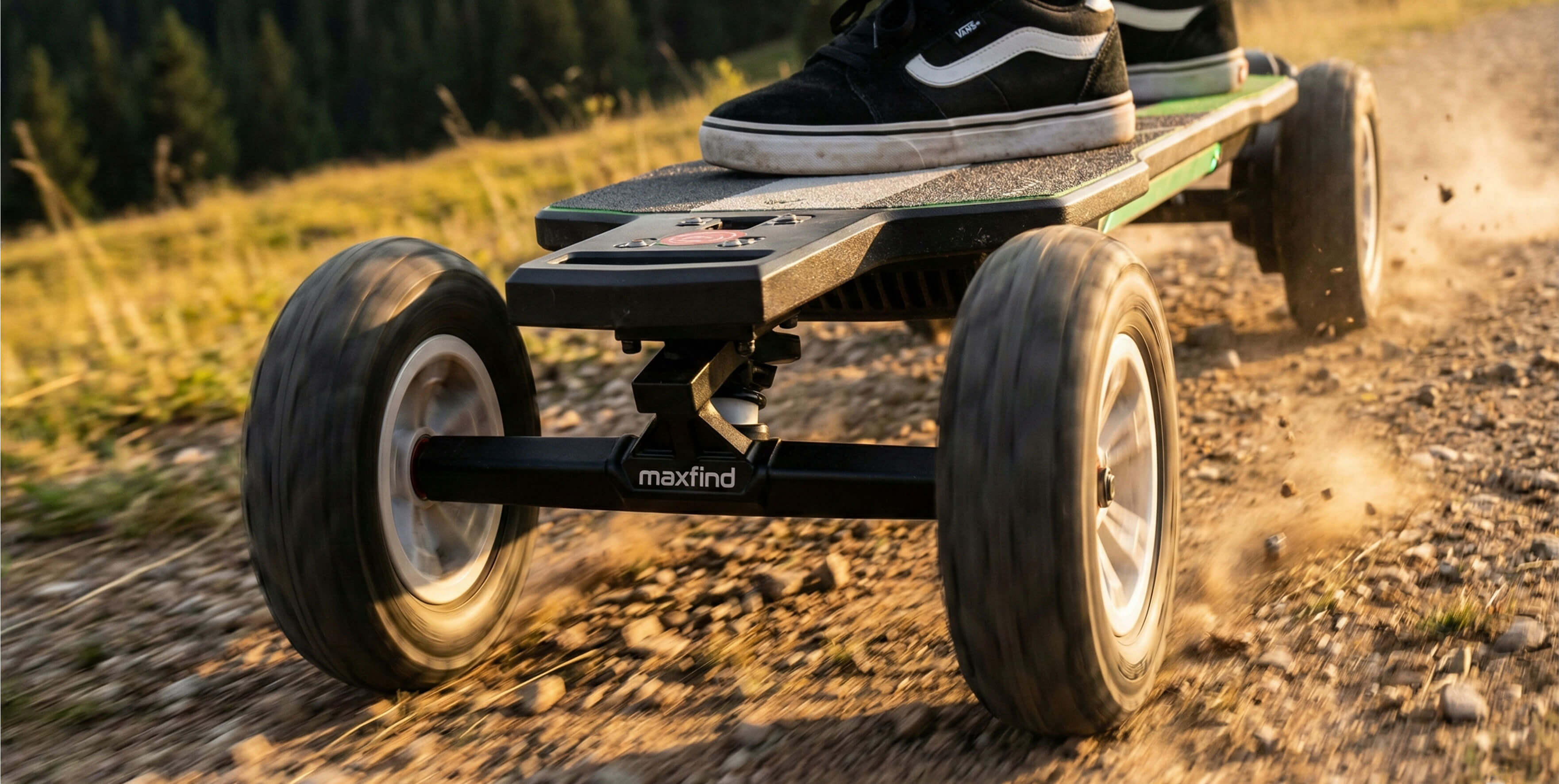
À la fin de ce guide, vous saurez choisir et configurer une planche Maxfind pour réduire les vibrations transmises par la chaussée et rendre les trajets plus longs plus faciles pour vos pieds, vos chevilles et vos genoux. La décision la plus importante concerne d’abord le type et la taille des roues, puis la flexibilité du deck. Si votre itinéraire comprend de la chaussée fissurée, des briques et de l’asphalte rapiécé, cet ordre compte davantage que les caractéristiques du moteur ou le style.
Maxfind occupe une position intéressante pour les utilisateurs qui recherchent un confort abordable plutôt que les prix des marques haut de gamme. La gamme offre plusieurs solutions distinctes pour réduire la fatigue liée aux routes accidentées : le FF AT coûte 799 $ et atteint 28 mi/h, avec une autonomie de 17 miles, des roues en caoutchouc sous vide de 165 mm et une batterie à remplacement rapide ; le FF Belt coûte 599 $ et atteint 28 mi/h, avec une autonomie de 25 miles, un deck en matériau composite flexible et une batterie à remplacement rapide ; le FF Pro coûte 699 $ et atteint 28 mi/h, avec une autonomie de 28 miles, un deck en matériau composite flexible et une batterie à remplacement rapide. Le Cyber Ultra commence à 1 099 $, mais ses performances dépendent de la configuration : les versions à transmission par courroie atteignent 37 mi/h, la configuration tout-terrain de 175 mm est donnée pour 37 miles, la configuration avec roues Space Wheel de 107 mm est donnée pour une autonomie allant jusqu’à 56 miles, et le deck à transmission par courroie mesure 43 pouces ; la version à moteurs intégrés atteint au maximum 31 mi/h avec un deck de 41 pouces. Toutes les versions actuelles du Cyber Ultra sont annoncées avec une certification IPX5. Pensez à un trajet réel : un bloc de piste cyclable lisse, puis une portion d’asphalte rapiécé, ensuite un passage piéton en briques, puis une vieille chaussée fissurée près de la gare. C’est précisément là que la gestion des vibrations cesse d’être une simple donnée technique et devient un enjeu de sollicitation physique.
Choisissez le système de roues avant de comparer les moteurs ou le style.
|
Type d’utilisateur |
Surface de la route |
Modèle/configuration Maxfind recommandé(e) |
Principale variable de confort |
Résultat cible réaliste |
|
Usager urbain quotidien |
Chaussée urbaine fissurée et asphalte rapiécé |
FF Belt ou FF Pro avec deck en matériau composite flexible ; ajoutez une option de roues plus souples si nécessaire |
Flexibilité du deck en premier, souplesse des roues en second |
Moins de vibrations ressenties dans les pieds et moins d’impacts répétés sur les trajets réguliers |
|
Trajets domicile-travail avec des portions accidentées |
Passages sur pavés, joints irréguliers, blocs inégaux |
FF AT avec roues en caoutchouc sous vide de 165 mm |
Grand diamètre de roue en caoutchouc et capacité d’absorption |
Moins de secousses aux chevilles et moins de fatigue après des portions accidentées répétées |
|
Trajets sur surfaces mixtes |
Rue et pistes de parc |
FF Pro ou FF Belt pour les itinéraires plus lisses ; passez au FF AT si les portions accidentées sont fréquentes |
Équilibre entre la flexibilité du deck et la taille des roues |
Un meilleur confort sans passer directement à une configuration tout-terrain plus lourde |
|
Trajets plus longs sur routes accidentées |
Exposition répétée aux terrains tout-terrain ou aux chaussées dégradées |
Cyber Ultra pour les trajets tout-terrain à vitesse supérieure et une autonomie annoncée plus longue ; FF AT pour un confort à moindre coût sur routes accidentées |
Configuration de roues tout-terrain et plateforme de plateau plus longue |
Position plus stable et moindre fatigue cumulative des jambes pendant les longues sessions |
Le tableau ci-dessus utilise uniquement les données publiées. Si vous comparez ensuite avec d’autres planches, tout chiffre manquant doit être indiqué comme « Non publié » plutôt que deviné.
Commencez par faire correspondre votre trajet au système de roues, et non aux caractéristiques du moteur.
C’est ici que se joue l’essentiel des décisions en matière de confort. Les utilisateurs choisissent souvent d’abord en fonction de la vitesse maximale, mais les vibrations atteignent vos pieds, vos chevilles et vos genoux par la zone de contact, puis à travers le plateau. Une planche qui paraît enthousiasmante sur le papier peut néanmoins être éprouvante si les roues sont trop petites ou trop dures pour la chaussée sur laquelle vous roulez réellement.
Si votre trajet se fait principalement sur des chaussées urbaines ordinaires avec quelques portions irrégulières, les longboards orientés route sont le meilleur premier choix. La FF Belt atteint 28 mph, offre une autonomie annoncée de 25 miles, possède un plateau en composite flexible et une batterie à remplacement rapide, le tout pour 599 $. La FF Pro conserve la même vitesse maximale de 28 mph, porte l’autonomie annoncée à 28 miles et reste dans la catégorie du confort grâce à son plateau en composite flexible, pour 699 $. Ce sont les choix pratiques lorsque votre problème vient des vibrations quotidiennes plutôt que des nids-de-poule répétés.
Si votre trajet comprend régulièrement des pavés, de l’asphalte réparé, des accotements dégradés ou des portions de parc plus accidentées, passez à la FF AT. Elle est équipée de roues en caoutchouc sous vide de 165 mm, atteint une vitesse maximale de 28 mph, offre une autonomie de 17 miles et dispose d’une batterie à remplacement rapide pour 799 $. Ce changement de roues n’est pas purement esthétique. C’est le premier grand progrès en matière de confort.

Si vous recherchez une planche tout-terrain plus sportive, offrant davantage de vitesse et une autonomie annoncée plus longue, la Cyber Ultra constitue une étape supérieure. Elle est proposée à partir de 1 099 $ et est classée IPX5, mais la transmission et la configuration des roues comptent : la version à transmission par courroie atteint 37 mph, tandis que la version à moteurs intégrés est donnée pour 31 mph ; les configurations tout-terrain de 175 mm sont annoncées pour 37 miles, tandis que la configuration 2-en-1 à transmission par courroie atteint le chiffre phare de 56 miles avec des Space Wheels de 107 mm. Electric Skateboard HQ a estimé l’autonomie réelle plus près de 45 km, soit environ 30 miles, avec des roues tout-terrain de 175 mm. Cette estimation est utile, car les surfaces plus irrégulières et les roues plus grandes réduisent généralement l’autonomie réelle par rapport au chiffre annoncé.
Pour simplifier : les chaussées lisses à modérément irrégulières favorisent les longboards flexibles, tandis qu’une exposition répétée aux routes dégradées favorise les roues tout-terrain ou les grandes roues en caoutchouc. Si c’est le trajet lui-même qui provoque les douleurs, commencez par résoudre ce problème.
Choisissez l’option de roues axée sur le confort et présentant le plus grand diamètre indiqué, à condition qu’elle soit adaptée à votre surface de roulage.
Lorsque les riders parlent de chocs aux genoux, ils font généralement référence aux pics d’impact répétés causés par les joints, les fissures, les rebords de pavés et l’asphalte réparé. Le moyen le plus rapide d’atténuer cela consiste à augmenter la capacité d’amortissement et le diamètre des roues. Dans cette gamme, le matériel roulant le plus clairement axé sur le confort est la configuration de roues en caoutchouc sous vide de 165 mm de la FF AT.
Cela compte parce que les grandes roues en caoutchouc assurent une grande partie du premier filtrage avant même que les vibrations n’atteignent le deck. Sur un revêtement accidenté, elles aident la planche à franchir des irrégularités qui sembleraient plus sèches avec de petites roues de ville. eSkate Hub a décrit la FF-AT comme le skateboard électrique idéal pour les trajets quotidiens, car elle est extrêmement confortable à conduire et permet de s’attaquer aux itinéraires imparfaits sans aucune inquiétude. C’est exactement le type de formulation axée sur le confort et propre à l’itinéraire auquel les adeptes des longs trajets devraient prêter attention.
La solution avec accessoires est également utile, mais elle répond à un autre niveau de problème. Les PE Cloudwheels sont affichées à 149 $. Les Galaxy Cloudwheels sont affichées à 139 $. Les roues PU standard de 90 mm sont affichées à 29 $. Ces options peuvent aider à régler une planche de ville, surtout si votre itinéraire se compose principalement d’un revêtement en bon état avec seulement quelques sections accidentées. Elles ne reviennent pas au même que de passer à une configuration tout-terrain dédiée ou à de grandes roues en caoutchouc.
Utilisez cette règle générale :
· Si votre itinéraire comprend des nids-de-poule, des pavés, de l’asphalte réparé ou des portions de chaussée régulièrement dégradées, passez à la FF AT ou à la Cyber Ultra.
· Si votre itinéraire se compose principalement de chaussée urbaine avec quelques portions accidentées, la FF Belt ou la FF Pro avec une option de roues plus souples pourraient suffire.
· Si votre problème actuel est surtout des vibrations dans les pieds plutôt que des impacts violents, la flexibilité du deck et la souplesse des roues peuvent ensemble régler le problème sans passer entièrement au tout-terrain.
· Si votre problème actuel est une succession de secousses aux chevilles et de douleurs aux genoux après les sections accidentées, la taille des roues devrait être votre première amélioration.
Vous saurez que le choix des roues va dans la bonne direction lorsque les mêmes sections accidentées familières provoqueront moins de vibrations perçues dans les pieds et moins d’impacts secs transmis par votre position. Évaluez le changement sur plusieurs trajets au lieu d’attendre un résultat fixe après un nombre précis de kilomètres ou de minutes. La planche devrait donner moins l’impression de transmettre directement chaque fissure à vos jambes.
Il y a aussi un aspect lié au bruit. Le comparatif des skateboards tout-terrain d’eSkate Hub a classé le FF AT comme le « meilleur pour rouler silencieusement ». Pour les trajets urbains, cela compte plus que beaucoup de riders ne le pensent. Un ensemble de roues en caoutchouc plus silencieux peut rendre un itinéraire accidenté plus calme et moins fatigant, simplement parce que le trajet semble moins agressif à l’oreille comme au ressenti.
Après avoir choisi les roues, optez pour la planche dont la construction du deck, effectivement documentée, est la plus axée sur le confort.
Les roues absorbent le premier choc. La flexibilité du deck absorbe les trépidations qui subsistent. Sur un bitume irrégulier, cette seconde couche évite qu’une sortie ne se transforme en séance constante de renforcement léger des jambes.
La FF Belt et la FF Pro misent sur le confort offert par un deck en composite flexible, ce qui les rend pertinentes pour les utilisateurs qui roulent principalement sur le bitume plutôt que sur de véritables terrains tout-terrain. Un deck en composite flexible peut atténuer les vibrations à haute fréquence de la chaussée, que de petites roues urbaines transmettraient autrement directement à votre position.
La FF AT apporte d’autres éléments concernant le deck. eSkate Hub a présenté la FF-AT avec un deck de 42 pouces en PPS et fibre de verre, et a mis en avant sa batterie à remplacement rapide, ses pneus increvables, son grip en caoutchouc et sa poignée de transport. Cette combinaison est importante, car une plateforme de deck plus longue et axée sur le confort complète les grandes roues au lieu de les contrarier. Le résultat est une planche conçue pour lisser les irrégularités du terrain plutôt que de simplement les supporter.

La Cyber Ultra suit une logique similaire, mais à un niveau de performances supérieur. Les spécifications actuelles indiquent un deck de 43 pouces pour les versions à transmission par courroie et de 41 pouces pour la version à moteurs-roues, ainsi qu’une construction en composite PPS renforcé de fibre de verre, une résistance aux intempéries IPX5 et une batterie de 648 Wh. La plateforme plus longue des versions à courroie offre davantage d’espace pour adopter une position stable, tandis que la construction en composite renforcé de fibre de verre correspond mieux à une conception axée sur la gestion des vibrations qu’une plateforme rigide et courte principalement conçue pour être compacte.
Un autre élément vient également étayer cette conclusion, avec une autre famille de modèles. Lors de son test du FF Plus, ERideHero a décrit le deck comme très flexible et indiqué la présence de roues de 6,5 pouces, de deux moteurs-roues de 1 200 W, d’une vitesse maximale mesurée de 21,8 mph et d’une autonomie de 7,8 miles en utilisation normale. Ce test est utile, car il met en évidence une préférence de conception récurrente sur les planches de confort de cette marque : ici, la flexibilité n’est pas qu’un argument marketing ; elle se retrouve dans les sensations de conduite et le comportement observé lors des tests.
Attention à ne pas généraliser les matériaux du deck à toute la gamme. Des informations détaillées sur les matériaux sont disponibles pour certaines planches, mais pas pour tous les modèles. Il est plus judicieux de fonder votre choix en matière de confort sur les planches dont la construction du deck est effectivement précisée, plutôt que de supposer que toutes les planches du catalogue se comportent de la même manière.
Choisissez les mini-planches pour la portabilité, les longboards flexibles pour le confort quotidien sur la chaussée et les planches tout-terrain pour affronter régulièrement les routes dégradées.
C’est à ce stade que la décision d’achat devient personnelle. Deux pratiquants peuvent emprunter le même parcours et avoir besoin de planches différentes : l’un privilégiera la portabilité, l’autre le confort sur les longues sorties, et un autre encore cherchera à réduire ses douleurs aux genoux après 10 miles.
Voici la manière la plus claire de situer les différents modèles :
· MAX2 PRO: Idéal pour les trajets où la portabilité est essentielle. La version X est donnée pour 24 mph et 21 miles ; la version à deux moteurs pour 24 mph et 15 miles ; et la version à moteur unique pour 20 mph et 15 miles. La section consacrée aux caractéristiques techniques indique une capacité à gravir des pentes de 25 %. Choisissez-la si transporter la planche compte presque autant que la conduire.
· MAX5S: Idéal pour les débutants qui recherchent une première planche longue plus simple. Elle est annoncée à 24 mph, avec une autonomie de 15 miles et une capacité à gravir des pentes de 25 %. C’est la première étape la plus accessible si vous apprenez encore à vous positionner, à freiner et à lire votre parcours.
· FF Belt: Idéal pour un confort privilégiant le rapport qualité-prix. À 599 $, avec une vitesse de 28 mph, une autonomie de 25 miles, un plateau flexible en matériau composite et une batterie à remplacement rapide, c’est le compromis idéal pour ceux qui veulent réduire les vibrations de la chaussée sans payer le prix d’une planche tout-terrain.
· FF Pro: Idéal pour les longues sorties sur route. Il conserve une vitesse de pointe de 28 mph, porte l’autonomie annoncée à 28 miles et reste dans la catégorie des plateaux flexibles en matériau composite, à 699 $.
· FF AT: Idéal pour les chaussées dégradées et le confort plus silencieux des roues en caoutchouc. À 799 $, avec des roues en caoutchouc plein de 165 mm et une batterie à remplacement rapide, c’est le meilleur choix en matière de confort par dollar si votre parcours vous malmène physiquement.
· Cyber Ultra: Idéal pour les pratiquants qui recherchent des capacités tout-terrain à vitesse élevée et une autonomie annoncée plus longue, sans passer au niveau de prix le plus premium. Les versions à transmission par courroie atteignent 37 mph avec un plateau de 43 pouces, tandis que la version à moyeu atteint 31 mph avec un plateau de 41 pouces. Les configurations tout-terrain de 175 mm sont données pour 37 miles d’autonomie ; les 56 miles concernent la configuration à transmission par courroie équipée de roues Space Wheels de 107 mm. Toutes les versions actuelles sont annoncées avec une certification IPX5.
Fiez-vous aux signaux de votre corps, pas uniquement aux caractéristiques techniques. Si vos pieds s’engourdissent régulièrement sur les chaussées dégradées, une meilleure absorption au niveau des roues ou davantage de flexibilité du plateau pourraient vous aider. Si vos genoux vous font systématiquement mal lors des longues sorties, les chocs répétés peuvent être en cause, ce qui peut orienter votre choix vers le FF AT ou le Cyber Ultra, même si la position, la vitesse, les chaussures, l’état du parcours et les particularités de chaque pratiquant comptent également. Si les nids-de-poule et les raccords irréguliers continuent de malmener vos chevilles, une planche de street peut rester suffisamment rapide, mais ce n’est peut-être pas l’outil le plus adapté à votre confort.
La batterie à remplacement rapide mérite davantage d’attention qu’elle n’en reçoit habituellement. Lors des longues sorties, la fatigue ne dépend pas seulement de la capacité de la planche à continuer d’avancer. Elle dépend aussi de la possibilité de prolonger la session sans modifier la configuration de confort que vous avez déjà réglée. Une batterie amovible vous permet de conserver la même combinaison de plateau et de roues, au lieu de sacrifier les sensations de conduite simplement pour gagner en autonomie.
Le principal atout ici n’est pas un raffinement premium absolu, mais un accès à moindre coût aux fonctionnalités de confort sur routes accidentées.
Cette distinction est importante. Les planches premium restent généralement en tête pour la finition de leur écosystème, les sensations offertes par la télécommande, la qualité de l’application ou la sophistication de la suspension. Mais si votre objectif principal est de réduire les vibrations de la chaussée sans dépenser une somme premium, le rapport qualité-prix devient très vite convaincant.
|
Modèle |
Prix |
Vitesse de pointe |
Autonomie annoncée |
Éléments de confort du système roues/plateau communiqués |
Poids |
Indice de résistance aux intempéries |
Positionnement en matière de confort |
Compromis notable |
|
Maxfind FF AT |
$799 |
28 mph |
17 miles |
Roues en caoutchouc sous vide de 165 mm ; plateau en PPS/fibre de verre de 42 pouces ; batterie à remplacement rapide |
28 lb |
IPX5 |
Confort sur routes accidentées à un prix avantageux ; option tout-terrain à conduite silencieuse |
Autonomie annoncée plus courte que celle des grandes planches tout-terrain premium |
|
Maxfind Cyber Ultra |
$1,099 |
37 mph avec courroie ; 31 mph avec moteur intégré |
37 miles avec les roues tout-terrain ; jusqu’à 56 miles avec les Space Wheels de 107 mm |
Plateau composite en PPS + fibre de verre de 43 pouces avec courroie / 41 pouces avec moteur intégré ; roues tout-terrain de 175 mm avec courroie ou de 165 mm avec moteur intégré |
29 lb indiqué ; la valeur métrique affichée sur la page est contradictoire |
IPX5 |
Option tout-terrain moins premium, avec roues et transmission configurables |
Les performances et l’autonomie dépendent de la transmission et des roues sélectionnées |
|
Exway Atlas Pro V3 |
$2,499 |
40 mph |
31 miles |
Batterie de 972 Wh ; plateau intégré en fibre de carbone ; système de direction FKP |
Non publié |
Non publié |
Positionnement premium axé sur l’écosystème et les performances tout-terrain |
Prix beaucoup plus élevé ; indiqué comme disponible en précommande |
|
Meepo Hurricane Bamboo Pro |
$1,099 |
32 mph |
21 à 31 miles |
Pneus pneumatiques de 175 mm ; plateau en bambou/fibre de verre/composite ; batterie de 864 Wh |
35,5 lb |
IP65 |
Alternative tout-terrain pneumatique plus performante |
Indiqué comme épuisé au moment de la vérification |
|
Propel Endeavor 3S |
$999 |
34 mph |
23 miles |
Roues tout-terrain de 8 pouces ; suspension indépendante urbaine ; plateau composite en érable |
44 lb |
Non publié |
Référence du confort axée sur la suspension |
Beaucoup plus lourd qu’un longboard classique |
|
Backfire Ranger X6 |
$1,099 |
26 mph |
17 à 21 miles |
Pneus en caoutchouc sans chambre à air de 165 mm ; plateau composite ; deux moteurs intégrés aux moyeux |
28 lb |
IP65 |
Référence actuelle des roues tout-terrain sans chambre à air |
Vitesse de pointe et autonomie inférieures à celles de plusieurs modèles à transmission par courroie |
Le tableau compare uniquement les données communiquées. Les chiffres manquants sont indiqués par « Non publié », car les décisions en matière de confort ne s’améliorent pas lorsque les caractéristiques manquantes sont complétées par des suppositions.
La conclusion pratique est simple. D’après les prix vérifiés en juillet 2026, la FF AT coûte 1 700 $ de moins que l’Exway Atlas Pro V3, tandis que la Cyber Ultra coûte 1 400 $ de moins. La Meepo Hurricane Bamboo Pro est affichée au même prix de 1 099 $ que la Cyber Ultra, même si la disponibilité et les priorités en matière d’équipement diffèrent. Cela ne signifie pas automatiquement qu’une planche est globalement meilleure qu’une autre, mais montre à quel point la transmission, le type de roues, la suspension, le poids et la disponibilité actuelle influencent la comparaison du confort par rapport au prix.
Les affirmations concernant le confort deviennent convaincantes lorsque différents évaluateurs continuent de décrire le même comportement sur la route.
La FF AT présente les arguments de confort les plus solides de ce groupe du point de vue des tests indépendants. Electrek a indiqué qu’elle disposait de deux moteurs- moyeux de 1 500 W, d’une batterie de 376 Wh, d’une autonomie de 17 miles, d’une vitesse maximale de 28 mph, d’une capacité à gravir des pentes de 35 % et d’un poids de 27 livres. Plus important encore, Micah Toll a écrit que la planche « roule aussi bien, voire mieux, que certains des modèles les plus réputés du marché ». Il l’a également qualifiée de l’une de ses planches électriques longues préférées, aussi bien sur route qu’en tout-terrain. C’est un éloge particulièrement fort dans une catégorie où le confort sur les routes dégradées est souvent coûteux.
eSkate Hub a confirmé la même tendance du point de vue d’un utilisateur quotidien. Son avis sur la FF-AT qualifiait la planche de parfaite pour les trajets quotidiens sur des chemins imparfaits et mettait en avant le deck de 42 pouces en PPS/fibre de verre, la batterie interchangeable rapidement, les pneus increvables, le grip en caoutchouc et la poignée de transport. Cet ensemble de caractéristiques correspond bien à ce que ressentent réellement les adeptes des longues sorties : moins de rudesse sous les pieds, une gestion plus simple de la batterie et une planche qui reste pratique au quotidien.
L’histoire du confort de la Cyber Ultra est un peu différente. Electric Skateboard HQ a salué la télécommande IMPULSE et indiqué que la Rexus d’Exway et la Major V3 de Backfire donnent encore une impression plus haut de gamme. Cette distinction est utile. La planche peut tout de même être un excellent choix en matière de confort, même si un modèle concurrent premium l’emporte sur la finition de la télécommande. Le même avis estimait également l’autonomie réelle à environ 45 km, soit près de 30 miles, avec des roues AT de 175 mm : c’est exactement le type de vérification concrète dont les acheteurs de modèles destinés aux longues sorties ont besoin.
Le ressenti des propriétaires ajoute un niveau d’information supplémentaire. En juillet 2026, Trustpilot affichait une note de 3,6 sur 5 basée sur 146 avis. Son résumé automatisé des avis faisait référence à un échantillon plus restreint de 39 avis ; le nombre total d’avis et l’échantillon utilisé pour le résumé par IA ne doivent donc pas être considérés comme le même chiffre. Les retours restaient partagés, avec des éloges concernant le service client et les performances de la planche, mais aussi des plaintes au sujet de l’assistance et de problèmes liés au produit. Ce n’est pas une note parfaite, mais c’est un indicateur concret à prendre en compte si le service après-vente compte beaucoup pour vous.
Adaptez votre configuration à la texture de l’itinéraire, à la gestion de la batterie et à la stabilité de votre position avant de commencer la sortie.
· Une planche adaptée à votre itinéraire : longboard flexible pour les chaussées majoritairement pavées, roues tout-terrain ou grandes roues en caoutchouc pour les portions régulièrement accidentées
· La configuration de roues choisie : roues en caoutchouc sous vide de 165 mm sur la FF AT, ou une option d’accessoires plus souple comme les PE Cloudwheels ou les Galaxy Cloudwheels pour les configurations urbaines compatibles
· Un plan pour la batterie : particulièrement important si vous utilisez une planche à batterie interchangeable rapidement pour les sessions plus longues
· Un type d’itinéraire clairement défini : chaussée lisse, rues urbaines fissurées, portions pavées, chemins de parc ou terrain mixte
· Familiarité avec la télécommande : particulièrement si vous passez à la plateforme Cyber et souhaitez utiliser la télécommande IMPULSE en toute confiance
Si votre itinéraire comprend des pavés, de l’asphalte rapiécé, des nids-de-poule ou des chaussées régulièrement dégradées, commencez par la FF AT ou la Cyber Ultra. Les roues en caoutchouc sous vide de 165 mm de la FF AT sont l’équipement le plus clairement axé sur le confort de la gamme. La configuration tout-terrain et le plateau plus long de la Cyber Ultra sont plus adaptés lorsque l’itinéraire est accidenté et la sortie plus longue.

Vous saurez que c’est le bon choix lorsque la planche cessera de transmettre de petits chocs secs à vos genoux et à vos chevilles. Elle devrait donner l’impression de franchir les irrégularités au lieu de vous signaler chacune d’entre elles.
Si votre itinéraire se compose principalement de bitume urbain avec des portions irrégulières, plutôt que d’un véritable usage tout-terrain, choisissez la FF Belt ou la FF Pro. Leurs plateaux en composite flexible constituent la deuxième couche de contrôle des vibrations après le choix des roues. Cette configuration convient aux utilisateurs qui souhaitent réduire les vibrations ressenties dans les pieds et la fatigue du bas des jambes sans passer à une planche tout-terrain plus grande.
Vous saurez que cela fonctionne lorsque vos pieds seront moins « engourdis par les vibrations » après les 15 à 20 premières minutes et que vous n’aurez plus besoin d’alléger constamment votre poids à chaque jointure.
Les longues sorties ne dépendent pas uniquement du pourcentage de batterie. Elles dépendent aussi de la fatigue de votre corps alors que la planche dispose encore d’autonomie. Si vous prévoyez des sorties au-delà de la durée réellement confortable de votre configuration, une planche à batterie interchangeable rapidement offre une solution plus adaptée que de passer à une planche moins confortable simplement pour gagner en autonomie.
Les FF Belt, FF Pro et FF AT sont tous équipés d’un remplacement rapide de la batterie. Vous pouvez ainsi conserver la configuration de roues et de plateau qui vous convient le mieux et simplement prolonger la session grâce à une batterie de rechange.
Les caractéristiques actuelles des FF Belt, FF Pro, FF AT et Cyber Ultra indiquent toutes une résistance à l’eau IPX5. Cette classification ne les rend pas adaptées à une exposition prolongée à la pluie ni à l’immersion, et les pages produit recommandent toujours d’éviter les fortes pluies. Considérez l’IPX5 comme une résistance limitée, et non comme une raison d’ignorer les conditions météorologiques.
Les premiers signes d’une mauvaise adéquation entre le trajet et la configuration apparaissent souvent avant la moitié du parcours. Une gêne répétée aux pieds, des chocs brusques aux chevilles sur les nids-de-poule ou une douleur aux genoux après des sections accidentées peuvent indiquer que les roues, la vitesse, la position ou le trajet sont trop exigeants. Une configuration mieux adaptée au confort devrait offrir une conduite plus calme sur les mêmes sections familières, avec une position plus naturelle et moins besoin de se raidir en permanence.
Conseil de pro : Si le bruit de la route en ville vous gêne autant que la rudesse des impacts, privilégiez les roues en caoutchouc plus silencieuses. La réputation de conduite silencieuse de la FF AT n’est pas qu’un simple avantage supplémentaire. Un niveau sonore réduit peut rendre les trajets domicile-travail moins stressants et plus maîtrisés, en particulier tôt le matin ou après le travail dans les rues urbaines très fréquentées.
Oui, lorsque le trajet est suffisamment accidenté pour provoquer des chocs répétés. La configuration de roues la plus axée sur le confort ici est celle de la FF AT, avec ses roues en caoutchouc plein de 165 mm. Les roues plus grandes en caoutchouc ou de type tout-terrain absorbent mieux les pavés, l’asphalte rapiécé et les revêtements dégradés que les roues standard en PU de 90 mm. Si votre trajet se fait principalement sur un revêtement lisse, des roues accessoires plus souples peuvent suffire, mais pour réduire réellement les chocs ressentis aux genoux sur les surfaces accidentées, la configuration avec de grandes roues est plus efficace.
Oui, cela peut aider, surtout sur un revêtement fissuré où le problème vient davantage des vibrations constantes que des gros impacts. La FF Belt et la FF Pro misent sur le confort d’une plateforme en composite flexible, et eSkate Hub indiquait que la FF-AT était équipée d’une plateforme de 42 pouces en PPS/fibre de verre. ERideHero décrivait également la FF Plus comme dotée d’une plateforme très flexible. Ce type de flexibilité peut réduire les vibrations à haute fréquence transmises par la position des pieds, même si la réaction varie selon l’utilisateur.
Pour la plupart des utilisateurs, la FF Belt est la première amélioration la plus judicieuse. Elle coûte 599 $, atteint 45 km/h, offre une autonomie annoncée de 40 km et ajoute une plateforme en composite flexible ainsi qu’un remplacement rapide de la batterie. Si votre planche actuelle est inconfortable, mais que votre trajet se fait encore principalement sur du bitume, c’est l’étape logique suivante. Si votre trajet est réellement très accidenté et que vos genoux encaissent les chocs, passez directement à la FF AT.
Généralement, pas autant que ne le laisse penser le chiffre mis en avant, en particulier avec de grandes roues tout-terrain et sur des surfaces accidentées. Le meilleur exemple ici est le Cyber Ultra. Les caractéristiques actuelles indiquent une autonomie de 37 miles pour les configurations tout-terrain de 175 mm et réservent le chiffre de 56 miles à la configuration à transmission par courroie équipée de Space Wheels de 107 mm. Electric Skateboard HQ a estimé l’autonomie en conditions réelles à environ 45 km, soit environ 30 miles, avec des roues tout-terrain de 175 mm. Le revêtement accidenté, le poids de l’utilisateur, la vitesse et le choix des roues influencent tous l’autonomie ; les configurations axées sur le confort sacrifient donc souvent un peu d’efficacité pour une conduite plus agréable.
Plus que ne le pensent de nombreux utilisateurs. Une batterie interchangeable rapidement n’amortit pas directement les chocs, mais elle permet de prolonger une sortie sans modifier la configuration de la planche qui offre déjà une bonne sensation sous vos pieds. Les FF Belt, FF Pro et FF AT incluent tous une batterie interchangeable rapidement. C’est important lorsque vous avez enfin trouvé la combinaison de roues et de deck qui préserve le confort de vos pieds et de vos genoux et que vous souhaitez parcourir davantage de distance sans compromettre ce confort.
Dans certains cas, oui. Electric Skateboard HQ a fait l’éloge de la télécommande IMPULSE du Cyber Ultra, tout en affirmant que la Rexus d’Exway et la Major V3 de Backfire donnent une impression plus haut de gamme. Cela correspond à l’histoire générale du rapport qualité-prix. L’intérêt en matière de confort réside ici dans l’accès à un matériel et une qualité de conduite adaptés aux routes accidentées à un prix inférieur, pas nécessairement dans la capacité à surpasser des planches plus coûteuses sur tous les aspects de leur écosystème.
Le meilleur rapport qualité-prix de Maxfind pour atténuer les vibrations sur l’asphalte repose sur une combinaison simple : des decks conçus pour être flexibles, de grandes roues privilégiant le confort et une batterie interchangeable rapidement, le tout à des prix inférieurs à ceux de nombreuses alternatives tout-terrain haut de gamme. Les choix les plus évidents selon les besoins sont le FF AT pour le confort sur routes accidentées à prix avantageux, le FF Belt ou le FF Pro pour les trajets en longboard plus fluides avec amortissement des vibrations, et le Cyber Ultra pour les utilisateurs qui recherchent les capacités tout-terrain à vitesse élevée sans passer au niveau de prix le plus haut de gamme.
Les prix et les caractéristiques indiqués ont été vérifiés en juillet 2026 ; confirmez les prix actuels, la disponibilité et les détails de configuration avant l’achat.
1. Page produit officielle de Maxfind MAX2 PRO
2. Page produit officielle de Maxfind MAX5S
3. Page produit officielle de Maxfind FF BELT
4. Page produit officielle de Maxfind FF PRO
5. Page produit officielle de Maxfind FF AT
6. Page produit officielle de Maxfind CYBER ULTRA
8. Cloudwheels Galaxy Maxfind de 105 mm
9. Roues en PU Maxfind de 90 mm
10. Electrek : avis sur Maxfind FF AT
11. eSkate Hub : avis sur Maxfind FF AT
12. Electric Skateboard HQ : avis sur Maxfind Cyber Ultra
13. Forbes : avis sur Maxfind FF Belt
14. ERideHero : avis sur Maxfind FF Plus
15. Trustpilot : avis sur Maxfind
16. Page produit officielle d’Exway Atlas Pro V3
17. Page produit officielle de Meepo Hurricane Bamboo Pro
Partager:
Comment évaluer la sécurité et la fiabilité des trajets domicile-travail en skateboard électrique
Meilleurs skateboards électriques pour les étudiants universitaires en 2026