

Promotion de rentrée scolaire ! 🏷️ Un excellent rapport qualité-prix !

Quick Answer: Maxfind’s all-terrain collection explicitly addresses dirt trails, gravel paths, grass, and broken pavement, making it a relevant starting point for a mixed-surface weekend route. [1] To choose a suitable setup, follow Maxfind’s terrain-first approach: evaluate wheel type, drive system, range, and deck response against the route rather than choosing on top speed alone. [1]
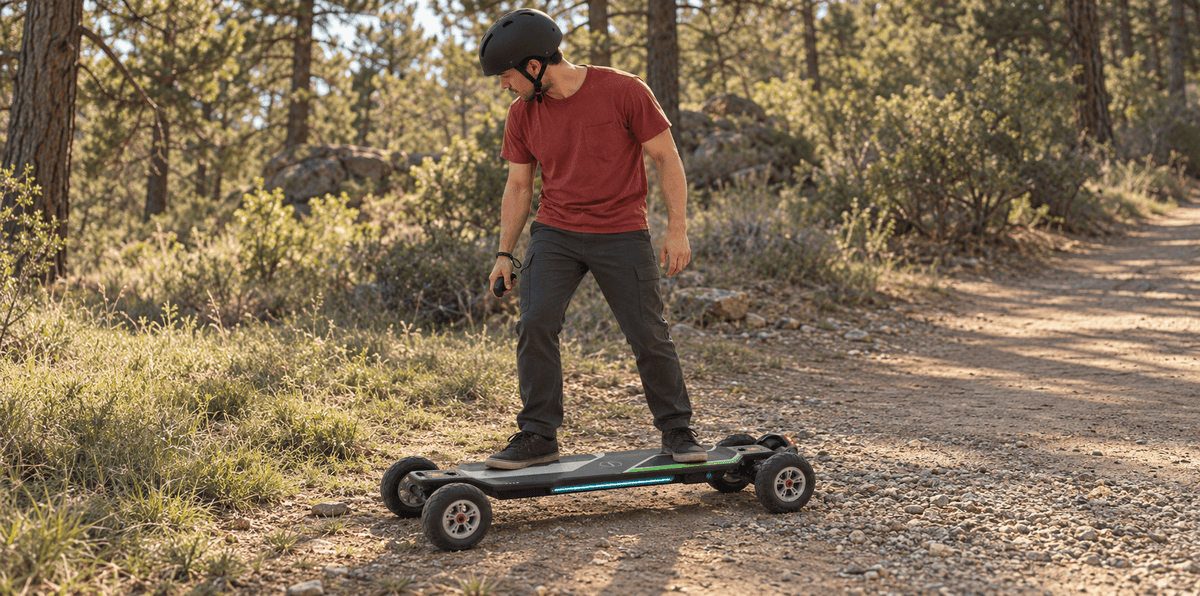
A weekend route described as “dirt, gravel, and grass” can contain very different riding demands. Firm, packed dirt with a relatively smooth surface presents a different challenge from deep loose gravel or soft soil. Grass adds another variable: a short, firm stretch may conceal ruts, roots, or softer patches. Assess the ground beneath the surface label, particularly where the route changes from one material to another.
Maxfind’s collection-level terrain guidance gives you a useful way to begin that assessment. Its emphasis on wheels, drive system, range, and deck response connects the board choice to the ride you actually want to take. [1] Start with the most demanding unavoidable section of your route, then consider the longer, easier stretches. A short soft crossing or deeply rutted approach can determine whether the whole route fits a setup.

Maxfind’s general wheel guidance describes pneumatic, air-filled wheels in the 6–8-inch category as offering strong shock absorption and traction, with maintenance needs and exposure to punctures. [1] For a rider prioritizing cushioning on uneven ground, that makes pneumatic construction worth examining among the configurations approved for the exact board.
The same guidance describes honeycomb or airless rubber wheels as offering puncture-resistant durability with somewhat less shock absorption. [1] That trade-off matters if you prefer to reduce puncture-related upkeep, but still need to account for how much roughness the route presents. These are manufacturer-described wheel-category differences, not measured comparisons between specific Maxfind packages or approval to convert a board.
Maxfind separately describes treaded polyurethane wheels of 120–150 mm as suitable for smoother off-pavement surfaces and transitions between surface types, while performing poorly on extremely rough terrain. [1] That guidance is most relevant when your route is predominantly firm and relatively smooth, with occasional off-pavement transitions. It does not provide a fitment recommendation for a particular board.
If you are considering Cloudwheels, identify the exact accessory and its approved board pairing before applying any of these comparisons. The name alone does not establish whether that wheel belongs to the pneumatic, honeycomb/airless rubber, or treaded polyurethane category described above. Ask for its actual construction and compatibility so the selection rests on the wheel you would receive.

Deck response also deserves attention on uneven ground. Maxfind describes PPS composite technology and injection-molded decks as part of its engineering approach, emphasizing flexibility, impact resistance, and durability. [2] That brand-level description explains why deck behavior features in its terrain-first guidance; the exact board’s specifications must establish its deck construction and response.
For route planning, consider how the deck behaves under your rider-and-gear load and how much space remains beneath the board. Loaded ground clearance helps determine whether a line around a rut, root, or rock offers enough room for the underside to pass. Flexibility by itself does not establish obstacle clearance or traction.
Motor and drive-component placement matters for the same reason. Determine which components sit near the ground, where they may encounter rocks or raised edges, and what protection the exact model provides. The loaded clearance, motor location, and protective construction remain unresolved until a particular Maxfind setup is identified. Do not assume protective hardware from an all-terrain label.
Within the brand’s lineup, MAXFIND CYBER ULTRA appears in Maxfind’s high-performance navigation. [1] It is a named option to explore, while the route-fit decision still depends on the specifications and approved wheel package of the board you choose.
The practical selection criterion is straightforward: compare your route’s toughest sections with the exact board’s approved wheels, terrain guidance, loaded clearance, and drive protection. For a longer loop, also compare its range claim and stated conditions with the planned distance and surface mix. A range figure is most useful when its operating conditions resemble your intended ride.
Reliable passage through soft ground or grass without bogging down cannot be established for an unspecified Maxfind configuration. That makes surface detail especially valuable: “grass” could mean firm ground with short turf or a soft, uneven field, and those call for different assessments.
To move from browsing to a useful recommendation, identify the exact US board and wheel package you are considering. Send Maxfind photos of the difficult sections, descriptions of surface firmness and gravel depth, obstacle details, planned distance, and your total rider-and-gear load. Ask which approved configuration suits those conditions and request the matching US operating and setup instructions. Let those instructions govern any tire-pressure adjustment, wheel change, or setting rather than applying a generic off-road recipe.
The answer depends on the exact model and drive configuration. Maxfind’s general all-terrain guidance recommends evaluating the drive system against terrain demands, but that guidance supplies no model-specific motor specification or climbing rating. [1] With the board and wheel package unspecified, steep-climb capability—including sustained climbing for a heavyweight rider—remains unresolved.
A useful climbing claim needs more context than a maximum gradient. Drive effort must reach the ground through tire grip; loose surfaces can limit that grip. Total rider-and-gear load affects the effort required, while climb length distinguishes a brief steep section from a sustained ascent. Battery charge and operating conditions also matter when deciding whether a claim applies to your ride.
Keep manufacturer-rated gradients separate from measured ascents. An advertised maximum grade is a stated capability under the manufacturer’s conditions. A measured climb is an observed result for a particular configuration, rider load, surface, duration, and battery condition. Neither should be generalized to a different setup without checking those details.
If your route includes grades above 25 percent, treat that as a requirement to verify rather than an assumed Maxfind capability. Percent grade and degrees are different measurements, so keep the units consistent when comparing your route with a rating.
Match the exact US model’s climbing specification and operating instructions to the hill’s grade, length, surface, and your combined rider-and-gear load. Where the rating’s conditions are unspecified, ask Maxfind whether it applies to a sustained climb like yours and what operating limits govern that use.
Partager:
Maxfind Cyber Max Urban Commuting Efficiency Verification